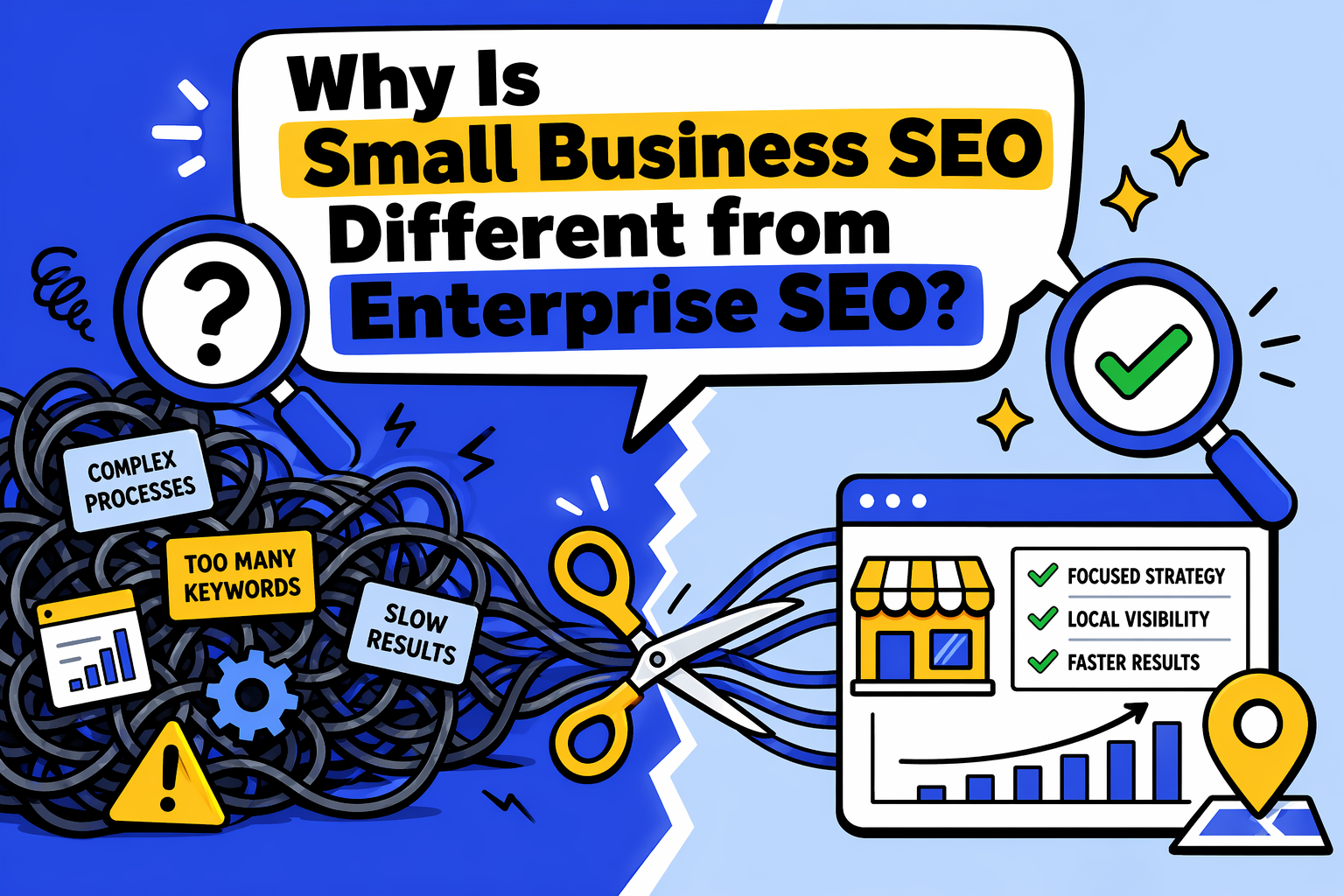
Why Is Small Business SEO Different from Enterprise SEO?
Posted by
 Stefan Winter
TL;DR
Small businesses have unique SEO advantages over enterprises by focusing on local keywords, geographic targeting, and community engagement rather than competing for high-volume national terms. Success requires strategic keyword research, on-page optimization, Google Business Profile management, and consistent local directory listings to dominate local search results with limited budgets.
How to Implement SEO for Small Business: A Complete 2026 Strategy Guide
Small business owners often feel overwhelmed when it comes to search engine optimization. Unlike large corporations with dedicated marketing teams, small businesses must maximize their SEO impact with limited resources and budgets. The good news? Small businesses actually have unique advantages in SEO that larger competitors can't match. In this comprehensive guide, you'll discover how to build an effective SEO strategy tailored specifically for small business needs, focusing on local visibility, targeted keywords, and cost-effective tactics that deliver real results.
Why Is Small Business SEO Different from Enterprise SEO?
Small business SEO operates under completely different constraints and opportunities compared to enterprise-level optimization. While large companies focus on competing for high-volume national keywords, small businesses can dominate local search results and build stronger community connections.
The key differences lie in resource allocation, target audience, and competitive landscape. Small businesses typically serve local or regional markets, allowing them to focus on geographic-specific keywords with less competition. They can also respond faster to market changes and build more personal relationships with their customer base.
What makes small business SEO different from enterprise SEO becomes clear when you consider the personalized approach small businesses can take. Unlike large corporations, small businesses can directly engage with customers, respond to reviews personally, and create content that reflects their unique brand personality.How Do You Start with Small Business SEO Keyword Research?
Effective keyword research forms the foundation of any successful small business SEO strategy. Start by identifying the specific problems your business solves and the language your customers use when searching for solutions.
Begin with local keyword variations that include your city, neighborhood, or region. For example, instead of targeting "plumber," focus on "emergency plumber downtown Seattle" or "affordable plumbing services Bellevue." These longer, more specific phrases have lower competition and higher conversion rates.
Use free tools like Google's Keyword Planner and Google Trends to discover search volumes and seasonal patterns. Pay attention to question-based keywords that reflect how people actually search. Phrases like "how to fix a leaky faucet" or "best Italian restaurant near me" often convert better than generic terms.
| Keyword Type | Example | Competition Level | Conversion Potential |
|---|---|---|---|
| Generic | "restaurant" | Very High | Low |
| Local Generic | "Seattle restaurant" | High | Medium |
| Local Specific | "Italian restaurant Capitol Hill" | Medium | High |
| Long-tail Local | "best family Italian restaurant Capitol Hill Seattle" | Low | Very High |
What Are the Essential On-Page SEO Elements for Small Businesses?
On-page optimization for small businesses requires focusing on elements that search engines and customers both value. Start with your title tags, which should include your primary keyword and location when relevant. Keep titles under 60 characters to ensure they display fully in search results.
Meta descriptions act as your search result advertisement, so write compelling copy that includes your target keywords and a clear value proposition. While meta descriptions don't directly impact rankings, they significantly influence click-through rates.
Header tags (H1, H2, H3) help structure your content for both users and search engines. Use your primary keyword in the H1 tag and related keywords in H2 and H3 tags. This hierarchy makes your content easier to scan and helps search engines understand your page's main topics.
How Should Small Businesses Optimize Their Content?
Content optimization goes beyond keyword placement. Focus on creating genuinely helpful content that answers your customers' questions and solves their problems. Search engines increasingly prioritize content quality and user satisfaction over keyword density.
Write in a natural, conversational tone that reflects how your customers speak. Include local references, case studies from actual clients, and specific examples relevant to your community. This approach not only improves SEO but also builds trust with potential customers.
Internal linking helps search engines understand your site structure while keeping visitors engaged longer. Understanding how to identify your true SEO competitors can help you create content that outperforms local rivals.
How Can Small Businesses Dominate Local SEO?
Local SEO represents the biggest opportunity for small businesses to compete effectively against larger companies. Start by claiming and optimizing your Google Business Profile, ensuring all information is accurate, complete, and regularly updated.
Consistency across all online directories is crucial. Your business name, address, and phone number (NAP) should be identical across Google, Yelp, Facebook, and industry-specific directories. Even small discrepancies can confuse search engines and hurt your local rankings.
Encourage satisfied customers to leave reviews on Google and other relevant platforms. Respond to all reviews professionally, thanking positive reviewers and addressing concerns raised in negative reviews. According to BrightLocal's Local Consumer Review Survey, 87% of consumers read online reviews for local businesses.
What Local Content Should Small Businesses Create?
Create content that demonstrates your connection to the local community. Write blog posts about local events, partnerships with other businesses, or how local regulations affect your industry. This type of content naturally includes location-based keywords while providing genuine value.
Consider creating location-specific landing pages if you serve multiple areas. Each page should include unique content about that specific location, not just the same template with different city names. Include local landmarks, neighborhood characteristics, and area-specific services or considerations.
How Do You Build Authority Through Small Business Link Building?
Link building for small businesses focuses on quality over quantity. Start with local opportunities like chamber of commerce memberships, local business associations, and community organization sponsorships. These links provide both SEO value and potential direct business.
Partner with complementary local businesses for cross-promotional opportunities. A wedding photographer might partner with local florists, caterers, and venues to create mutually beneficial content and linking opportunities.
Guest posting on local blogs, contributing to community publications, and participating in local podcasts can generate valuable backlinks while establishing your expertise in the community. Content planning strategies help ensure your outreach efforts align with your overall marketing goals.
What Technical SEO Basics Should Small Businesses Prioritize?
Small businesses should focus on fundamental technical SEO elements that provide the biggest impact. Start with website speed optimization, as slow-loading sites frustrate users and hurt search rankings. Use Google's PageSpeed Insights to identify specific improvements.
Mobile optimization is non-negotiable in 2026. Ensure your website looks and functions perfectly on smartphones and tablets. Google's mobile-first indexing means the mobile version of your site is what search engines primarily evaluate.
Implement SSL certificates to secure your website and improve trustworthiness. Search engines favor secure sites, and customers expect to see the padlock icon when entering personal information.
How Can Small Businesses Monitor Their SEO Progress?
Set up Google Analytics and Google Search Console to track your SEO performance. These free tools provide insights into which keywords drive traffic, how users interact with your site, and technical issues that need attention.
Monitor your local search rankings for key terms, but don't obsess over daily fluctuations. Focus on long-term trends and how rankings translate into actual business inquiries and sales.
Track metrics that matter to your business: phone calls, form submissions, store visits, and ultimately, revenue. SEO success should be measured by business growth, not just search engine rankings.
How Should Small Businesses Approach SEO in 2026 and Beyond?
The SEO landscape continues evolving, with artificial intelligence and voice search changing how people find information. Small businesses should focus on creating comprehensive, helpful content that answers complete questions rather than just targeting individual keywords.
Invest in understanding your customers' entire journey, from initial awareness through purchase and beyond. The questions you ask matter for SEO success because they help you create content that matches real search intent.
Stay informed about SEO best practices through reputable sources like Google's Search Central documentation, but avoid chasing every algorithm update. Consistent, customer-focused optimization efforts typically weather algorithm changes better than tactical manipulations.
Conclusion
Implementing effective SEO for small business requires a strategic approach that leverages your unique advantages while working within resource constraints. Focus on local optimization, create genuinely helpful content, and build authentic relationships within your community. Remember that SEO is a long-term investment that compounds over time. Start with the fundamentals covered in this guide, measure your progress consistently, and adjust your strategy based on what works for your specific business and market. Ready to take your small business SEO to the next level? Begin with a comprehensive audit of your current online presence and identify the quick wins that can deliver immediate impact while building toward long-term success.
Frequently Asked Questions
Small business SEO focuses on local and regional markets with geographic-specific keywords and lower competition, while enterprise SEO targets high-volume national keywords. Small businesses can respond faster to market changes and build personal customer relationships that larger corporations cannot match.
Start with local keyword variations that include your city or region, such as 'emergency plumber downtown Seattle' instead of just 'plumber.' Use free tools like Google Keyword Planner and focus on long-tail, question-based keywords that have lower competition and higher conversion rates.
Key elements include title tags (under 60 characters with location), compelling meta descriptions, and properly structured header tags (H1, H2, H3). Focus on creating high-quality, conversational content that answers customer questions and includes local references and case studies.
Google Business Profile is essential for local SEO success, allowing your business to appear in local search results and Google Maps. Ensure all information is accurate and complete, maintain consistency across online directories, and encourage customer reviews to improve visibility and credibility.
Customer reviews are highly important—87% of consumers read online reviews for local businesses according to BrightLocal's research. Actively encourage satisfied customers to leave reviews and respond professionally to all reviews to build trust and improve local search rankings.

Stefan Winter
Founder & SEO Expert
Founder of Fast SEO Fix and SEO automation expert. Stefan built Fast SEO Fix to solve the tedious problem of manual SEO work. He specializes in SEO optimized content generation, keyword research, and automated SEO strategies.
