What Makes Content "SEO Content" in the First Place?
Posted by
 Stefan Winter
How to Use SEO Content Examples to Build Pages That Actually Rank

If you have ever stared at a blank document wondering what "good SEO content" actually looks like in practice, you are not alone. Most guides explain the theory behind search-optimized writing, but very few show you real-world SEO content examples you can study, model, and apply to your own site. This post changes that. You will walk away with a clear understanding of what high-performing SEO content looks like across different formats, why certain examples work, and how to use those patterns to create content that earns rankings and keeps readers engaged.
What Makes Content "SEO Content" in the First Place?
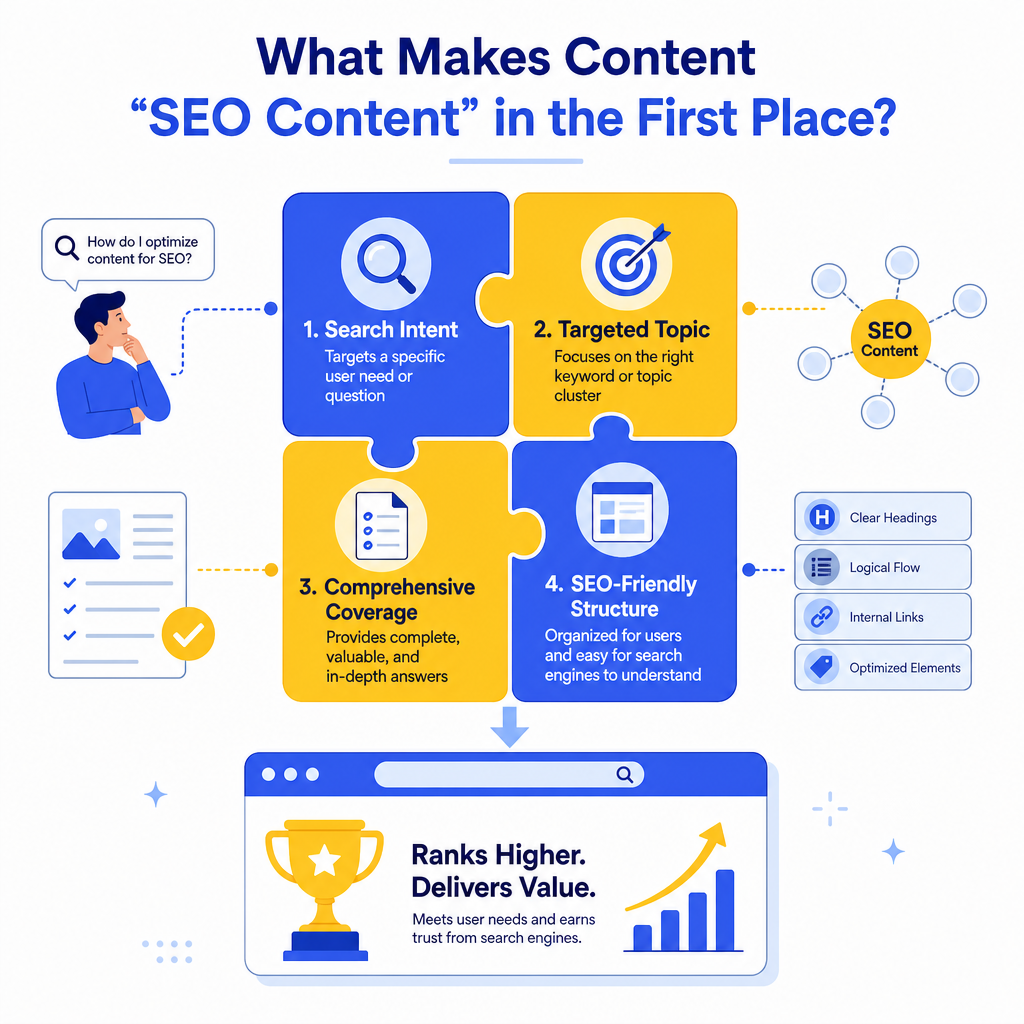
Before diving into specific examples, it helps to define what separates SEO content from regular writing. SEO content is created with a specific search intent in mind. It targets a defined keyword or topic cluster, satisfies the user's query thoroughly, and is structured in a way that search engines can crawl and understand.
Good SEO content is not keyword-stuffed or robotic. The best examples you will find online read naturally while still signaling relevance to search engines through proper heading structure, internal linking, and topical depth. According to Google's Search Essentials documentation, content that is helpful, reliable, and people-first is what earns lasting visibility in search results.
Understanding this distinction is the foundation. Now let us look at what this actually looks like across the most common content types.
The 6 Most Effective SEO Content Formats (With Examples)
Not all SEO content looks the same. Different formats serve different search intents, and choosing the right one is just as important as writing quality copy. Here are the six formats that consistently perform well in organic search, along with what makes each one work.
How-To Guides
How-to guides are among the strongest performers in SEO because they match instructional search intent directly. A user searching "how to write a meta description" wants step-by-step guidance, and a well-structured how-to guide delivers exactly that.
A strong how-to guide example will include a clear numbered sequence, actionable steps written in plain language, and supporting visuals or examples within each step. The content should answer the question fully without requiring the reader to visit another site. Pages that do this well tend to earn featured snippets and position-zero placements in Google results.
Listicles and Roundup Posts
Listicles work because they match the way people scan content online. A post titled "9 SEO Content Examples That Drive Real Traffic" gives readers a clear expectation and delivers information in digestible chunks. For SEO purposes, each list item can target a related keyword or subtopic, which expands the page's topical footprint.
The best listicle examples are not shallow. Each item includes a brief explanation, a real-world application, and sometimes a supporting statistic or case study. Thin listicles with one sentence per point rarely rank well because they fail to satisfy search intent at a deep enough level.
Pillar Pages and Topic Clusters
Pillar pages are long-form, comprehensive resources that cover a broad topic and link out to more detailed cluster content. A well-executed pillar page on "SEO content strategy," for example, might cover keyword research, content formats, on-page optimization, and performance tracking, all in one place.
What makes pillar page examples effective is their internal linking architecture. They serve as hubs that connect related content across your site, which strengthens topical authority. If you are planning a content cluster, it is worth reading about how to define your goals before you write a single word to make sure your pillar page starts with a clear strategic purpose.
Product and Service Pages
SEO content is not limited to blog posts. Product and service pages that rank well share specific characteristics: they use target keywords naturally in headings and body copy, they address buyer objections, and they include structured data markup to enhance how they appear in search results.
A strong service page example will open with a clear value proposition, include a benefits-focused description, address common questions, and close with a conversion-focused call to action. Pages that treat SEO and conversion as competing priorities tend to underperform at both. The best examples integrate them seamlessly.
Comparison and Versus Pages
Comparison content targets high-intent searchers who are close to making a decision. Pages like "Tool A vs. Tool B" or "Option X vs. Option Y" attract users who have already done initial research and are evaluating specific choices.
These pages perform well because they match transactional or decision-stage search intent. A well-structured comparison page will include a summary table, an objective breakdown of features, and a clear recommendation. According to Semrush's content marketing research, comparison content consistently ranks among the highest-converting formats in organic search.
FAQ and Q&A Pages
FAQ pages are underused as a standalone SEO format. When built around real search queries (not generic questions), they can capture significant long-tail traffic and appear in People Also Ask boxes on Google.
The key to a strong FAQ page example is using actual language from search queries as your questions. Tools like Google's autocomplete, Answer the Public, or keyword research platforms reveal exactly how people phrase their questions. Answers should be concise but complete, typically between 50 and 150 words each.
SEO Content Examples by Industry: A Quick Reference
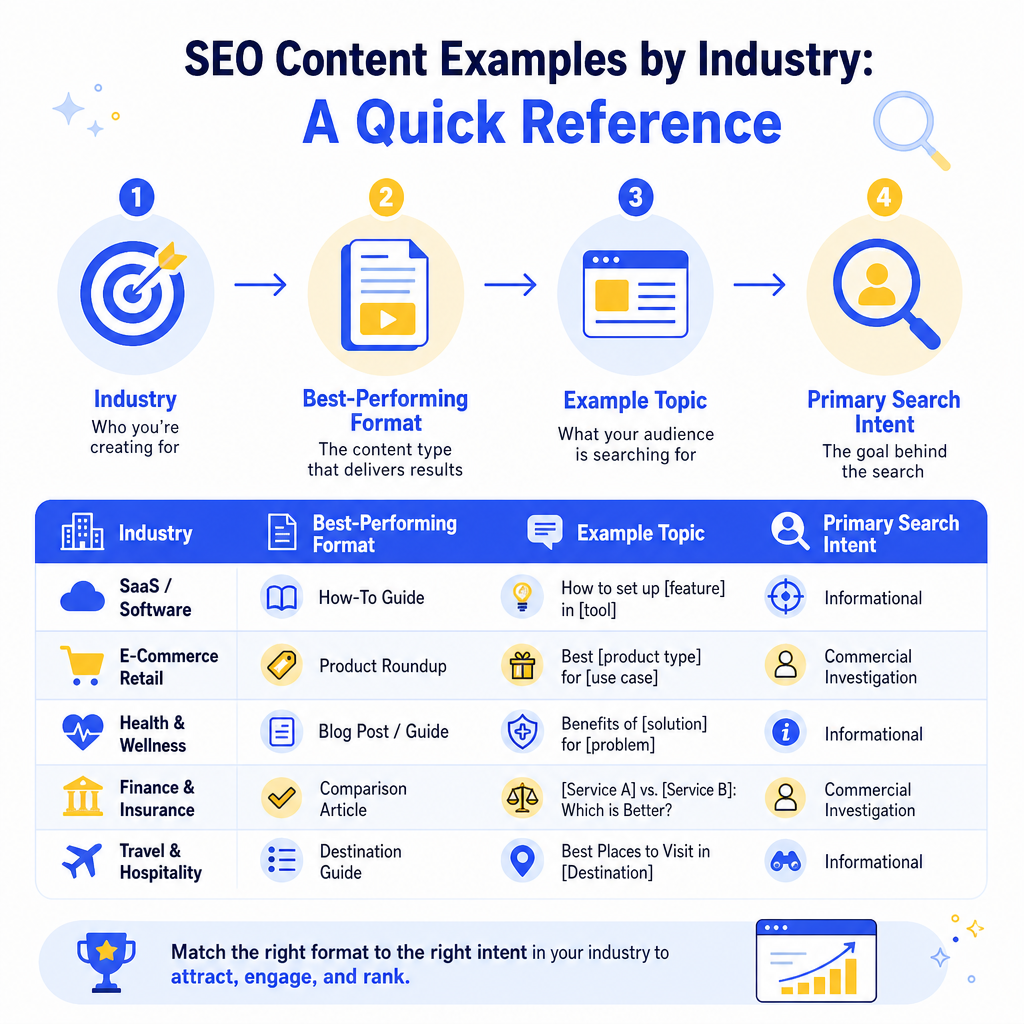
To make this more concrete, here is a comparison table showing how different industries apply these content formats effectively.
| Industry | Best-Performing Format | Example Topic | Primary Search Intent |
|---|---|---|---|
| SaaS / Software | How-To Guide | "How to set up [feature] in [tool]" | Informational / Product |
| E-commerce | Product + Comparison Pages | "[Product A] vs. [Product B]" | Transactional |
| Healthcare | FAQ + Long-Form Articles | "What are the symptoms of [condition]?" | Informational |
| Legal Services | Pillar Pages + FAQs | "What is [legal term] and how does it work?" | Informational |
| Marketing / SEO | Listicles + How-To Guides | "Best tools for [task] in 2026" | Informational / Commercial |
| Local Businesses | Service Pages + Reviews | "[Service] in [City]: What to Expect" | Local / Transactional |
How Do You Analyze an SEO Content Example to Learn From It?
One of the most practical skills in SEO writing is the ability to reverse-engineer content that ranks. Here is a simple process for doing that.
Step 1: Identify a top-ranking page for your target keyword. Run a search for your primary keyword and note the top three to five organic results (excluding ads and featured snippets for now). Step 2: Analyze the structure. Look at the heading hierarchy. How many H2 and H3 sections does the page use? Does it include a table of contents? How long is the content overall? Step 3: Identify the search intent being served. Ask yourself what the reader was looking for and whether the page answers that question completely. Note any gaps where the content falls short. Step 4: Review keyword usage. Notice where the primary keyword appears (title, first paragraph, headings, conclusion) and how naturally it reads. Check whether the page uses related terms and synonyms. Step 5: Note the content depth. Does the page include examples, data, visuals, or original insights? Shallow content rarely holds top rankings in 2026, especially after Google's continued focus on helpful content signals.This analysis process pairs well with a broader SEO gap analysis, which helps you identify where your existing content is missing opportunities compared to competitors.
What Tools Help You Create Better SEO Content?

Studying examples is valuable, but you also need the right tools to execute effectively. Content optimization platforms like Surfer SEO, Clearscope, and MarketMuse analyze top-ranking pages and give you data-driven recommendations for your own content. These tools look at factors like word count, keyword frequency, heading structure, and topical coverage.
For a deeper look at how these platforms work and when to use them, the guide on what a content optimization tool is and how it works walks through the mechanics in detail.
According to Ahrefs' content marketing research, pages that are updated regularly and cover topics more comprehensively than their competitors tend to maintain and improve their rankings over time. Tools that help you measure topical depth are therefore not optional extras. They are core to a sustainable SEO content strategy.
Common Mistakes That Weaken SEO Content (Even With Good Examples to Follow)
Even with strong examples as a reference, certain mistakes consistently hold content back from ranking. Here are the most common ones to avoid.
- Ignoring search intent: Writing a blog post when the top results are all product pages (or vice versa) signals a mismatch that is hard to overcome with quality alone.
- Keyword stuffing in headings: Forcing your primary keyword into every H2 reads unnaturally and can trigger over-optimization signals.
- Publishing without internal links: Every piece of SEO content should link to related pages on your site. Isolated pages receive less crawl equity and rank harder.
- Copying structure without adding original value: Modeling a successful example is smart. Replicating it without adding new insights, data, or a unique angle is not.
- Neglecting content updates: A page that ranked well in early 2025 may lose ground by mid-2026 if competitors have published fresher, more comprehensive versions.
Conclusion
SEO content examples are not just inspiration. They are a roadmap. When you study what ranks, analyze why it works, and apply those patterns with your own original perspective and depth, you give your content a real competitive advantage. The formats covered here (how-to guides, listicles, pillar pages, comparison content, service pages, and FAQs) each serve distinct search intents, and choosing the right one for each piece of content you create is half the battle.
Start by picking one keyword you want to rank for, finding the top three organic results, and running them through the five-step analysis process outlined above. You will quickly see patterns that you can apply immediately. If you want to go further, explore content optimization tools and build a structured internal linking strategy to support every new page you publish.
The gap between content that ranks and content that gets ignored is almost always a gap in understanding what good SEO content actually looks like in practice. Now you have the examples and the framework to close it.

Stefan Winter
Founder & SEO Expert
Founder of Fast SEO Fix and SEO automation expert. Stefan built Fast SEO Fix to solve the tedious problem of manual SEO work. He specializes in SEO optimized content generation, keyword research, and automated SEO strategies.
