What Is a Gap Analysis in SEO?
Posted by
 Stefan Winter
How to Run a Gap Analysis That Actually Improves Your SEO Rankings

If your website is publishing content consistently but still not ranking where you want it to, the problem might not be your writing quality or your publishing frequency. It might be what you are not covering. A gap analysis is the process of identifying the specific topics, keywords, and content opportunities your competitors are capturing that you are missing entirely. Done correctly, it gives you a clear roadmap for what to create next, and why it will actually move the needle.
This guide walks you through a practical, step-by-step approach to running a gap analysis in 2026, from setting up your baseline to turning your findings into a content plan that drives real organic traffic.
What Is a Gap Analysis in SEO?
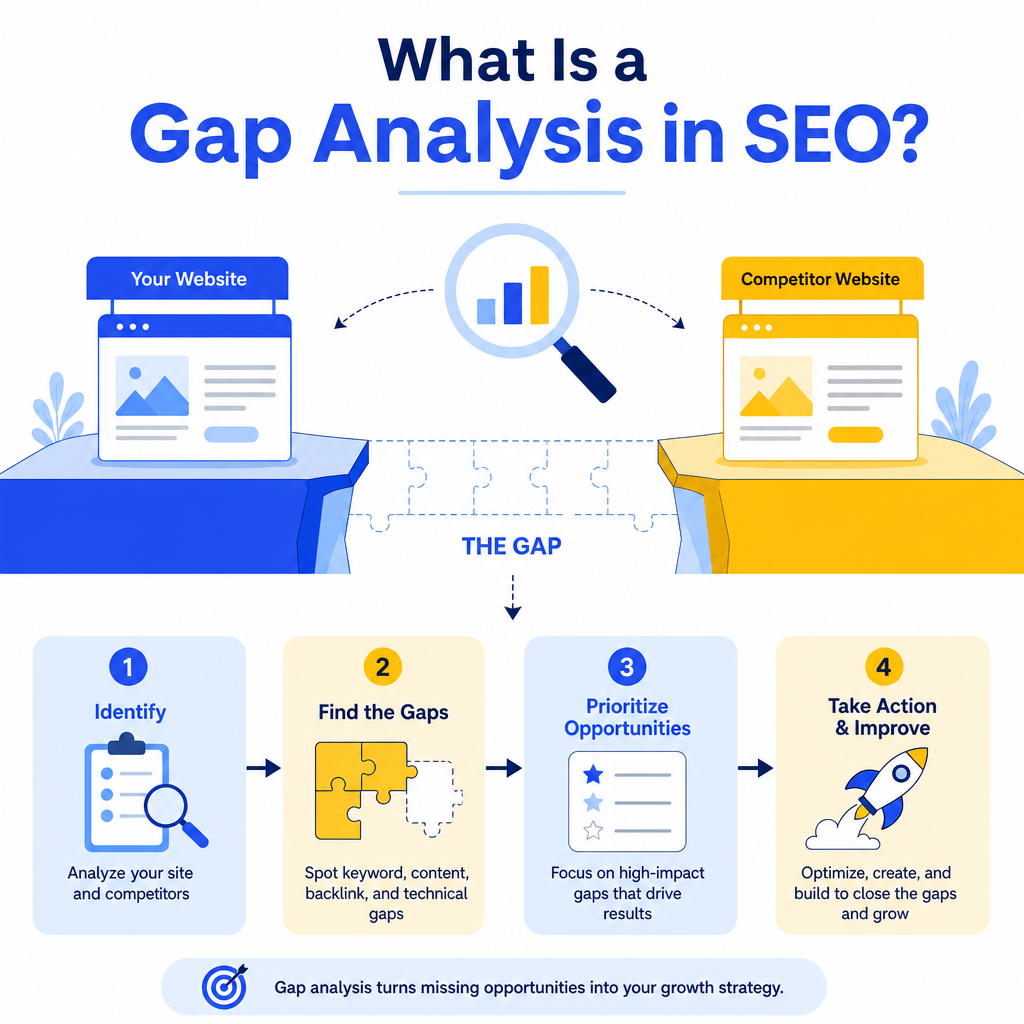
What does "gap" actually mean here?
In the context of SEO and content strategy, a gap refers to any keyword, topic, or search intent that your competitors are ranking for but your website is not. Think of it as a map of missed opportunities. Every gap represents a real user with a real question who found someone else's answer instead of yours.
Gap analysis is not just about finding keywords you forgot to target. It also surfaces structural weaknesses in your content, such as missing subtopics within an existing article, missing content formats for a specific audience segment, or entire subject areas your site has never addressed. According to Semrush's State of Content Marketing report, brands that regularly audit their content gaps produce significantly more traffic growth than those that publish without a strategic framework.
How is gap analysis different from regular keyword research?
Standard keyword research starts from scratch. You brainstorm topics, plug them into a tool, and find search volumes. Gap analysis is competitive by design. You start by looking at what is already working for your rivals and then reverse-engineer the opportunity. This makes the process faster, more targeted, and more likely to produce results because you are not guessing at demand. You are observing it in real time.
Before you dive into the steps, it helps to define your SEO goals clearly so you know which gaps are actually worth filling for your specific business.
Step 1: Identify Your True Competitors
Not every website in your niche is a direct competitor for SEO purposes. Your content competitors are the sites ranking on page one for the keywords you want to own. They may or may not be your business competitors.
Start by searching five to ten of your most important target keywords in Google and noting which domains appear consistently in the results. These are your SEO competitors. Build a short list of three to five of them. You do not need dozens. A focused comparison against a handful of strong competitors will surface more than enough gaps to keep your content team busy for months.
Tools like Ahrefs, Semrush, or Moz allow you to input a competitor domain and see every keyword they rank for. Export these lists into a spreadsheet. You are building the raw material for your analysis in the next steps.
Step 2: Map Your Current Keyword Coverage

Before you can find what is missing, you need a clear picture of what you already have. Pull a full export of the keywords your own site currently ranks for, including position, search volume, and the specific URL that ranks. Many teams skip this step and end up creating duplicate content that competes with their own existing pages.
Group your keywords into themes or topic clusters. This gives you a visual map of the territory you already own. You might discover you have strong coverage in one area but almost nothing in a closely related area that your audience also cares about. That imbalance is itself a type of gap.
If you want a deeper layer of insight, pair this step with a content audit using a dedicated tool to assess not just which keywords you rank for, but whether the content ranking for them is actually performing well or quietly underdelivering.
Step 3: Run the Comparison and Surface the Gaps
Now comes the core of the process. Take your competitor keyword lists and compare them against your own. Any keyword a competitor ranks for in the top 20 results that your site does not rank for at all is a potential gap. Any keyword where a competitor ranks significantly higher than you is a competitive gap, meaning you have some presence but are losing ground.
Here is a simple framework for categorizing what you find:
| Gap Type | Definition | Priority Level |
|---|---|---|
| Missing topic gap | Competitor ranks; you have zero content | High |
| Ranking gap | Both rank, but competitor is pages ahead | Medium to High |
| Depth gap | You cover the topic but miss key subtopics | Medium |
| Format gap | Right topic, wrong content type for intent | Medium |
| Freshness gap | Your content exists but is significantly outdated | Low to Medium |
Step 4: Validate Intent Before You Write Anything

Finding a gap is not the same as confirming you should fill it. Before you invest time in creating content, manually search the keyword and study the top-ranking pages. Ask yourself three questions.
First, does the search intent match what your website offers? If the top results are all e-commerce product pages and you run an informational blog, ranking there will be difficult regardless of your content quality. Second, is the content complexity realistic for your team? Some gaps exist because the topic requires deep technical expertise or original research that most sites cannot easily produce. Third, does this keyword connect to your business goals? Traffic for its own sake is not a strategy.
Google's Search Quality Rater Guidelines emphasize that content should demonstrate expertise, authoritativeness, and trustworthiness. Filling gaps with thin or generic content will not move your rankings. Only fill gaps where you can genuinely deliver better value than what is currently ranking.Step 5: Build Your Gap-Filling Content Plan
Once you have validated your priority gaps, translate them into a concrete content plan. Each gap should map to one of the following actions:
- Create new content for missing topic gaps where you have zero coverage.
- Update and expand existing content for ranking gaps and depth gaps where you already have a page but it is underperforming.
- Restructure or reformat content for format gaps where the intent calls for a video, comparison table, or step-by-step guide rather than a standard article.
- Refresh outdated content for freshness gaps, updating statistics, examples, and internal links.
It is also worth exploring keyword gap analysis as its own specialized discipline to go deeper on the technical side of competitive keyword comparison, especially if you are working in a highly competitive niche.
Step 6: Measure Results and Repeat the Process
Gap analysis is not a one-time event. Your competitors are publishing new content, updating old pages, and targeting new keywords every week. The gaps that exist today will shift over the next quarter. Build a repeating review cycle into your content calendar, whether that is monthly for fast-moving industries or quarterly for more stable niches.
Track the performance of every piece of content you create from a gap analysis. Monitor keyword ranking changes, organic traffic growth to the specific URL, and whether the page is beginning to appear for related long-tail variations. According to Ahrefs' research on content performance, most new pages take three to six months to reach their peak ranking position, so patience combined with consistent measurement is essential.
When a gap-filling piece starts ranking, look at what new keywords it is picking up organically. Those secondary keywords often point to the next round of gaps worth exploring, creating a compounding cycle of content growth.
Conclusion
A gap analysis gives you something that most content strategies lack: a clear, evidence-based reason to create each piece of content you publish. Instead of guessing what your audience wants or copying what seems popular, you are working from real competitive data that shows exactly where the opportunity lives.
The process does not have to be complicated. Identify your competitors, map your current coverage, surface the differences, validate intent, build a prioritized plan, and measure what happens. Repeat that cycle consistently and your content strategy will compound in value over time.
If you are ready to stop publishing content that disappears into the void and start creating pages that actually rank, a gap analysis is the most direct path forward. Start with one competitor, one keyword category, and one round of comparison. The clarity you gain from even a basic analysis will reshape how you think about content creation entirely.

Stefan Winter
Founder & SEO Expert
Founder of Fast SEO Fix and SEO automation expert. Stefan built Fast SEO Fix to solve the tedious problem of manual SEO work. He specializes in SEO optimized content generation, keyword research, and automated SEO strategies.
