What Is User Intent, and Why Does It Drive Rankings?
Posted by
 Stefan Winter
How to Use User Intent to Create Content That Actually Ranks
If you have ever published a blog post that checked every SEO box, targeted the right keyword, had solid backlinks, and still refused to rank, user intent is likely the reason. Search engines in 2026 are not simply matching keywords to pages. They are trying to understand what a person actually wants when they type a query, and then serving the content that best satisfies that want. If your content does not align with that underlying need, it will struggle no matter how well-optimized it is technically.
This guide walks you through exactly how to identify user intent, how to map it to your content strategy, and how to write pages that search engines and real people will both appreciate.
What Is User Intent, and Why Does It Drive Rankings?
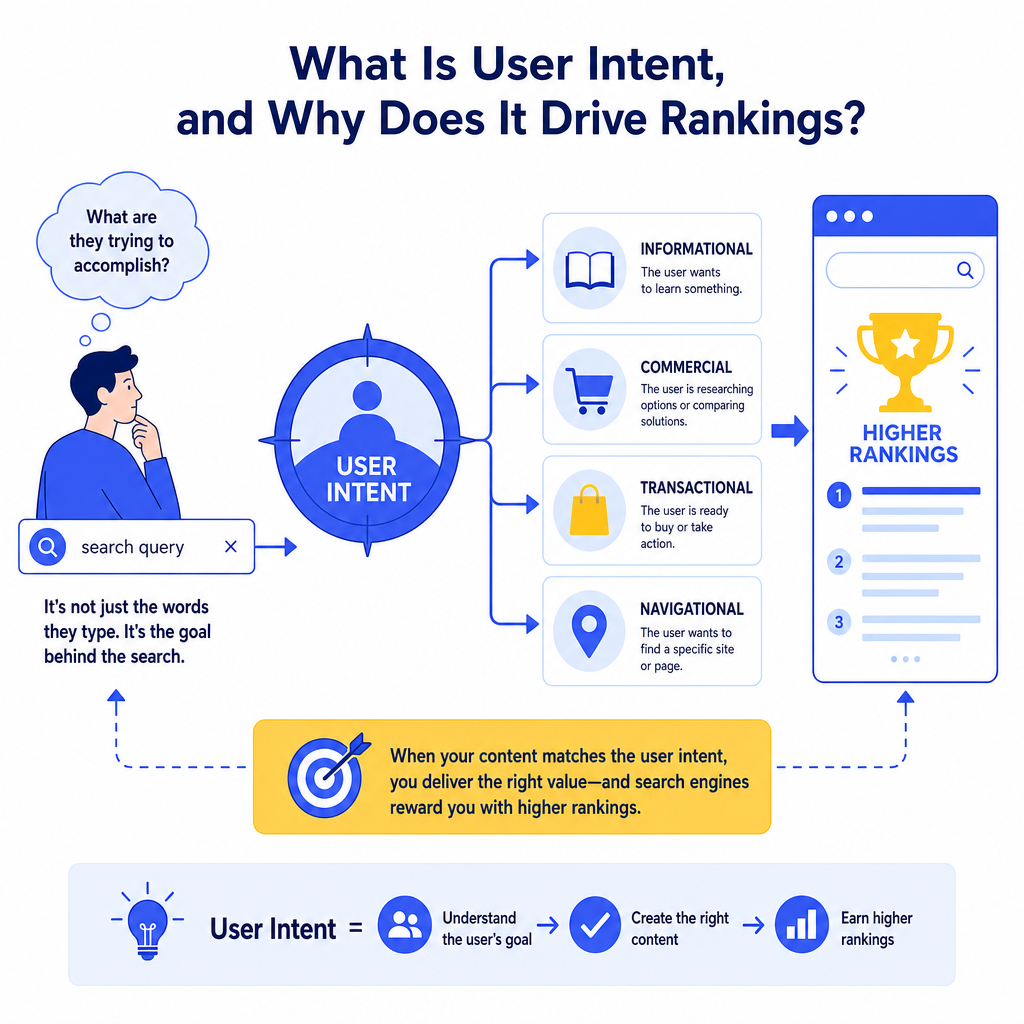
User intent (sometimes called search intent) is the underlying goal a person has when they enter a query into a search engine. It is not just about the words they typed. It is about what they are trying to accomplish. Are they trying to learn something? Are they ready to buy? Are they looking for a specific website?
Google and other search engines have invested enormous resources into understanding intent because satisfying it is literally their business model. According to Google's Search Quality Evaluator Guidelines, page quality and the degree to which content meets user needs are two of the most critical factors human raters use to assess search results. If Google's raters see that your page does not actually answer what users are asking, your rankings will reflect that.
This is why keyword stuffing stopped working years ago. A page can mention a keyword 50 times and still fail to serve the user's intent, which means it fails to rank.
The Four Core Types of User Intent
Before you can align your content with intent, you need to know which category a query falls into. Most search queries fit into one of four types.
| Intent Type | What the User Wants | Example Query | Best Content Format |
|---|---|---|---|
| Informational | To learn or understand something | "how does SEO work" | Blog post, guide, explainer |
| Navigational | To find a specific website or page | "Fast SEO Fix blog" | Homepage, brand page |
| Commercial | To research before making a decision | "best SEO tools 2026" | Comparison post, review |
| Transactional | To complete an action or purchase | "buy SEO audit service" | Product/service page, landing page |
How to Identify User Intent for Any Keyword
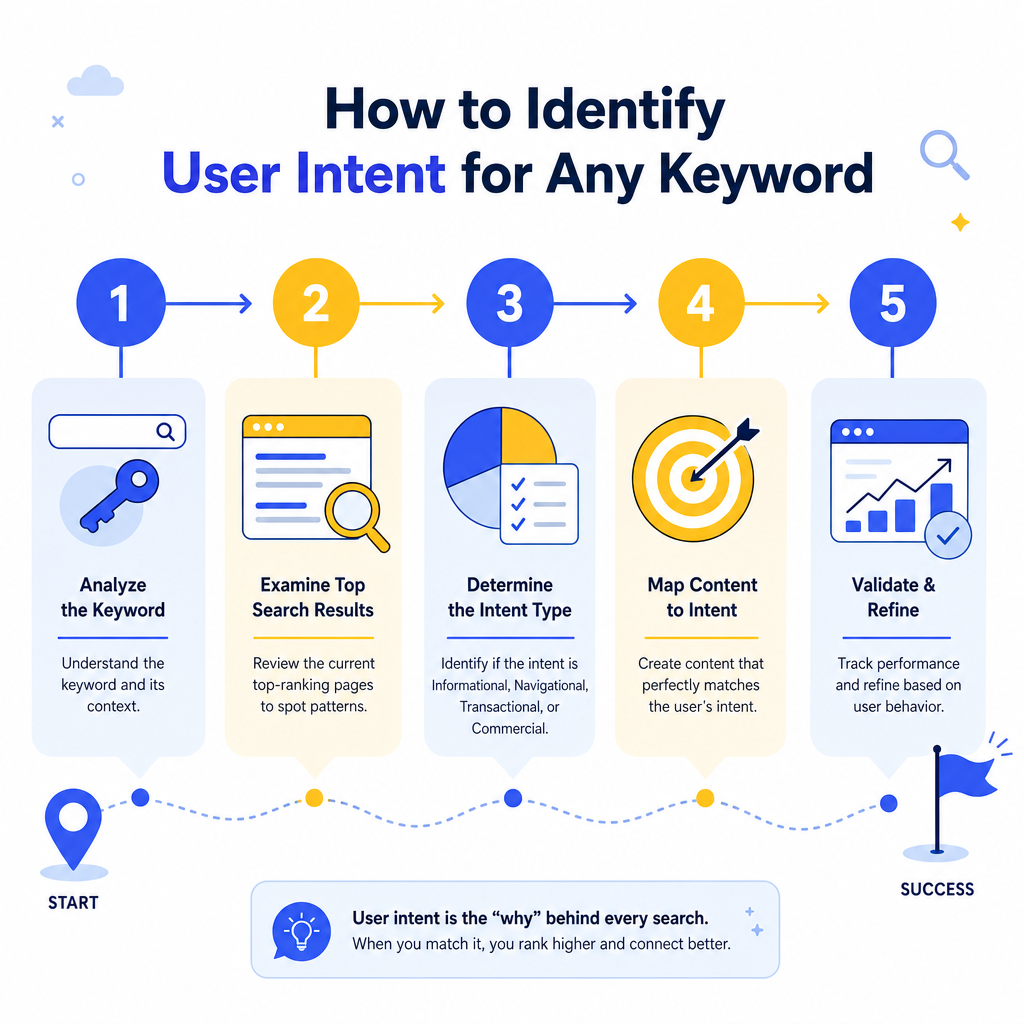
Step 1: Analyze the Search Engine Results Page (SERP)
The fastest and most reliable way to understand intent is to look at what is already ranking. Open an incognito browser window, search your target keyword, and study the top five results. Ask yourself these questions.
- What type of content dominates? (Articles, videos, product pages, forums)
- What is the average content length?
- Are the results mostly beginner-friendly or advanced?
- Do the titles use words like "how to," "best," "buy," or "review"?
Step 2: Look at the "People Also Ask" and Related Searches Sections
These sections reveal the subtopics and follow-up questions users commonly have around your main query. They show you the full shape of the intent, not just the surface-level question. If your content answers the main query AND addresses these related questions, you are far more likely to satisfy the complete intent behind the search.
Step 3: Use Keyword Modifiers as Intent Signals
Certain words in a query are strong signals of intent. Words like "how," "what," "why," and "guide" almost always indicate informational intent. Words like "best," "top," "vs," and "review" point to commercial intent. Words like "buy," "discount," "order," and "near me" signal transactional intent. Building a habit of reading modifiers will make intent identification almost automatic over time.
How to Map User Intent to Your Content Strategy
Step 4: Audit Your Existing Content for Intent Mismatches
Before creating new content, check whether your current pages are aligned with intent. Pull your top-landing pages from Google Search Console, identify the primary keyword driving traffic to each, and then search that keyword yourself. Does your page match what the SERP is showing as the dominant format? If not, you have found an optimization opportunity that requires no new content, just realignment.
When you are building a broader content plan, tools that help you organize this process are invaluable. A well-structured SEO content planner can help you map intent categories to specific pages across your entire site, preventing overlap and ensuring every piece of content has a clear purpose.
Step 5: Match Your Content Format to the Intent Type
Once you know the intent, choose the format that best delivers on it. Informational intent usually calls for comprehensive guides, tutorials, or explainers. Commercial intent is served well by comparison tables, pros and cons breakdowns, and in-depth reviews. Transactional intent needs persuasive, conversion-focused landing pages with clear calls-to-action.
Format is not just about content type. It also includes things like reading level, content depth, and visual aids. A user with informational intent who is a complete beginner needs a different tone and structure than a professional researcher. The Moz Beginner's Guide to SEO is a strong example of format matching intent perfectly: comprehensive, accessible, and structured for someone who wants to learn from scratch.
Step 6: Write Your Content Around the Intent, Not Just the Keyword
This is where many writers go wrong. They optimize for the keyword and then fill in content around it, rather than starting with the user's goal and letting the keyword appear naturally. Start every piece of content by writing one sentence that answers this question: "What does someone searching this keyword actually want to walk away knowing or doing?" That sentence becomes your north star for the entire piece.
According to Semrush's research on content performance, content that directly addresses user intent outperforms keyword-stuffed content across nearly every engagement metric, including time on page, bounce rate, and conversion rate.
Common User Intent Mistakes to Avoid
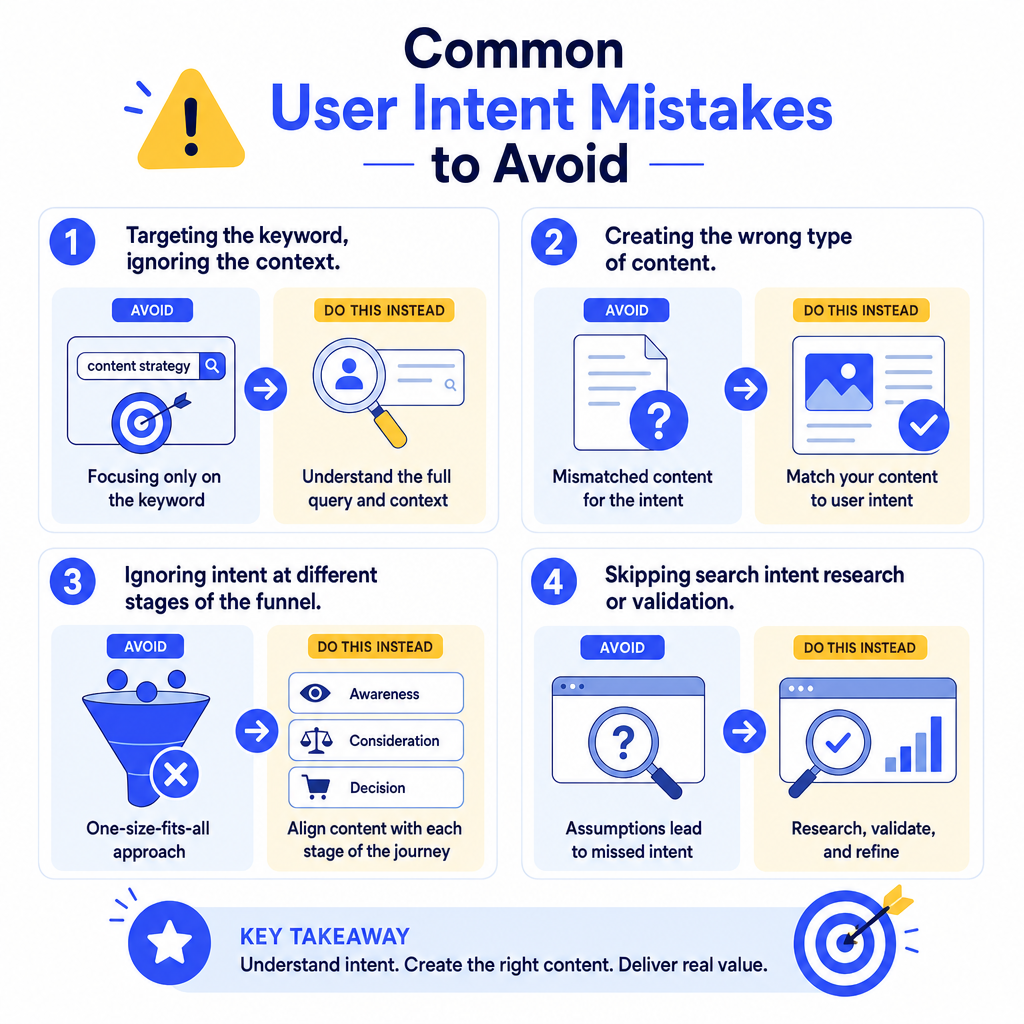
Even experienced content creators fall into predictable traps when dealing with intent. Here are the most common ones and how to sidestep them.
- Targeting the keyword, ignoring the context. A keyword like "content strategy" could be informational or commercial depending on the full query. Always look at the full phrase, not just the head term.
- Publishing one format for all intent types. Your blog post template should not be applied to every page. Transactional pages need a completely different structure.
- Ignoring intent shifts over time. Search intent for a keyword can change. A query that was informational in 2022 might be dominated by commercial results in 2026 as the market matures. Re-audit your top pages regularly.
- Satisfying intent without satisfying depth. Matching the format is not enough. Your content needs to be the most thorough, accurate, and useful answer available for that intent.
How to Measure Whether You Have Satisfied User Intent
After publishing or updating content for intent alignment, track these signals in Google Search Console and your analytics platform.
- Click-through rate (CTR): A low CTR suggests your title and meta description are not matching what users expect to find.
- Bounce rate and time on page: High bounce rates often mean users landed on your page and immediately decided it was not what they were looking for.
- Rankings for related queries: If you have satisfied intent well, you will often start ranking for related questions and long-tail variants naturally.
- Scroll depth: Users who scroll through most of your content are engaging with it, a strong signal that it is meeting their needs.
Conclusion
User intent is not a trend or a tactic. It is the foundation of how modern search engines decide which content deserves to rank. When you start every content decision by asking what the user actually wants, rather than what keyword you want to target, your entire approach to SEO shifts in a more effective direction.
The steps in this guide give you a practical framework: analyze the SERP, read intent signals in the query, match your format to the intent type, write for the user's goal first, and then measure whether you delivered. Apply this process consistently and you will find that rankings, engagement, and conversions all improve together, because you are finally giving people exactly what they came looking for.
Ready to put this into practice? Start with your top three underperforming pages, run them through the intent analysis process above, and see what a difference alignment makes.

Stefan Winter
Founder & SEO Expert
Founder of Fast SEO Fix and SEO automation expert. Stefan built Fast SEO Fix to solve the tedious problem of manual SEO work. He specializes in SEO optimized content generation, keyword research, and automated SEO strategies.
