What Is an SEO Content Planner, and Why Do You Need One?
Posted by
 Stefan Winter
How to Build an SEO Content Planner That Actually Drives Rankings

If you have ever published blog post after blog post only to watch them disappear into the void of page two (or worse), the problem likely is not your writing. It is your planning. A well-structured SEO content planner is the backbone of any content strategy that consistently earns organic traffic, builds authority, and converts readers into customers. Without one, you are essentially guessing, and guessing rarely scales.
This guide walks you through exactly how to build and use an SEO content planner from the ground up. Whether you are a solo blogger, a marketing manager, or a content team lead, these steps will help you move from reactive publishing to a disciplined, search-driven content operation.
What Is an SEO Content Planner, and Why Do You Need One?
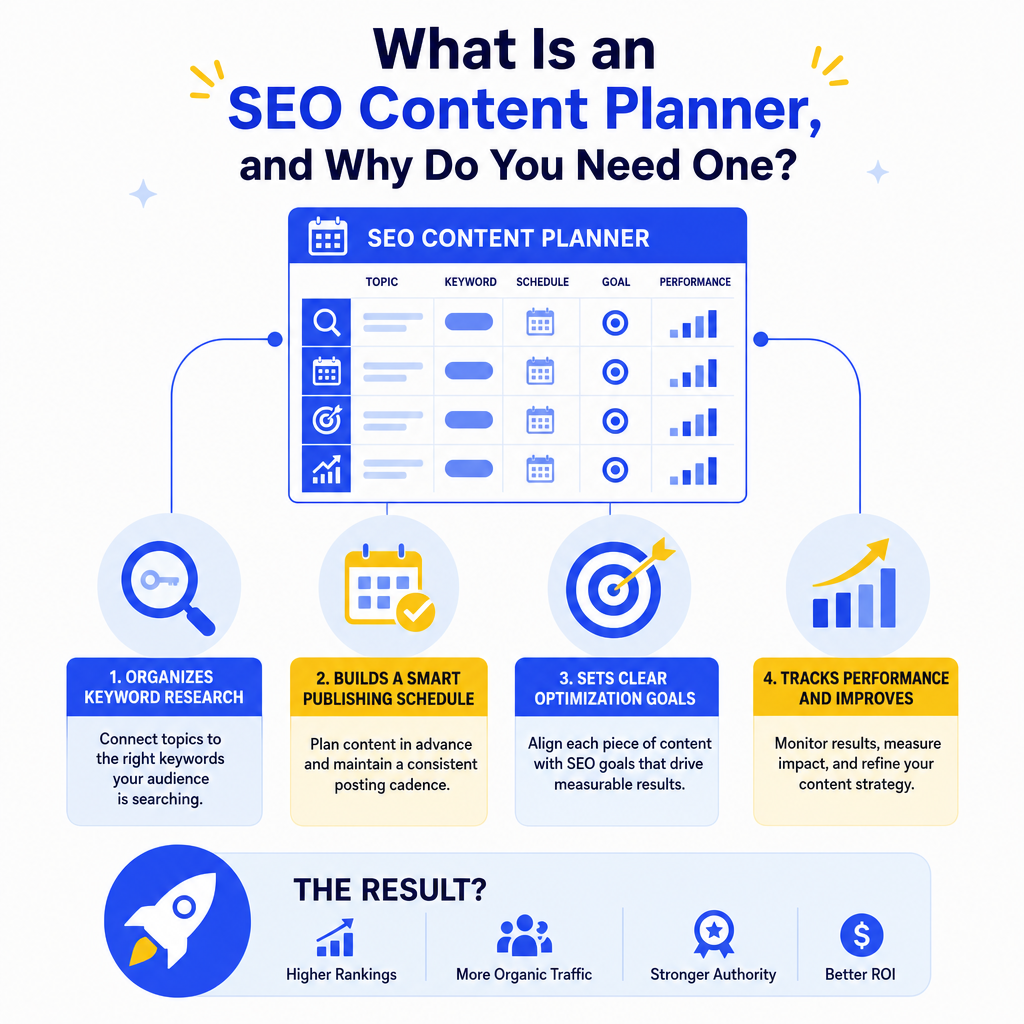
An SEO content planner is a structured system (usually a spreadsheet, database, or dedicated tool) that maps out your content topics, target keywords, publishing schedule, optimization goals, and performance benchmarks in one place. It connects keyword research to editorial calendars and ties individual pieces of content to broader business objectives.
Without a planner, content creation becomes fragmented. Writers produce pieces based on gut feeling, topics overlap, keyword cannibalization creeps in, and important search opportunities get missed entirely. A planner solves all of that by giving your team a single source of truth.
According to the Content Marketing Institute's annual research on B2B content marketing, marketers who document their content strategy are significantly more likely to report success than those who do not. An SEO content planner is exactly that kind of documentation, translated into an actionable, living system.
Step 1: Define Your Content Goals and Audience
Before you open a spreadsheet or sign up for a tool, get clear on what you want your content to accomplish. Traffic growth, lead generation, brand awareness, and customer education each require different content types and keyword strategies.
Ask yourself:
- What does my target audience search for at each stage of the buyer journey?
- Which business goals does content directly support?
- What does success look like at 30, 90, and 180 days?
Step 2: Conduct Keyword Research and Build Your Topic Bank
Keyword research is the engine that powers your SEO content planner. Start by identifying a mix of head terms (high volume, high competition) and long-tail keywords (lower volume, high intent). Tools like Google Search Console are invaluable here because they show you exactly what queries are already bringing people to your site.
Organize your keywords into topic clusters. A topic cluster groups a broad pillar topic with several related subtopics, all of which link back to a central pillar page. This structure signals topical authority to search engines and makes navigation intuitive for readers.
For each keyword in your bank, capture:
- Primary keyword and monthly search volume
- Keyword difficulty score
- Search intent (informational, navigational, transactional, or commercial)
- Assigned content type (blog post, landing page, comparison guide, etc.)
- Priority level (high, medium, or low based on business impact)
Step 3: Set Up Your Planner Structure
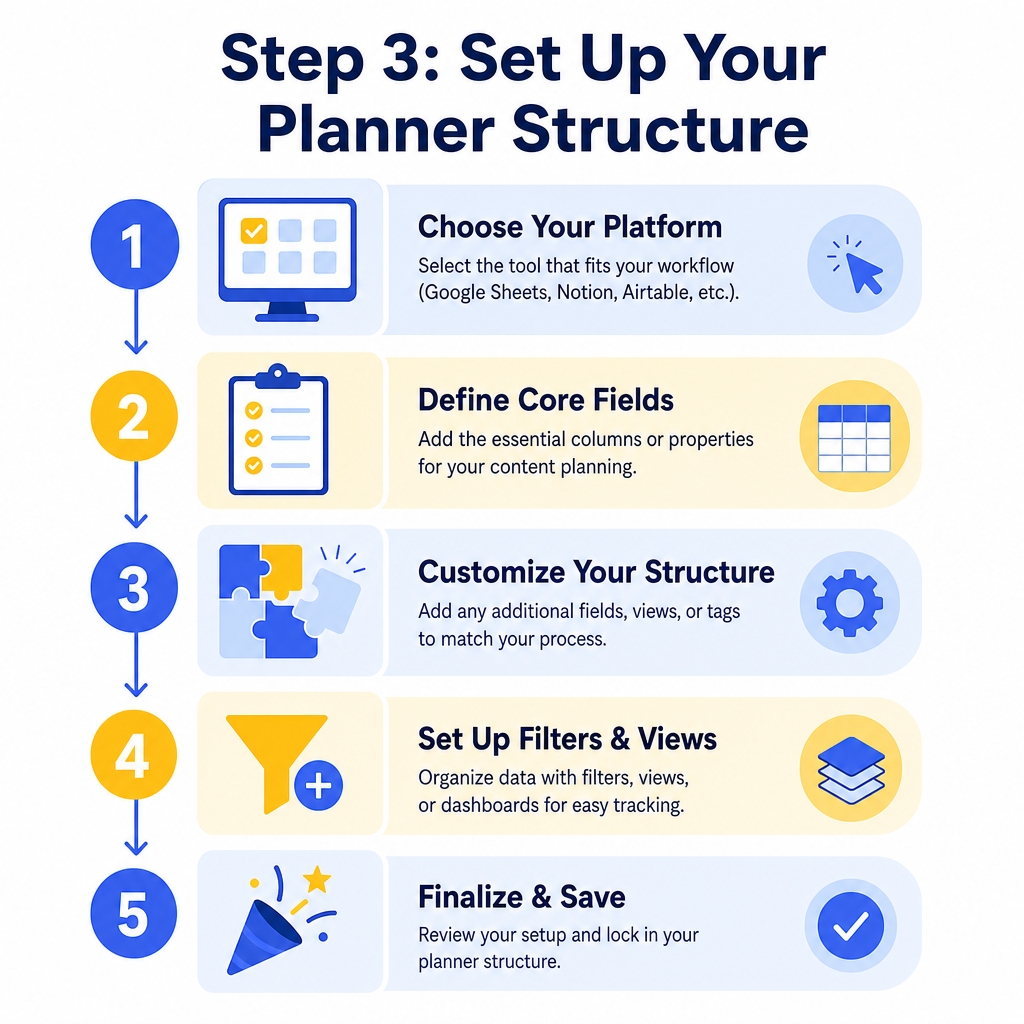
Now it is time to build the actual planner. You can use Google Sheets, Notion, Airtable, or a dedicated content planning tool. The platform matters less than the fields you include.
What Fields Should Your SEO Content Planner Include?
Here is a table that outlines the essential columns for an effective SEO content planner:
| Field | Purpose | Example |
|---|---|---|
| Content Title | Working title for the piece | "How to Build an SEO Content Planner" |
| Primary Keyword | Main search term to target | seo content planner |
| Secondary Keywords | Supporting terms to weave in | content calendar, editorial planner |
| Search Intent | What the reader wants | Informational / How-to |
| Content Type | Format of the piece | Blog post, landing page, video |
| Word Count Target | Estimated length based on SERP | 1,500 words |
| Assigned Writer | Who is responsible | Jane D. |
| Due Date | Deadline for first draft | March 15, 2026 |
| Publish Date | Scheduled go-live date | March 22, 2026 |
| Status | Current stage in workflow | In review |
| Internal Links | Planned links to other pages | /blog/content-workflow |
| Performance Notes | Post-publish metrics | 1,200 impressions, 3.2% CTR |
Step 4: Map Content to the Buyer Journey
Not every piece of content serves the same purpose. A first-time visitor who has never heard of your brand needs something very different from a prospect who is comparing your service to a competitor's. Your SEO content planner should reflect this by tagging each piece of content with a funnel stage.
- Top of funnel (awareness): Educational, informational posts that answer broad questions
- Middle of funnel (consideration): Comparison guides, case studies, how-to tutorials
- Bottom of funnel (decision): Service pages, testimonials, pricing comparisons
Understanding what a content workflow looks like can help you move pieces through each funnel stage with greater consistency and speed.
Step 5: Build Your Editorial Calendar
With your topic bank organized and your planner structure in place, it is time to schedule. Your editorial calendar is the publishing layer of your SEO content planner. It answers the question: what goes live, and when?
When building your calendar, consider:
- Publishing frequency: Be realistic. Two high-quality posts per month outperform six mediocre ones.
- Seasonal relevance: Are there topics that spike in search volume at certain times of year?
- Content refresh cycles: Plan to update older posts every six to twelve months to keep them competitive.
- Internal linking opportunities: Schedule related posts close together so you can link between them immediately upon publishing.
Step 6: Optimize Each Piece Before It Goes Live
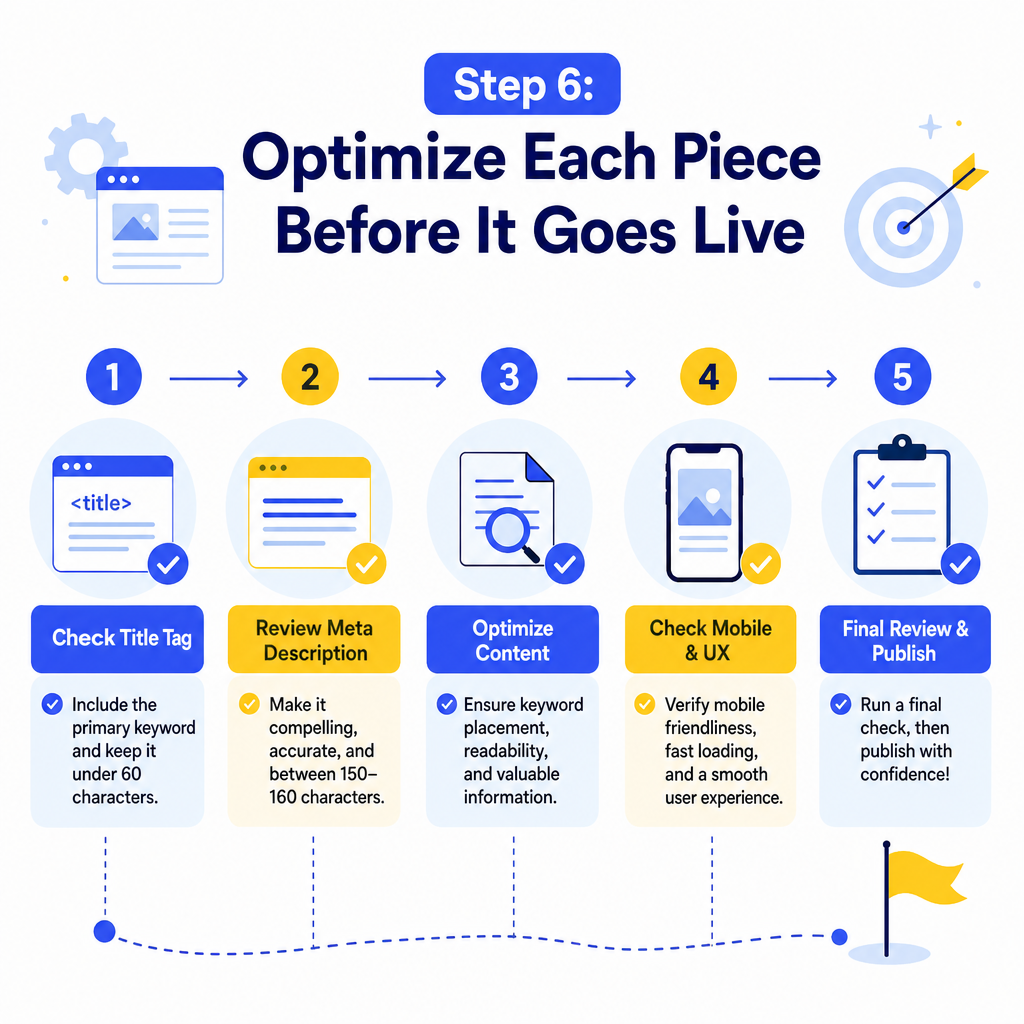
Planning gets you to the starting line. Optimization wins the race. Before you publish anything in your planner, run each piece through a pre-publish checklist:
- Does the title tag include the primary keyword and stay under 60 characters?
- Is the meta description compelling, accurate, and between 150 and 160 characters?
- Are internal links placed naturally throughout the body?
- Does the content match the search intent identified during keyword research?
- Are images compressed and tagged with descriptive alt text?
- Is the URL slug clean, short, and keyword-relevant?
Step 7: Track Performance and Iterate
Your SEO content planner is not a set-it-and-forget-it document. It is a living system that should evolve based on data. After each piece publishes, give it 60 to 90 days to gain traction in search results, then pull performance data from Google Search Console or your analytics platform.
Track these metrics per piece:
- Impressions and clicks from organic search
- Average position for target keywords
- Bounce rate and time on page as engagement signals
- Conversions or goal completions tied to the content
According to Ahrefs' content marketing research, the majority of pages that rank in the top ten on Google are at least two to three years old, which underscores the importance of tracking long-term performance rather than expecting instant results.
Conclusion
Building an SEO content planner is one of the highest-leverage investments you can make in your content strategy. It transforms content creation from a scattered, reactive process into a disciplined, data-informed operation that compounds over time. By defining your goals, building a keyword-rich topic bank, structuring your planner with the right fields, mapping content to the buyer journey, and tracking performance consistently, you position your site to earn and hold organic rankings well into the future.
Start simple. Even a basic spreadsheet with the fields outlined in this guide is infinitely more effective than no plan at all. As your content operation grows, your planner can grow with it. The goal is not perfection on day one. It is a repeatable system that gets smarter with every piece you publish.
Ready to take your content strategy to the next level? Explore the resources on Fast SEO Fix to sharpen your keyword research, streamline your workflow, and publish content that search engines and readers both love.

Stefan Winter
Founder & SEO Expert
Founder of Fast SEO Fix and SEO automation expert. Stefan built Fast SEO Fix to solve the tedious problem of manual SEO work. He specializes in SEO optimized content generation, keyword research, and automated SEO strategies.
