What Is Traditional Advertising, and Does It Still Work?
Posted by
 Stefan Winter
How to Use Traditional Advertising Effectively in a Digital-First World
Traditional advertising still works. Despite the overwhelming shift toward digital channels, billboards still catch eyes on morning commutes, radio spots still reach millions of listeners, and direct mail still lands in real hands. The challenge for most businesses today is not whether to use traditional advertising, but how to use it strategically so that every dollar spent delivers measurable results.
This guide walks you through exactly how to do that. Whether you are a small business owner exploring offline channels for the first time or a marketing manager looking to strengthen an integrated campaign, you will find practical, step-by-step guidance here for making traditional advertising work harder for your brand in 2026.
What Is Traditional Advertising, and Does It Still Work?
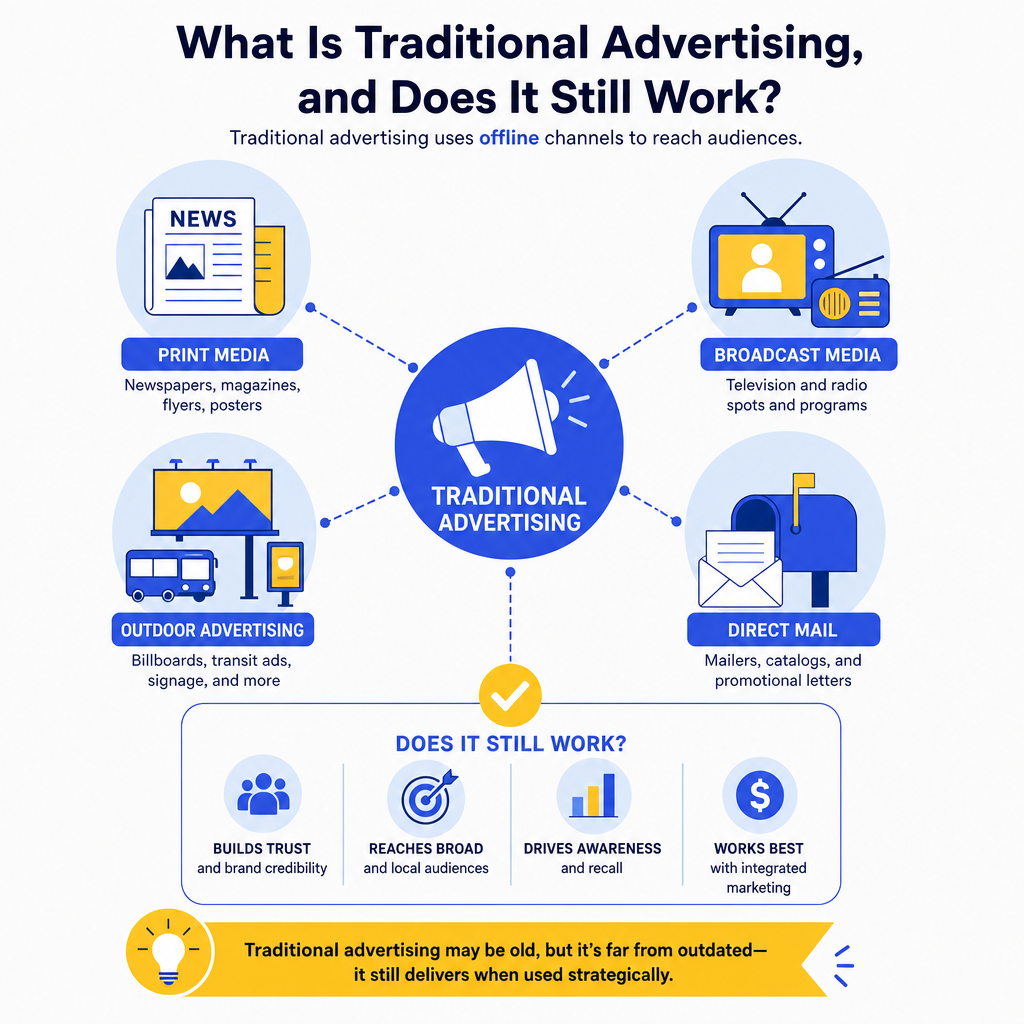
Traditional advertising refers to any form of promotion that operates through offline channels. This includes print media (newspapers, magazines, flyers), broadcast media (television and radio), outdoor advertising (billboards, transit ads, signage), and direct mail. These channels existed long before the internet, and many people assume they have become obsolete.
That assumption is incorrect. According to Nielsen's Total Audience Report, traditional media still reaches the vast majority of American adults on a weekly basis. Television alone continues to command significant viewing hours, and direct mail response rates frequently outperform digital display ads. The key is knowing how to use these channels with intention rather than habit.
Traditional advertising works best when it is planned deliberately, targeted carefully, and integrated with your broader marketing strategy. The businesses that dismiss it entirely often leave a meaningful segment of their audience completely unaddressed.
Step 1: Define Your Advertising Goals Before Choosing a Channel
Every effective advertising campaign starts with a clear objective. Before you spend a single dollar on a print ad or radio spot, you need to answer one question: what do you want this campaign to accomplish?
Common goals for traditional advertising include:
- Building brand awareness in a specific geographic area
- Driving foot traffic to a physical location
- Announcing a product launch or seasonal promotion
- Reaching an older demographic that is less active online
- Reinforcing a digital campaign with offline touchpoints
Step 2: Identify the Right Traditional Advertising Channel for Your Audience
Which Traditional Advertising Formats Should You Consider?
Not all traditional channels reach the same audiences. Choosing the wrong format is one of the most common and costly mistakes businesses make. Here is a breakdown of the major formats and who they tend to reach most effectively:
| Channel | Best For | Typical Audience | Average Cost Range |
|---|---|---|---|
| Television | Mass brand awareness | Broad, 18-65+ | High ($1,000+ per spot) |
| Radio | Local reach, frequency | Commuters, 25-54 | Moderate ($200-$1,000/spot) |
| Print (Newspapers) | Local targeting, older readers | 45+ adults | Low to Moderate |
| Magazines | Niche interest targeting | Specific demographics | Moderate to High |
| Billboards | Geographic visibility | Commuters, local residents | Moderate ($1,500-$3,000/month) |
| Direct Mail | Personalized outreach | Homeowners, local customers | Low to Moderate per piece |
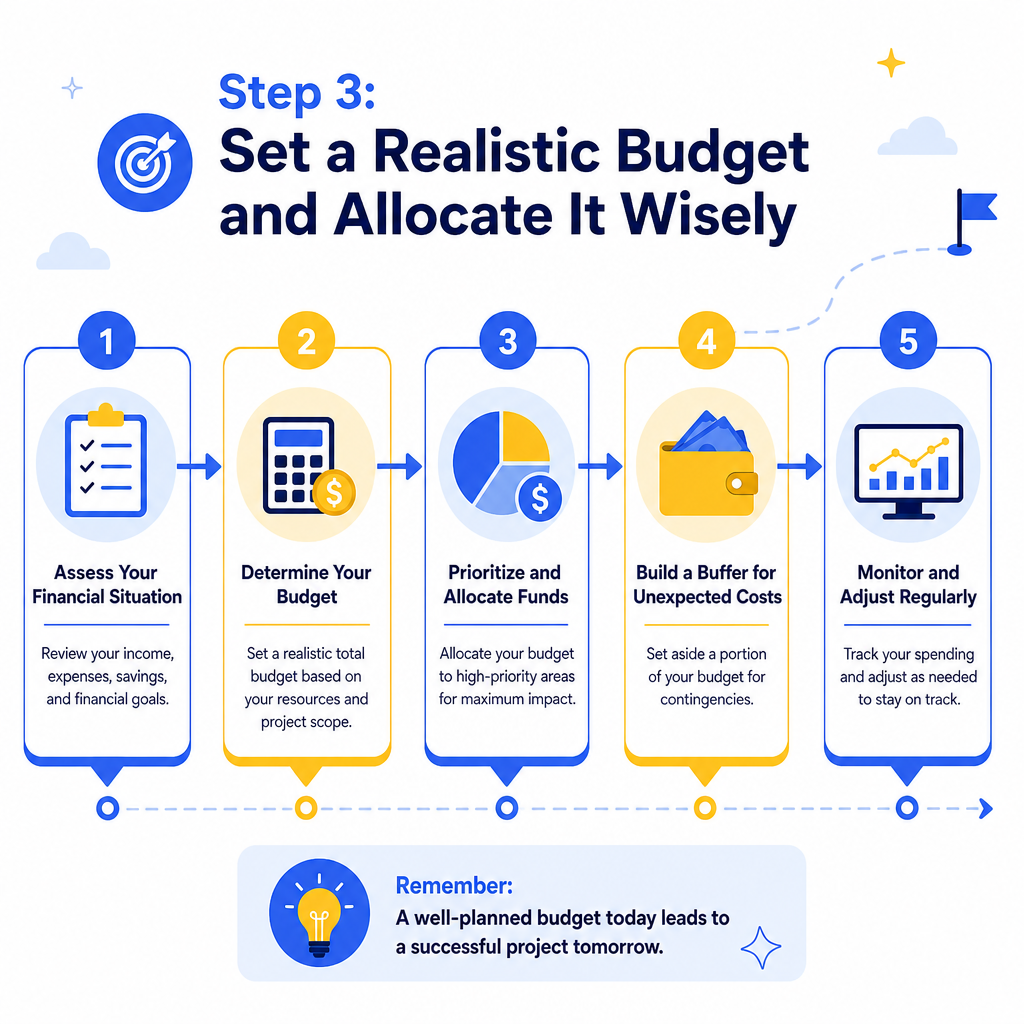
Step 3: Set a Realistic Budget and Allocate It Wisely
How Much Should You Spend on Traditional Advertising?
Budget allocation is where many businesses struggle. Traditional advertising can range from extremely affordable (a classified ad in a local paper) to very expensive (a prime-time television spot). The Small Business Administration recommends that small businesses allocate between 7% and 8% of gross revenue to marketing, with the specific split between traditional and digital depending on the audience and goals.
A practical approach for most businesses is to start with a test budget. Rather than committing your entire advertising spend to one channel, allocate a smaller portion to two or three traditional formats and measure their performance over 60 to 90 days. This gives you real data to work with before scaling up.
Keep in mind that traditional advertising often requires frequency to be effective. A single radio ad or one direct mail piece rarely moves the needle. Plan for multiple exposures, which means your budget needs to account for repetition, not just a single placement.
Step 4: Create Compelling Ad Creative That Drives Action
The best channel placement in the world cannot save weak creative. Your ad copy, visuals, and call-to-action need to be sharp, clear, and relevant to your audience.
For traditional advertising, keep these principles in mind:
- Lead with the benefit, not the feature. Tell your audience what they gain, not just what you offer.
- Keep the message simple. You have limited time or space. One clear idea is more effective than five competing messages.
- Include a specific call-to-action. Tell people exactly what to do next: call this number, visit this address, use this code.
- Match your tone to the channel. Radio scripts should sound natural when spoken aloud. Print ads should be visually scannable. Billboard copy should be readable in under three seconds.
- Use consistent branding. Colors, fonts, and voice should align with your digital presence so that customers recognize you across every touchpoint.
Step 5: Track Performance and Measure ROI
How Do You Measure the Results of Traditional Advertising?
One of the most common criticisms of traditional advertising is that it is difficult to measure. That criticism is valid to a degree, but there are practical ways to track performance and calculate return on investment.
Here are the most effective tracking methods for traditional channels:
- Unique phone numbers: Use a dedicated call tracking number in your ad so you can count inbound calls directly attributed to that placement.
- Promo codes: Include a specific discount code in your ad and track how many times it is redeemed.
- Dedicated landing pages: Direct radio or print audiences to a unique URL and monitor traffic from that source.
- Customer surveys: Ask new customers how they heard about you and include your traditional channels as options.
- Coupon redemption: For direct mail, include a physical coupon and track how many are brought in.
If you are also running digital campaigns alongside your traditional efforts, understanding how to optimize content for maximum impact on those channels will help you create a cohesive strategy that reinforces your offline messaging online.
Step 6: Integrate Traditional Advertising with Your Digital Strategy
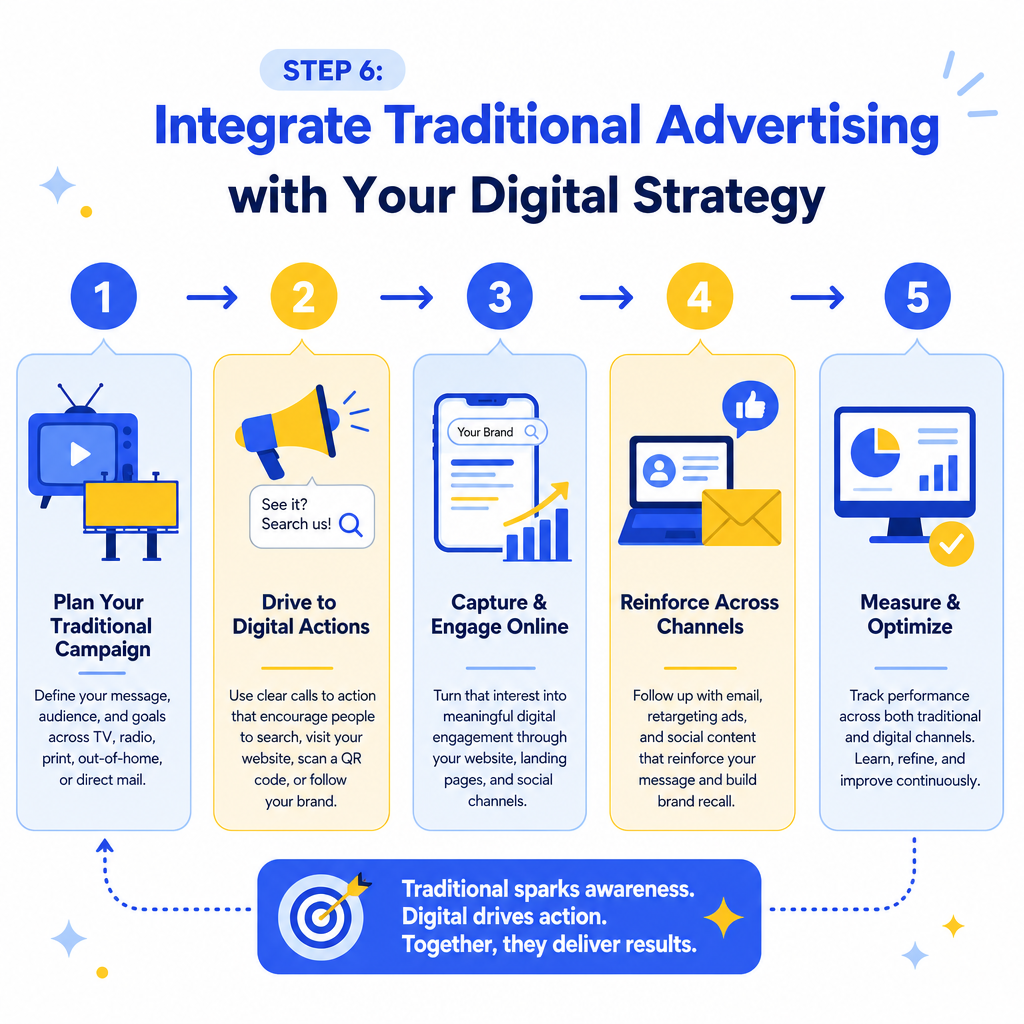
Traditional and digital advertising are not competitors. They are partners. The most effective marketing strategies in 2026 use both in a coordinated way, with each channel reinforcing the other.
A television ad can drive search traffic for your brand name. A billboard can prompt someone to look up your website. A direct mail piece can include a QR code that leads to a landing page. These integrations create multiple touchpoints with the same customer, which builds trust and increases the likelihood of conversion.
According to research from the Data and Marketing Association, campaigns that combine direct mail with digital channels see significantly higher response rates than either channel used in isolation. This is the principle of integrated marketing communications at work, and it is one of the strongest arguments for keeping traditional advertising in your mix.
If you are working to build local visibility, pairing traditional advertising with local SEO services can dramatically amplify your results. When someone sees your billboard and searches for your business online, you want to make sure they find you immediately.
Step 7: Review, Refine, and Repeat
No advertising campaign is perfect on the first run. After your initial campaign period, review the data you collected, identify what worked, and make adjustments before your next placement.
Ask yourself:
- Which channel delivered the most trackable responses?
- Did the creative resonate with the audience, or does it need refinement?
- Was the call-to-action clear enough to drive action?
- Did the budget allocation match the results, or should you shift spend?
For businesses that want to streamline the content side of their marketing, exploring tools like SEO content automation can free up time and resources that you can reinvest into your traditional advertising efforts.
Conclusion
Traditional advertising is far from dead. When planned strategically, executed with strong creative, and integrated with digital channels, it remains one of the most powerful ways to reach audiences that digital alone cannot capture. The businesses winning in 2026 are not choosing between traditional and digital. They are using both intelligently.
Start with a clear goal, choose the right channel for your audience, set a realistic budget, create compelling messaging, and measure your results consistently. Follow these steps and you will build a traditional advertising strategy that delivers real, trackable value for your business.
Ready to sharpen your overall marketing strategy? Explore the resources at Fast SEO Fix to learn how smart content and SEO practices can amplify every advertising channel you use.

Stefan Winter
Founder & SEO Expert
Founder of Fast SEO Fix and SEO automation expert. Stefan built Fast SEO Fix to solve the tedious problem of manual SEO work. He specializes in SEO optimized content generation, keyword research, and automated SEO strategies.
