What Is SEO Content Automation, and Why Does It Matter?
Posted by
 Stefan Winter
How to Build an SEO Content Automation System That Actually Works

If you're spending hours every week researching keywords, drafting outlines, writing blog posts, and optimizing each piece before it goes live, you already know how unsustainable that cycle becomes. SEO content automation offers a smarter path forward. It lets you systematize the repetitive parts of content production so your team can focus on strategy, creativity, and results. This guide walks you through exactly how to build an SEO content automation system from the ground up, covering the tools, workflows, and best practices that make it work in 2026.
What Is SEO Content Automation, and Why Does It Matter?
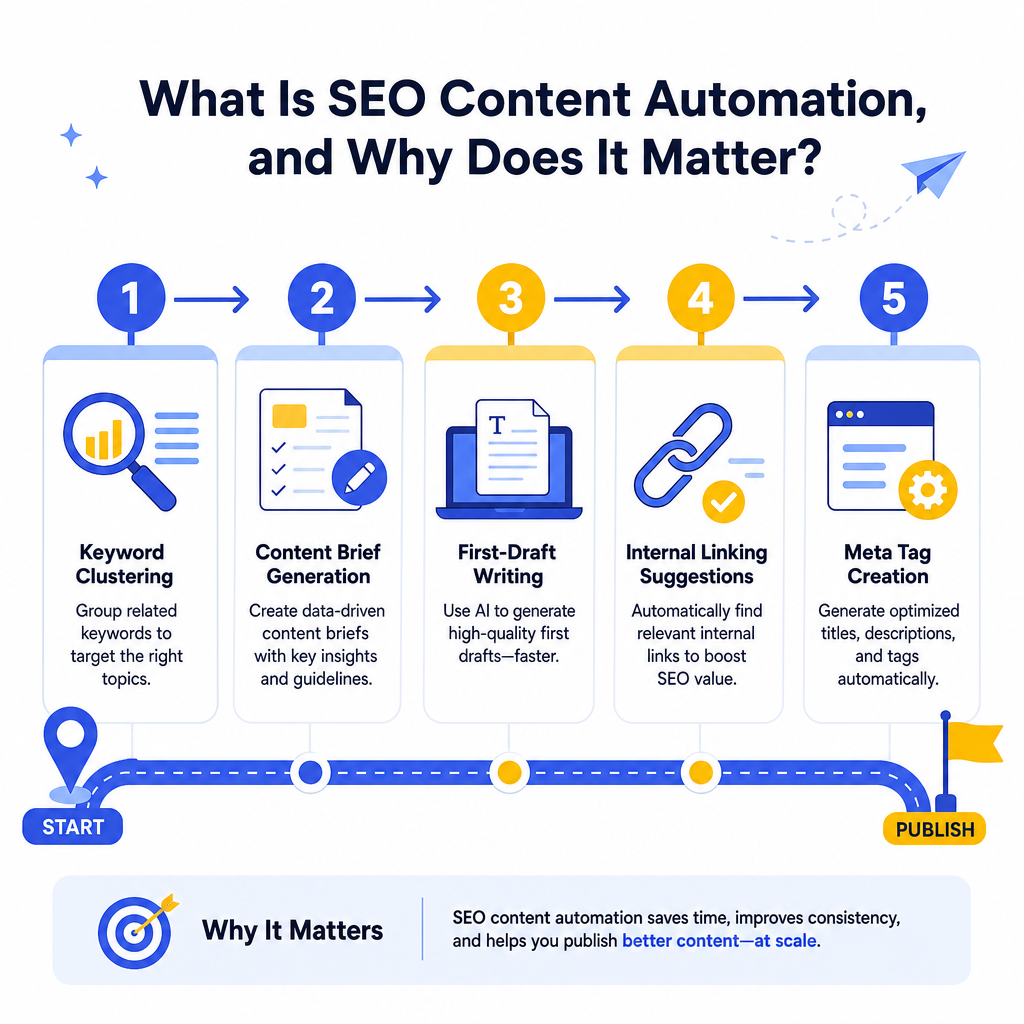
SEO content automation is the process of using software, AI tools, and structured workflows to handle repeatable tasks in your content production pipeline. These tasks can include keyword clustering, content brief generation, first-draft writing, internal linking suggestions, meta tag creation, and even publishing.
The goal is not to remove human judgment from the process. It is to remove the friction that slows your team down. When you automate the right tasks, you can publish more content consistently, maintain quality standards across every piece, and scale your organic traffic without proportionally scaling your headcount.
According to HubSpot's State of Marketing research, marketers who use automation report significantly higher content output and better alignment between their SEO goals and published results. For website owners and content teams trying to compete in crowded niches, that kind of efficiency is not a luxury. It is a competitive necessity.
Step 1: Audit Your Current Content Workflow
Before you automate anything, you need to understand what you are currently doing. A workflow audit helps you identify which tasks eat the most time, which steps are prone to inconsistency, and where automation would have the highest impact.
Start by listing every task involved in producing a single piece of content. This typically includes keyword research, topic selection, competitor analysis, outline creation, writing, editing, SEO optimization, internal linking, image selection, meta tag writing, and publishing. For each task, note how long it takes and how often the output varies in quality.
Look for tasks that are rule-based and repetitive. These are your best automation candidates. Tasks that require original thinking, brand voice judgment, or strategic decisions should stay in human hands, at least for now.
Step 2: Choose the Right SEO Content Automation Tools
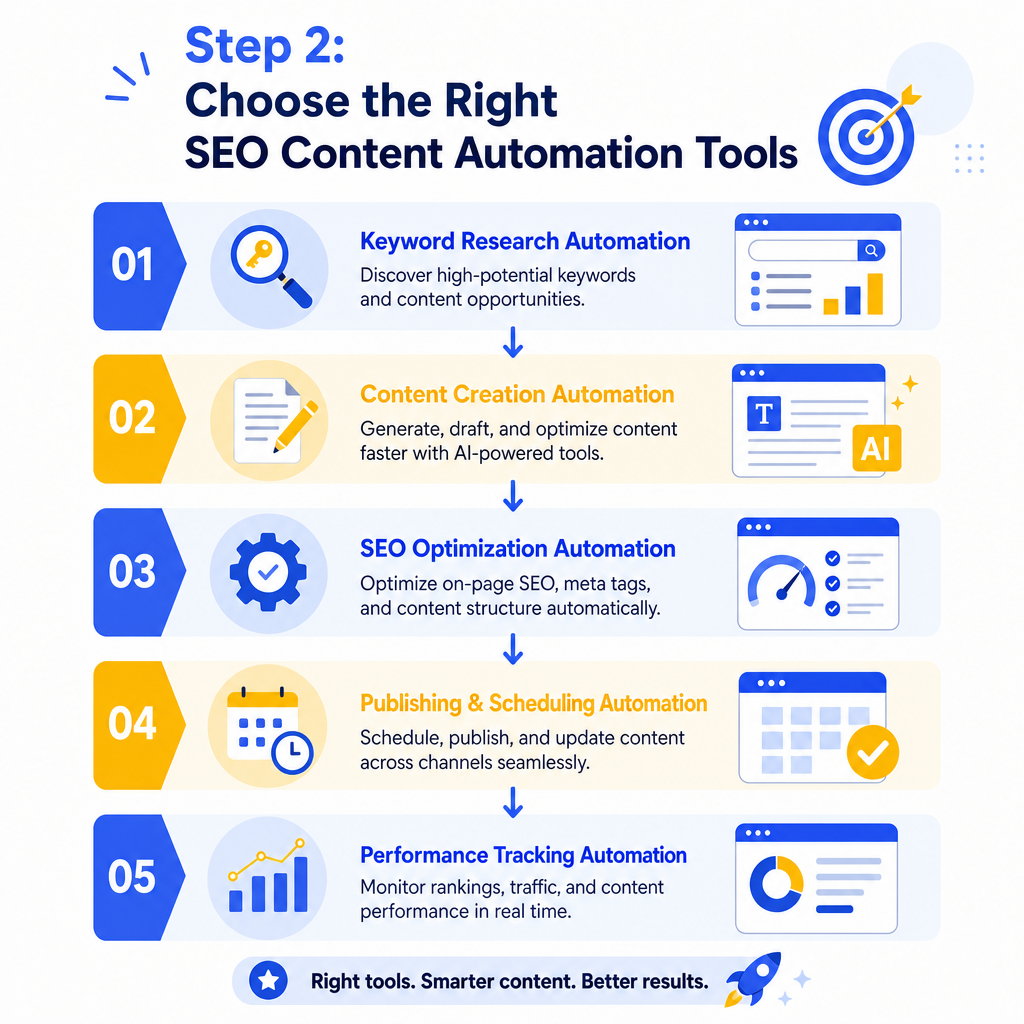
The market for automation tools has expanded significantly. Choosing the right stack depends on your budget, team size, and content goals. Here is a breakdown of the main tool categories and what they handle:
| Tool Category | Primary Function | Examples |
|---|---|---|
| Keyword Research Automation | Cluster keywords, find search intent | Semrush, Ahrefs, Surfer SEO |
| Content Brief Generators | Create structured outlines from SERPs | Frase, MarketMuse, Clearscope |
| AI Writing Assistants | Generate first drafts or sections | ChatGPT, Claude, Jasper |
| On-Page SEO Checkers | Score and optimize content before publish | Surfer SEO, Yoast, RankMath |
| Publishing Automation | Schedule and auto-publish to CMS | Zapier, Make (Integromat), WordPress |
| Internal Linking Tools | Suggest and insert relevant links | Link Whisper, NeuronWriter |
If you are still building out your broader strategy, it helps to understand what a content planning tool actually does before adding automation layers on top of it. Automation works best when it supports a clear plan, not when it substitutes for one.
Step 3: Build a Keyword-to-Content Pipeline
The most powerful thing SEO content automation can do is turn a keyword list into a steady stream of optimized content briefs. Here is how to build that pipeline step by step.
How Do You Automate Keyword Research?
Start by pulling a large keyword dataset from a tool like Semrush or Ahrefs. Export this list and run it through a keyword clustering tool, which groups keywords by search intent and semantic similarity. This gives you topic clusters rather than isolated keywords, which is exactly how modern search engines evaluate topical authority.
Once your clusters are organized, set up a trigger in a workflow tool like Zapier or Make. When a new keyword cluster is approved, the system automatically generates a content brief using a tool like Frase or MarketMuse. The brief includes target keywords, suggested headings, competitor insights, and recommended word count.
This pipeline can reduce the time from keyword discovery to content brief from several hours down to under 30 minutes per topic.
How Do You Automate Content Briefs and Outlines?
A good content brief is the backbone of every well-optimized piece. When you automate brief creation, you ensure consistency across all your content, regardless of who writes it.
Tools like Frase pull the top-ranking pages for your target keyword and extract the common headings, questions, and topics those pages cover. Your automated brief then includes all of this context, plus your own brand guidelines if you integrate them into the template. Writers receive a detailed roadmap, which reduces revision cycles and improves first-draft quality.
According to Google's Search Central documentation on helpful content, content that comprehensively covers a topic and satisfies user intent consistently performs better in rankings. Automated briefs that are built around SERP analysis naturally push your content in that direction.
Step 4: Integrate AI Writing Into Your Workflow (Without Losing Quality)
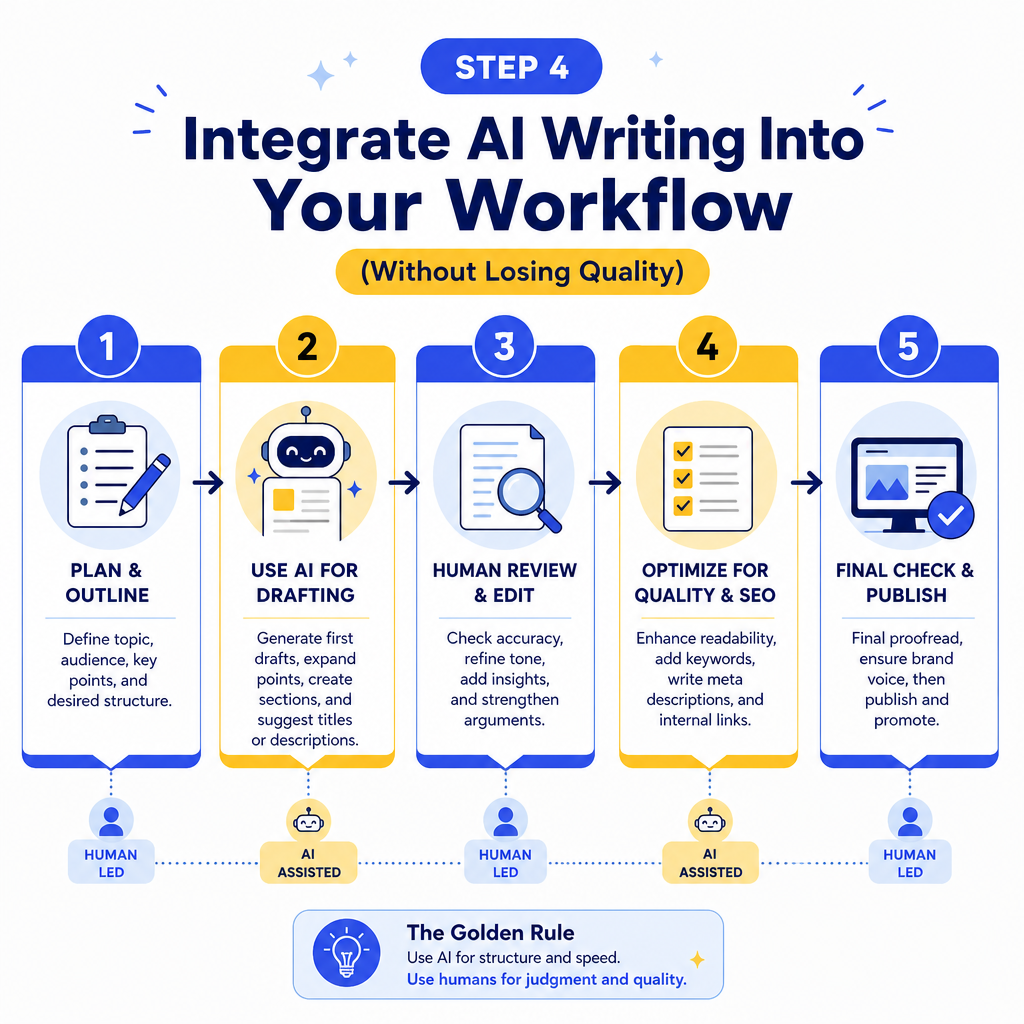
AI writing tools can generate first drafts, expand bullet points into full paragraphs, write meta descriptions, and even suggest title variations. The key is knowing where in your workflow to use them and where to keep humans in control.
A practical approach is to use AI for the structural and formulaic parts of writing, such as introductions, transition paragraphs, FAQ sections, and meta tags. Your human writers then focus on adding original insights, brand voice, and expert perspective. This hybrid model keeps content quality high while dramatically reducing the time each piece takes to produce.
One important note: AI-generated content still needs careful editing and fact-checking. Search engines in 2026 are increasingly sophisticated at evaluating content quality, and publishing thin or inaccurate AI output can damage your rankings rather than improve them. Treat AI as a skilled assistant, not an unsupervised writer.
For context on how quality writing fits into your broader SEO goals, the guide on what SEO content writing actually involves is worth reading before you hand tasks over to automation tools.
Step 5: Automate On-Page SEO and Publishing
Once a piece of content is written and edited, there is still a layer of technical optimization that needs to happen before it goes live. This is another area where automation saves significant time.
Tools like Surfer SEO or Clearscope analyze your draft and score it against top-ranking competitors in real time. They flag missing keywords, suggest semantic terms to include, and recommend structural improvements. Many of these tools integrate directly with Google Docs or your CMS, so the feedback appears as writers work rather than as a separate review step.
For publishing, tools like Zapier can connect your content workflow to WordPress or other CMS platforms. When a piece moves to "approved" status in your project management tool, it can automatically be pushed to a draft in your CMS with the correct category, tags, and meta data already filled in. Your team then reviews and schedules it, which takes minutes instead of an hour.
What About Internal Linking Automation?
Internal linking is one of the most consistently underused SEO tactics, largely because it is time-consuming to do manually. Tools like Link Whisper scan your existing content and suggest relevant internal links based on keyword matching and topical relevance.
This kind of automation ensures that every new piece of content gets connected to your existing library, which helps search engines understand your site structure and boosts the authority of individual pages. Understanding what content optimization really involves can help you see how internal linking fits into the bigger picture of on-page SEO.
Step 6: Monitor, Measure, and Refine Your Automation System
Building an SEO content automation system is not a one-time setup. It requires regular review to make sure the automated outputs are meeting your quality standards and that your content is actually ranking.
Set up a monthly audit where you review a sample of automated content briefs, check AI-generated drafts before and after editing, and pull ranking data for recently published posts. Look for patterns. If certain topic clusters consistently underperform, your keyword research automation may need recalibration. If AI drafts require heavy editing in specific content types, adjust the prompts or templates you are using.
The Moz Beginner's Guide to SEO is a reliable reference for benchmarking your optimization standards as you refine your automated workflows. Keeping your system aligned with current best practices is what separates teams that scale successfully from those that produce high volumes of content that never ranks.
Conclusion
SEO content automation is one of the highest-leverage investments a content team can make in 2026. By systematizing keyword research, brief creation, AI-assisted writing, on-page optimization, and publishing, you can dramatically increase your output without sacrificing the quality that search engines and readers both demand.
Start with a workflow audit, choose tools that match your actual bottlenecks, and build your pipeline one step at a time. The goal is a system where your team spends less time on repetitive tasks and more time on the strategic decisions that move the needle.
If you are ready to build a more efficient content operation, Fast SEO Fix is here to help. Explore the resources on our site, and start turning your content process into a competitive advantage.

Stefan Winter
Founder & SEO Expert
Founder of Fast SEO Fix and SEO automation expert. Stefan built Fast SEO Fix to solve the tedious problem of manual SEO work. He specializes in SEO optimized content generation, keyword research, and automated SEO strategies.
