The Complete Guide to Content Optimization Tips That Actually Drive Results
Posted by
 Stefan Winter
TL;DR
Content optimization is the process of improving your content to rank better in search engines and resonate with your audience, going far beyond keyword stuffing. By mastering keyword research, search intent mapping, on-page SEO techniques, and readability improvements, you can systematically increase organic visibility and drive meaningful results for your brand.
The Complete Guide to Content Optimization Tips That Actually Drive Results
Every piece of content you publish is competing for attention in an increasingly crowded digital landscape. Whether you are a seasoned marketer, a small business owner, or a blogger just finding your footing, understanding how to optimize your content can be the difference between a post that gets buried on page five of search results and one that consistently brings in organic traffic. This guide covers the most effective content optimization tips available in 2026, walking you through everything from keyword strategy and readability improvements to technical on-page elements and content freshness. By the time you finish reading, you will have a clear, actionable roadmap for making every piece of content work harder for your brand.
What Is Content Optimization and Why Does It Matter?
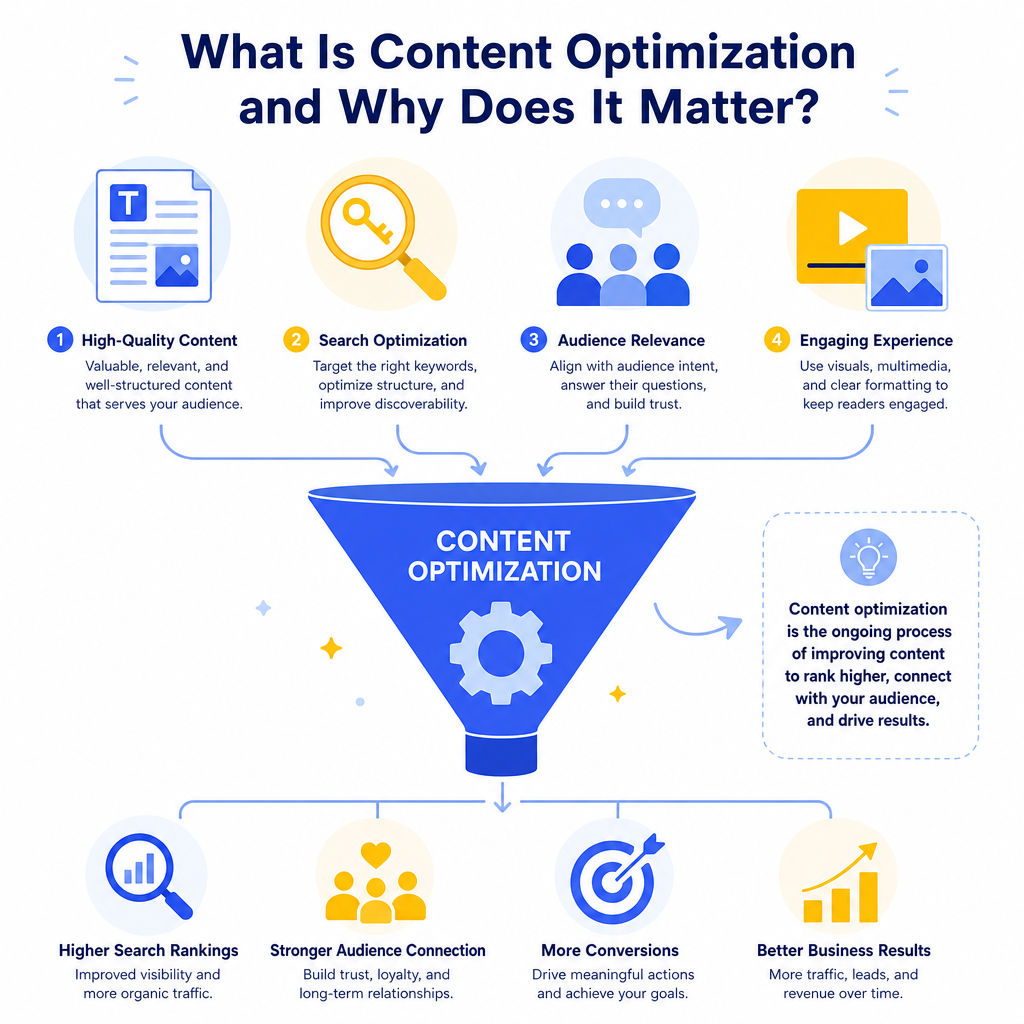
Content optimization is the process of improving your written, visual, or multimedia content so that it performs better in search engines, resonates more deeply with your target audience, and drives meaningful actions. It goes far beyond simply stuffing a keyword into a paragraph a few extra times. True optimization means aligning your content with user intent, making it easy to read and navigate, and ensuring that search engine crawlers can understand and index it properly.
In 2026, search engines are more sophisticated than ever. Google's algorithms now prioritize content that demonstrates genuine expertise, trustworthiness, and relevance to the reader's actual needs. That means thin, generic content simply does not cut it anymore. Brands that invest in thoughtful content optimization tips and apply them consistently are the ones seeing compounding returns in organic visibility, engagement, and conversions.
The good news is that content optimization is a learnable skill. With the right framework, you can systematically improve every piece of content you produce, whether you are starting from scratch or refreshing older posts that have started to lose their ranking positions.
How Do You Start With Keyword Research and Intent Mapping?
Keyword research is the foundation of any effective content optimization strategy. Before you write a single word, you need to understand what your audience is searching for and, more importantly, why they are searching for it. This "why" is called search intent, and matching your content to it is one of the most powerful content optimization tips you can apply right now.
There are four primary types of search intent to consider:
- Informational intent: The user wants to learn something (for example, "how does SEO work").
- Navigational intent: The user wants to find a specific website or page.
- Commercial intent: The user is researching before making a purchase decision.
- Transactional intent: The user is ready to buy or take a specific action.
Use tools like Semrush, Ahrefs, or Google's own Search Console to find keyword variations, check monthly search volumes, and analyze what types of content are currently ranking for your target terms. Look for long-tail keywords (phrases with three or more words) because they tend to have clearer intent and less competition, making them excellent targets for focused content optimization.
What Are the Most Effective On-Page Optimization Techniques?
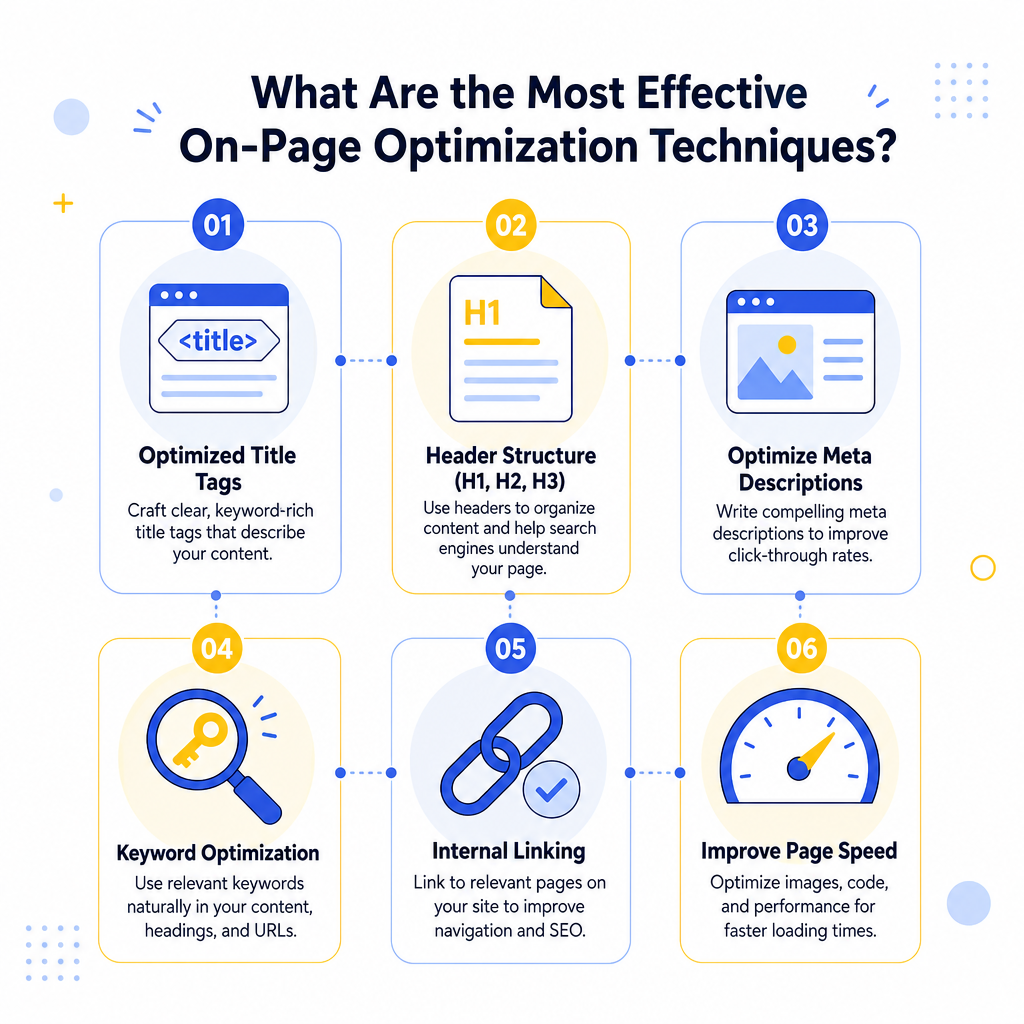
On-page optimization refers to all the elements within your content and its surrounding HTML that influence how search engines interpret and rank your page. Getting these right is a core part of any content optimization tips checklist.
How Should You Structure Your Title Tags and Meta Descriptions?
Your title tag is one of the most influential on-page ranking factors. It should include your primary keyword as close to the beginning as possible, stay within 50 to 60 characters, and clearly communicate what the page is about. Avoid clickbait titles that overpromise and underdeliver, as high bounce rates send negative signals to search engines.
Meta descriptions do not directly influence rankings, but they heavily impact click-through rates. Write a compelling, 150 to 160 character summary that includes your target keyword and gives the reader a clear reason to click. Think of it as a mini advertisement for your content.
Why Does Heading Hierarchy Matter for SEO?
Proper use of H1, H2, and H3 tags helps both readers and search engines navigate your content. Your H1 should contain your primary keyword and appear only once per page. Use H2s to introduce major sections and H3s for subsections within those areas. This logical hierarchy improves readability, reduces bounce rates, and gives search engines a clear map of your content's structure.
Beyond headings, pay attention to your URL structure. Keep it short, descriptive, and keyword-inclusive. For example, a URL like yoursite.com/content-optimization-tips is far more effective than yoursite.com/p?id=4892.
How Can Readability and User Experience Improve Your Rankings?
Search engines track how users interact with your content after they land on your page. If visitors leave within seconds, that signals a poor match between the content and what they were looking for. Improving readability is one of the most underrated content optimization tips because it directly affects dwell time, pages per session, and overall user satisfaction.
Here are practical ways to improve your content's readability:
- Use short paragraphs. Aim for three to four sentences per paragraph to prevent walls of text.
- Write at an accessible reading level. Tools like Hemingway Editor can help you simplify complex sentences.
- Include visual breaks. Bullet points, numbered lists, subheadings, and images keep readers engaged.
- Use active voice. Active sentences are more direct and easier to process than passive constructions.
- Add internal links. Linking to related posts on your site keeps users exploring and distributes page authority effectively.
Content Optimization Tips: A Quick Reference Table
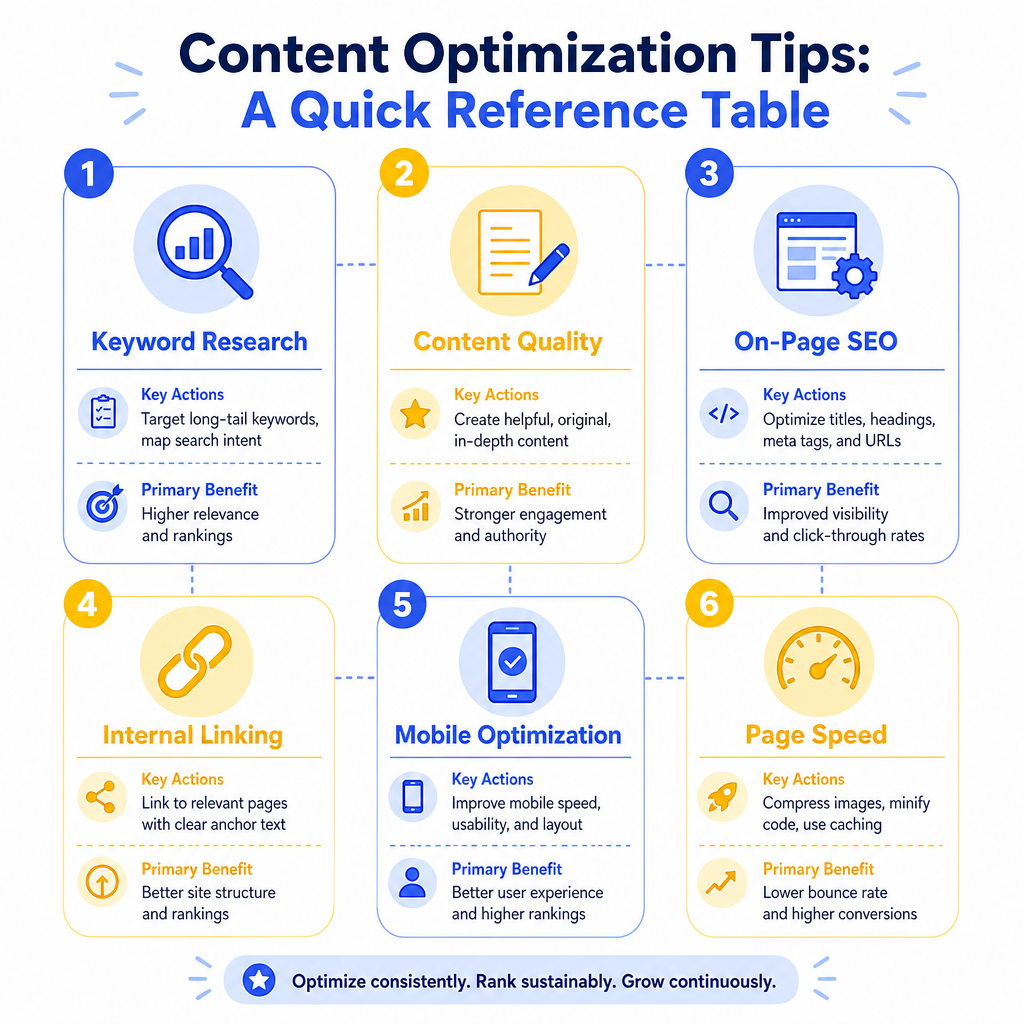
The following table summarizes the key content optimization areas, what to focus on in each, and the primary benefit of getting it right.
| Optimization Area | Key Actions | Primary Benefit |
|---|---|---|
| Keyword Research | Target long-tail keywords, map search intent | Higher relevance and ranking potential |
| Title Tags | Include primary keyword, keep under 60 characters | Better click-through rates from search results |
| Meta Descriptions | Write compelling 150-160 character summaries | Improved organic click-through rates |
| Heading Structure | Use H1, H2, H3 hierarchy logically | Better crawlability and user navigation |
| Readability | Short paragraphs, active voice, visual breaks | Lower bounce rates, higher dwell time |
| Internal Linking | Link to related content within your site | Stronger site architecture and page authority |
| Content Freshness | Update posts regularly with new data | Sustained or improved rankings over time |
| Image Optimization | Use descriptive alt text, compress file sizes | Faster load times and image search visibility |
How Does Content Freshness Impact Your Search Performance?
One of the most overlooked content optimization tips involves revisiting and updating your existing content. Search engines favor content that is current, accurate, and relevant. A post that was highly ranked in 2024 may start to slip if it contains outdated statistics, broken links, or information that no longer reflects industry best practices.
Set a regular schedule to audit your top-performing posts. Look for opportunities to add new data, update examples, improve internal links, and expand sections that could offer more depth. When you update a post, change the published date to reflect the revision. This signals to search engines that the content is fresh and actively maintained.
Beyond updates, consider expanding successful posts into content clusters. A cluster strategy involves creating a central "pillar" page on a broad topic and linking it to several more specific "cluster" pages. This approach strengthens your topical authority, which is a significant ranking factor in 2026's search environment.
What Role Do Images and Multimedia Play in Content Optimization?
Visual content is not just a design choice. It is an SEO asset when handled correctly. Every image you include should have a descriptive alt text that naturally incorporates relevant keywords where appropriate. Alt text helps search engines understand what an image depicts and improves accessibility for users relying on screen readers.
Compress your images before uploading them to reduce file sizes without sacrificing quality. Tools like TinyPNG or Squoosh make this process quick and straightforward. Large image files slow down page load times, and page speed is a confirmed ranking factor. Aim for a load time under three seconds on both desktop and mobile.
Consider incorporating video content, infographics, and interactive elements where they add genuine value. Pages with diverse content formats tend to earn more backlinks and social shares, both of which contribute to stronger domain authority over time.
Conclusion
Effective content optimization is not a one-time task. It is an ongoing commitment to quality, relevance, and user experience. By applying these content optimization tips consistently, including thorough keyword research, strong on-page structure, readable formatting, regular content updates, and smart use of multimedia, you build a content strategy that compounds in value over time.
The brands and creators seeing the strongest organic growth in 2026 are not necessarily the ones with the biggest budgets. They are the ones who take a thoughtful, systematic approach to every piece of content they publish. Start by auditing one or two of your existing posts using the framework outlined in this guide. Identify the gaps, make the improvements, and then measure the results. Small, consistent improvements add up to significant gains in visibility, traffic, and audience trust. Your next best-performing piece of content is the one you optimize today.
Frequently Asked Questions
Content optimization is a holistic approach that aligns your content with user intent, improves readability, and ensures proper technical SEO implementation. Keyword stuffing, by contrast, is an outdated tactic of artificially inserting keywords into content, which modern search engines penalize and which provides poor user experience.
Search intent refers to why a user is searching for a particular keyword. Matching your content format and depth to the user's intent (informational, navigational, commercial, or transactional) is crucial because misalignment is one of the primary reasons pages fail to rank, even when technically well-written.
Title tags should be 50 to 60 characters and include your primary keyword near the beginning. Meta descriptions should be 150 to 160 characters and include your target keyword while clearly communicating why users should click through to your content.
Use one H1 tag per page containing your primary keyword, H2 tags for major sections, and H3 tags for subsections. This logical hierarchy helps both search engines and readers navigate your content while improving overall readability and reducing bounce rates.
Search engines track user engagement metrics like dwell time and bounce rate after users land on your page. Improving readability through short paragraphs, clear formatting, and logical structure increases time on page and user satisfaction, which sends positive signals to search engines and can improve rankings.

Stefan Winter
Founder & SEO Expert
Founder of Fast SEO Fix and SEO automation expert. Stefan built Fast SEO Fix to solve the tedious problem of manual SEO work. He specializes in SEO optimized content generation, keyword research, and automated SEO strategies.
