What Is SEO Content Writing, and Why Does It Matter?
Posted by
 Stefan Winter
How to Master SEO Content Writing: A Step-by-Step Guide for 2026

If you have ever published a blog post that nobody read, you know the frustration. You spent hours crafting something valuable, hit publish, and heard nothing but silence. The problem usually is not the quality of your ideas. It is the way the content was written and structured for search engines. SEO content writing bridges the gap between what your audience is searching for and what you actually publish, and learning how to do it well is one of the highest-leverage skills you can develop for your website in 2026.
This guide walks you through every major step of the SEO content writing process, from keyword research to final optimization, so you can start producing content that ranks, earns clicks, and genuinely helps readers.
What Is SEO Content Writing, and Why Does It Matter?
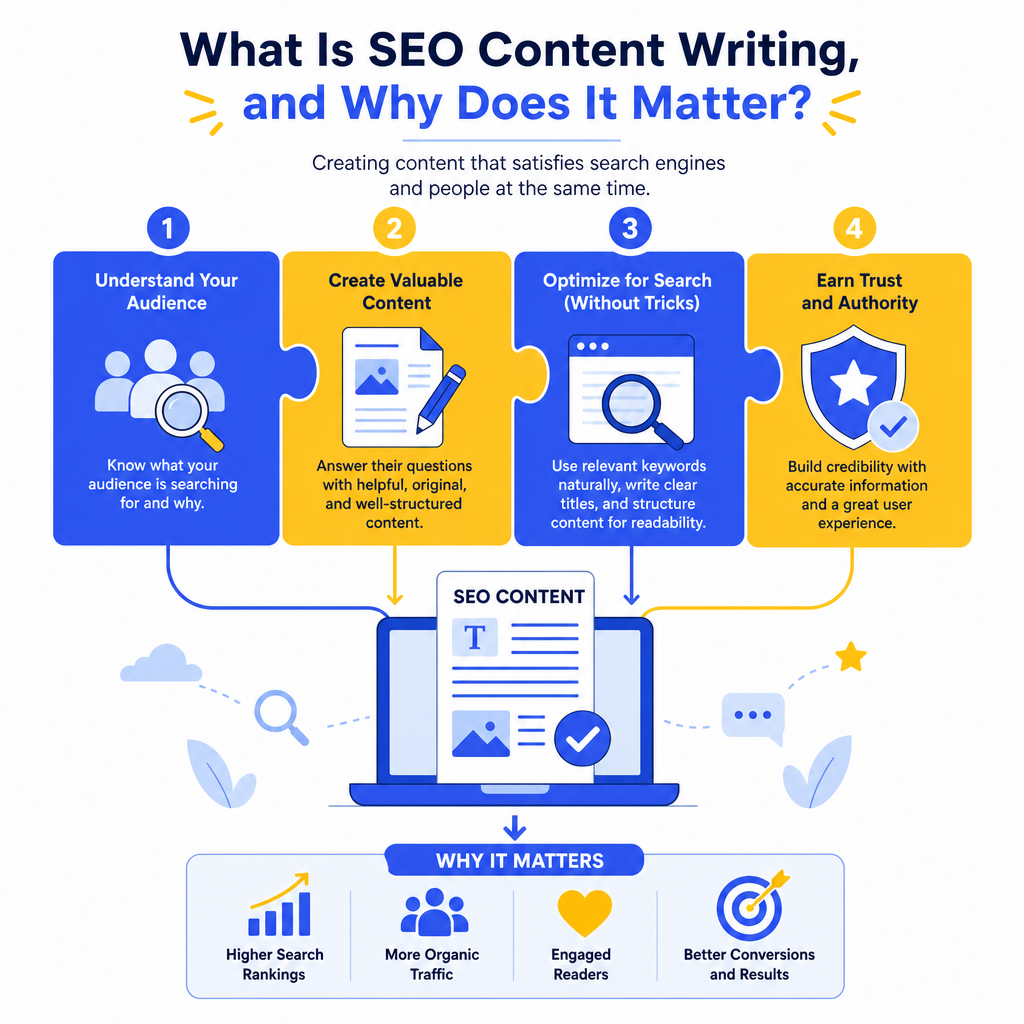
SEO content writing is the practice of creating written content that satisfies both search engine algorithms and human readers at the same time. It is not about stuffing keywords into paragraphs or tricking Google. It is about understanding what your target audience is searching for, answering those questions clearly, and presenting that information in a format that search engines can easily interpret and rank.
According to Google's Search Essentials documentation, Google's systems are designed to reward content that demonstrates expertise, experience, authoritativeness, and trustworthiness. In practical terms, that means your writing needs to be accurate, well-organized, and genuinely useful rather than written purely to game an algorithm.
The stakes are real. HubSpot's State of Marketing research consistently shows that companies that prioritize blogging and content creation generate significantly more organic traffic than those that do not. SEO content writing is the engine behind that traffic.
Step 1: Start with Targeted Keyword Research
Before you write a single word, you need to know what your audience is actually searching for. Keyword research is the foundation of every effective SEO content writing project.
Here is how to approach it:
- Identify your core topic. Start broad. If your site covers digital marketing, your broad topic might be "content marketing."
- Find specific, searchable variations. Use tools like Ahrefs' Keyword Explorer or Google Search Console to discover related phrases, long-tail keywords, and question-based queries.
- Evaluate search intent. Look at the top-ranking pages for your target keyword. Are they listicles, how-to guides, product pages, or definitions? This tells you what format Google believes best serves that query.
- Check difficulty versus volume. A keyword with 10,000 monthly searches and extremely high competition may be harder to rank for than a keyword with 1,000 monthly searches and moderate competition.
Step 2: Plan Your Content Structure Before You Write
Jumping straight into writing without a plan is one of the most common mistakes in SEO content writing. A clear outline helps you cover a topic comprehensively, which is exactly what search engines reward.
How Should You Structure SEO Content?
Think of your structure as a hierarchy. Your H1 is the main title, your H2s are major sections, and your H3s are subsections within those sections. This hierarchy signals to search engines how your content is organized and helps readers navigate to the information they need.
A strong structure for most SEO content pieces includes:
1. An introduction that hooks the reader and previews the content 2. A definition or foundational section that answers the core question 3. Step-by-step or detailed supporting sections 4. A practical tips or best practices section 5. A conclusion with a clear call to action
If you want to go deeper on how structure fits into a broader plan, our guide on what a content strategy is and why it matters is a strong next read.
Step 3: Write for Humans First, Search Engines Second

This is the principle that separates good SEO content writing from keyword-stuffed noise. Your primary reader is a human being with a real question or problem. Write for them.
Practical writing tips that serve both audiences:
- Use your primary keyword naturally in the first 100 words of your content. Do not force it, but do not bury it either.
- Write in short paragraphs. Three to four sentences per paragraph keeps content scannable and reduces bounce rate.
- Use active voice. "We increased traffic by 40%" reads better than "Traffic was increased by 40% by our team."
- Include your keyword in at least one H2 heading. This reinforces topical relevance without overdoing it.
- Avoid keyword stuffing. A keyword density of 1 to 2 percent is generally sufficient. Repeating a phrase unnaturally will hurt your rankings and your credibility.
Step 4: Optimize Key On-Page Elements
Writing great body copy is only part of SEO content writing. On-page optimization covers the technical signals that tell search engines what your content is about.
| On-Page Element | Best Practice for 2026 | Why It Matters |
|---|---|---|
| Title Tag (H1) | Include primary keyword near the beginning | Strong ranking signal and first impression in SERPs |
| Meta Description | 150 to 160 characters, include keyword naturally | Influences click-through rate from search results |
| URL Slug | Short, keyword-rich, no stop words | Improves crawlability and user trust |
| Image Alt Text | Descriptive, includes keyword where relevant | Helps with image search and accessibility |
| Internal Links | 2 to 4 links to related content | Distributes authority and improves site structure |
| First Paragraph | Include primary keyword within first 100 words | Confirms topical relevance quickly for crawlers |
Step 5: Add Depth with Supporting Content Formats
Text alone rarely wins top rankings in 2026. Search engines increasingly reward pages that offer multiple content formats because they tend to satisfy more types of users.
Consider adding:
- Tables to compare options or summarize data (like the one above)
- Numbered lists or bullet points to break down steps or features
- FAQ sections to capture question-based search queries
- Images or diagrams with descriptive alt text
- Quotes or statistics from authoritative sources to build credibility
If you are thinking about scaling your content production, it is worth exploring how content creation automation can help you maintain quality while increasing output.
Step 6: Review, Edit, and Optimize Before Publishing

What Should You Check Before You Publish?
The editing phase is where good SEO content writing becomes great. Use this checklist before you hit publish:
- Does the title include the primary keyword and accurately describe the content?
- Is the meta description compelling and within the character limit?
- Have you linked to two to four internal pages where relevant?
- Have you included at least one or two external links to authoritative sources?
- Does the content fully answer the search intent behind the target keyword?
- Have you read the content aloud to catch awkward phrasing?
- Is the content at least as comprehensive as the top-ranking pages for your target keyword?
Step 7: Promote and Monitor Your Content After Publishing
Publishing is not the finish line. SEO content writing includes what happens after you publish.
Share your content through your email list, social channels, and any relevant communities where your audience spends time. Building initial traffic signals to search engines that your content is worth indexing and ranking. You should also monitor performance using Google Search Console to see which queries are driving impressions, and update your content every six to twelve months to keep it accurate and competitive.
For a broader look at how to get your content in front of the right people, our overview of what content promotion is and why it matters covers the key channels and tactics worth knowing.
Conclusion
SEO content writing is not a single skill. It is a process that combines research, strategy, writing craft, and technical optimization into a repeatable system. When you follow the steps in this guide, you give every piece of content you publish a genuine chance to rank, attract the right readers, and deliver real value.
Start with keyword research, build a solid structure, write for humans with search engines in mind, optimize your on-page elements, and never skip the editing phase. Do that consistently, and you will see the difference in your organic traffic over time.
Ready to put this into practice? Explore the resources across Fast SEO Fix to sharpen every part of your content process, from strategy to execution.

Stefan Winter
Founder & SEO Expert
Founder of Fast SEO Fix and SEO automation expert. Stefan built Fast SEO Fix to solve the tedious problem of manual SEO work. He specializes in SEO optimized content generation, keyword research, and automated SEO strategies.
