The Complete Guide to Content Creation Automation in 2026
Posted by
 Stefan Winter
TL;DR
Content creation automation uses AI, workflow tools, and integrations to handle repetitive tasks like drafting, scheduling, and repurposing content, allowing teams to produce more material without increasing headcount or sacrificing quality. In 2026, automation is essential for meeting the constant demand for fresh content across blogs, social media, and email while freeing human creators to focus on strategy and storytelling.
The Complete Guide to Content Creation Automation in 2026

Imagine publishing high-quality blog posts, social media updates, email newsletters, and video scripts without spending every waking hour hunched over a keyboard. That is exactly what content creation automation makes possible. Whether you are a solo entrepreneur, a marketing manager at a growing company, or a content strategist at a large enterprise, automating parts of your content workflow can save you dozens of hours each week while maintaining the quality your audience expects. This guide breaks down everything you need to know about content creation automation, from the core concepts to the tools, strategies, and best practices that are shaping the industry in 2026.
What Is Content Creation Automation?
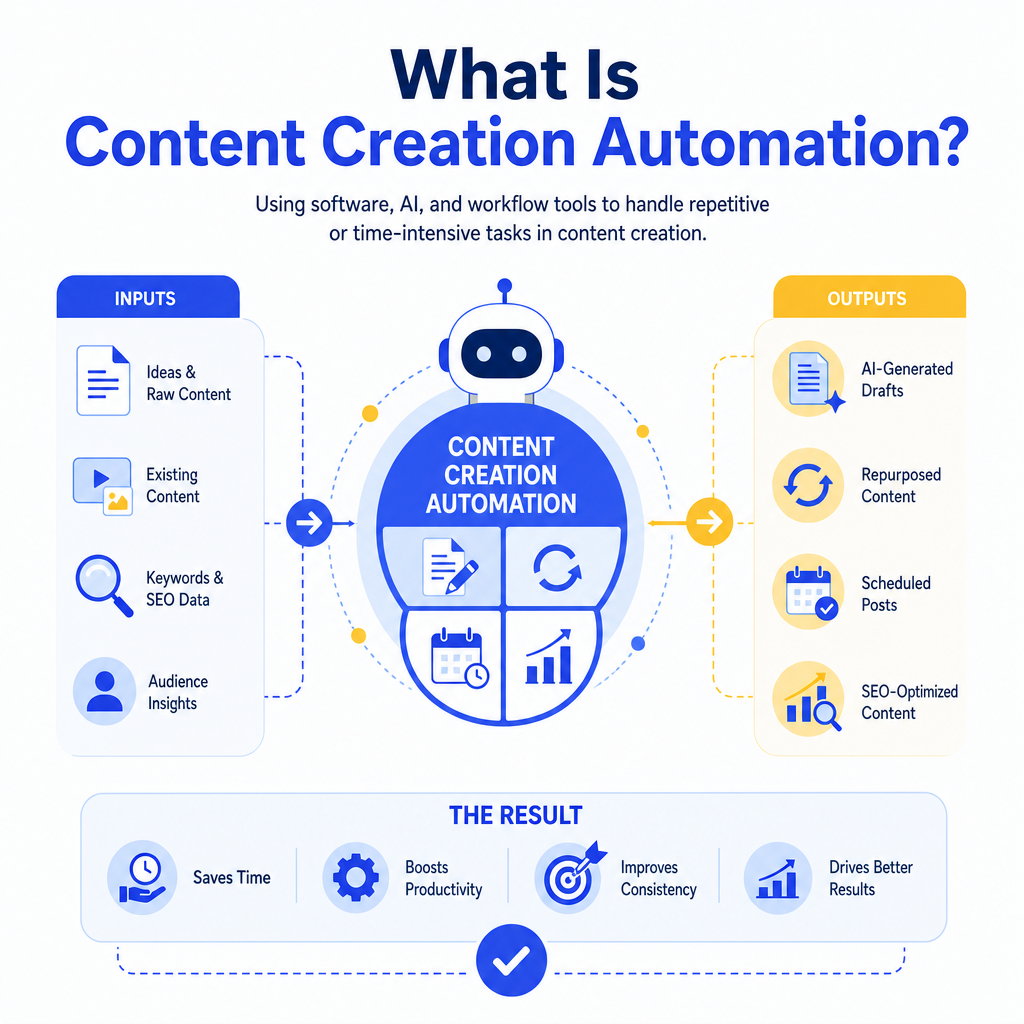
Content creation automation refers to the use of software, artificial intelligence, and workflow tools to handle repetitive or time-intensive tasks involved in producing content. This includes generating drafts, repurposing existing material, scheduling posts, optimizing for SEO, and even personalizing content for different audience segments.
It is important to clarify what automation does and does not mean in this context. Automation does not replace human creativity or strategic thinking. Instead, it handles the mechanical, repetitive parts of content production so that your team can focus on ideas, storytelling, and relationship building. Think of it as having a highly efficient assistant who never sleeps and never misses a deadline.
The scope of content creation automation has expanded dramatically. Early tools focused on simple social media scheduling. Today, platforms can generate full-length articles, produce video captions, write product descriptions in bulk, and adapt a single piece of content into formats suited for a dozen different channels.
Why Does Content Creation Automation Matter in 2026?
The demand for content has never been higher. Search engines reward websites that publish consistently. Social media algorithms favor accounts that post frequently. Email subscribers expect regular, relevant communication. Meeting all of these expectations manually is simply not sustainable for most teams.
Content creation automation addresses this challenge directly by increasing output without proportionally increasing cost or headcount. A marketing team of three people can now produce content at a volume that previously required a team of ten. This efficiency gain is not just about saving money. It also means faster response times to industry news, more consistent brand messaging, and better use of your most talented people.
Beyond volume, automation also improves accuracy and consistency. Automated tools can apply brand voice guidelines, check for grammar errors, insert relevant keywords, and format content according to your style guide every single time. Human writers have good days and bad days. A well-configured automation system delivers reliable results around the clock.
How Does Content Creation Automation Actually Work?
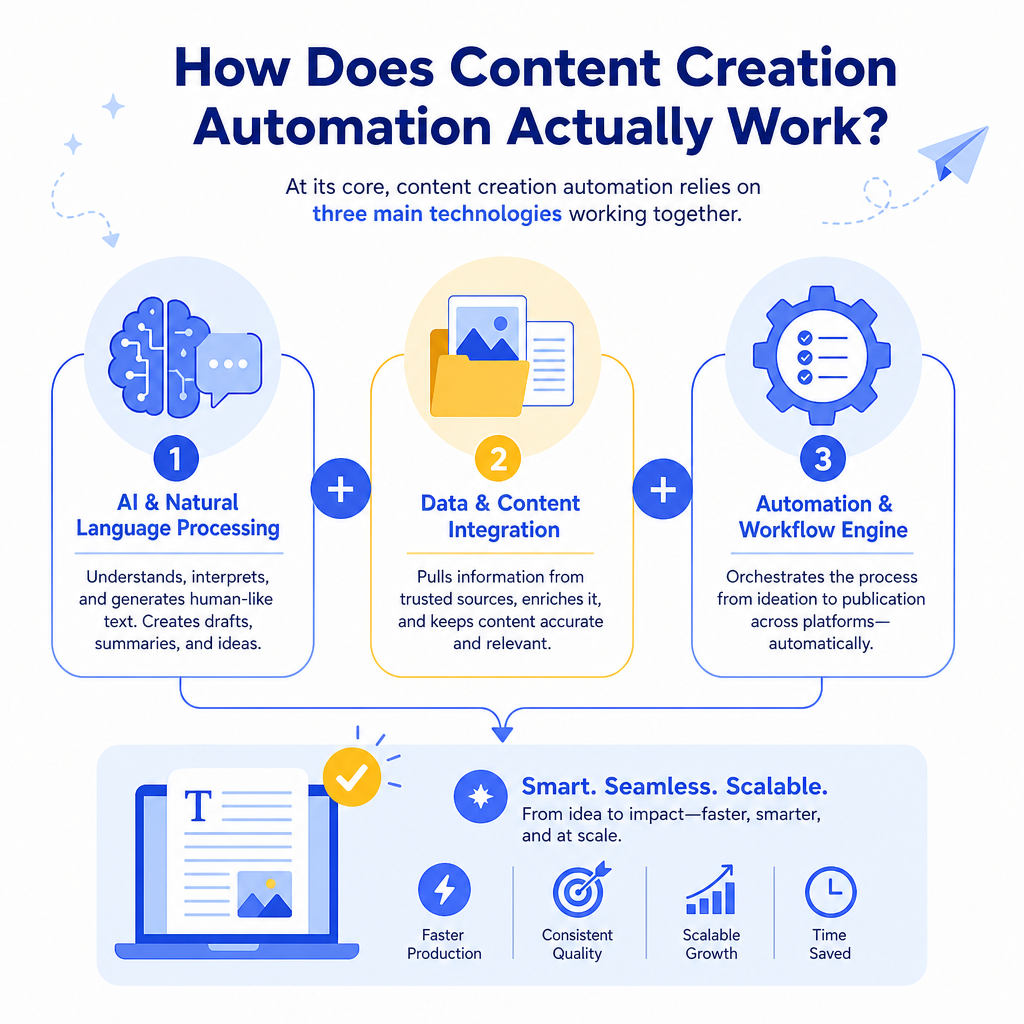
At its core, content creation automation relies on three main technologies working together.
Artificial Intelligence and Natural Language Processing (NLP): Modern AI models can read, understand, and generate human-like text. These models are trained on vast datasets and can produce drafts, summaries, headlines, and product descriptions based on simple prompts or structured inputs. Workflow Automation Platforms: Tools like Zapier, Make (formerly Integromat), and similar platforms connect different software applications. They trigger actions automatically, such as pulling a new product from your database and generating a description, then pushing that content to your website. Content Management Integrations: Most content creation automation tools integrate directly with popular CMS platforms, social media schedulers, and email marketing software. This means content can move from creation to publication without any manual copying or pasting.Together, these technologies create a pipeline where a single input (a topic, a product SKU, a data point) can generate multiple pieces of content across multiple channels with minimal human intervention.
Key Areas Where Content Creation Automation Delivers Results
How Can Automation Improve Blog and Article Production?
Blog content is one of the highest-impact areas for automation. AI writing assistants can generate research-backed outlines, draft full articles, and suggest internal linking opportunities. Your human writers then review, refine, and add unique insights before publication. This hybrid approach dramatically cuts writing time while preserving quality and originality.
Many teams use automation to handle the structural and technical parts of blogging, including meta descriptions, alt text for images, and header tag optimization. These tasks are important for SEO but time-consuming to do manually at scale.
What About Social Media Content?
Social media requires a constant stream of varied content. Automation tools can repurpose a single blog post into multiple social media formats. A 1,500-word article might automatically become five tweets, three LinkedIn updates, two Instagram captions, and a short video script. This kind of repurposing maximizes the value of every piece of content you create.
Scheduling tools then distribute this content at optimal times based on audience behavior data, removing the need for someone to manually post at 7:00 AM on a Tuesday.
Can Automation Help With Email Marketing Content?
Absolutely. Email automation goes beyond simply scheduling sends. Advanced platforms now use behavioral data to personalize email content dynamically. Subject lines, body copy, and calls-to-action can all vary based on subscriber preferences, past behavior, or purchase history. This level of personalization was once only possible for large enterprises with dedicated development teams. In 2026, it is accessible to businesses of all sizes.
Popular Content Creation Automation Tools Compared
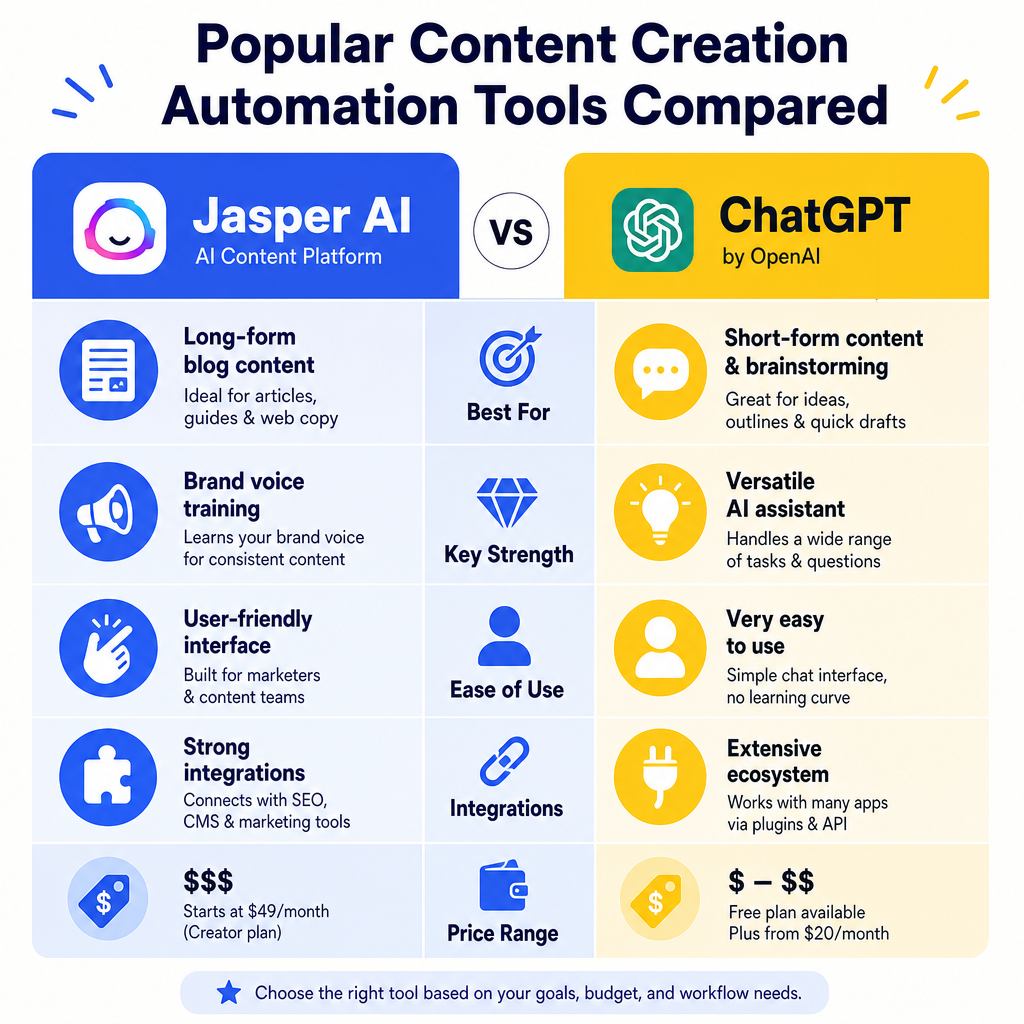
Choosing the right tools depends on your goals, budget, and technical capabilities. Here is a comparison of some leading platforms to help you make an informed decision.
| Tool | Best For | Key Strength | Price Range |
|---|---|---|---|
| Jasper AI | Long-form blog content | Brand voice training | Mid to High |
| Copy.ai | Marketing copy and ads | Speed and template variety | Low to Mid |
| Surfer SEO | SEO-optimized articles | Real-time SERP analysis | Mid |
| Buffer + AI | Social media content | Scheduling and repurposing | Low to Mid |
| HubSpot Content Hub | Full content marketing | CRM integration | Mid to High |
| Writesonic | E-commerce descriptions | Bulk content generation | Low to Mid |
How to Build a Content Creation Automation Strategy That Works
Step 1: Audit Your Current Content Workflow
Before automating anything, map out exactly how your content gets created today. Identify which tasks take the most time, which are most repetitive, and which require the highest level of human judgment. Tasks that are repetitive and rule-based are your best candidates for automation.
Step 2: Start Small and Scale Gradually
Trying to automate everything at once is a recipe for confusion and inconsistency. Start with one content type or one channel. Get the workflow running smoothly, measure the results, and then expand. Many successful teams begin with social media repurposing because it delivers quick wins without touching their core editorial process.
Step 3: Build in Human Review Checkpoints
Content creation automation works best when humans stay in the loop at key moments. Set up your workflows so that automated drafts are reviewed before publication. Over time, as you refine your prompts and configurations, you may reduce the review time needed. But removing human oversight entirely is rarely advisable, especially for content that represents your brand publicly.
Step 4: Measure Performance and Iterate
Automation creates a unique opportunity to test content at scale. Track which automated content formats, topics, and headlines perform best. Use that data to refine your prompts, templates, and distribution strategies. Content creation automation is not a set-it-and-forget-it solution. It is a system that improves with continuous attention and adjustment.
Common Mistakes to Avoid With Content Creation Automation
Even well-intentioned automation efforts can go wrong. Here are the most common pitfalls and how to avoid them.
- Over-automating without quality control: Publishing unreviewed AI-generated content can damage your brand reputation and hurt your search rankings if the content is inaccurate or generic.
- Ignoring audience feedback: Automation can make it easy to produce content in a vacuum. Keep monitoring comments, shares, and engagement to ensure your automated content resonates with real people.
- Neglecting brand voice consistency: Configure your tools with detailed brand voice guidelines. Without this, automated content can feel generic or off-brand.
- Failing to update your automation systems: AI tools and platforms update frequently. Regularly review your workflows to take advantage of new features and correct any issues that emerge over time.
- Treating automation as a cost-cutting shortcut: The best results come from using automation to amplify your team's capabilities, not to eliminate the human expertise that makes your content worth reading.
Conclusion
Content creation automation is one of the most powerful tools available to modern marketers, publishers, and business owners. When implemented thoughtfully, it allows you to produce more content, maintain higher consistency, and free your team to focus on the creative and strategic work that truly moves the needle.
The key takeaway from this guide is that automation works best as a partner to human creativity, not a replacement for it. Start by identifying the repetitive tasks in your current workflow, choose tools that fit your specific needs, and build in human review at the right moments. Measure your results, refine your approach, and scale what works.
If you are ready to take your content operation to the next level, start exploring content creation automation tools today. Even small steps toward automation can deliver significant results in a matter of weeks. Your audience is waiting for more great content, and automation can help you deliver it without burning out your team.
Frequently Asked Questions
No. Automation handles repetitive, mechanical tasks like scheduling and formatting, while humans focus on creativity, strategy, and storytelling. The best results come from a hybrid approach where AI generates drafts that humans refine and enhance.
The three core technologies are AI and Natural Language Processing (for generating text), workflow automation platforms like Zapier (for connecting apps and triggering actions), and CMS integrations (for moving content from creation to publication automatically).
A small team of three people can now produce content volume that previously required ten people. Automation increases output, improves consistency, ensures brand guidelines are applied, and reduces manual tasks like scheduling and formatting.
Blog articles, social media posts, email newsletters, product descriptions, video scripts, captions, meta descriptions, and more can all be automated or semi-automated. A single piece of content can be repurposed across multiple channels automatically.
When properly configured, automation improves SEO by ensuring consistent keyword optimization, proper formatting, and regular publishing schedules. Quality and engagement depend on human oversight—automation should enhance rather than replace editorial judgment.

Stefan Winter
Founder & SEO Expert
Founder of Fast SEO Fix and SEO automation expert. Stefan built Fast SEO Fix to solve the tedious problem of manual SEO work. He specializes in SEO optimized content generation, keyword research, and automated SEO strategies.
