What Is SEO Copywriting, and Why Should You Care?
Posted by
 Stefan Winter
How to Master SEO Copywriting and Turn Words Into Rankings
Every website owner wants the same thing: more traffic, more leads, and more conversions. But here is the reality, most websites struggle not because they lack a product or service worth promoting, but because their content fails to connect with both search engines and real human readers. That is where SEO copywriting comes in. It is the craft of writing content that ranks well in search results while simultaneously persuading visitors to take action. In this guide, you will learn exactly how to approach SEO copywriting in a way that drives measurable results, step by step.
What Is SEO Copywriting, and Why Should You Care?
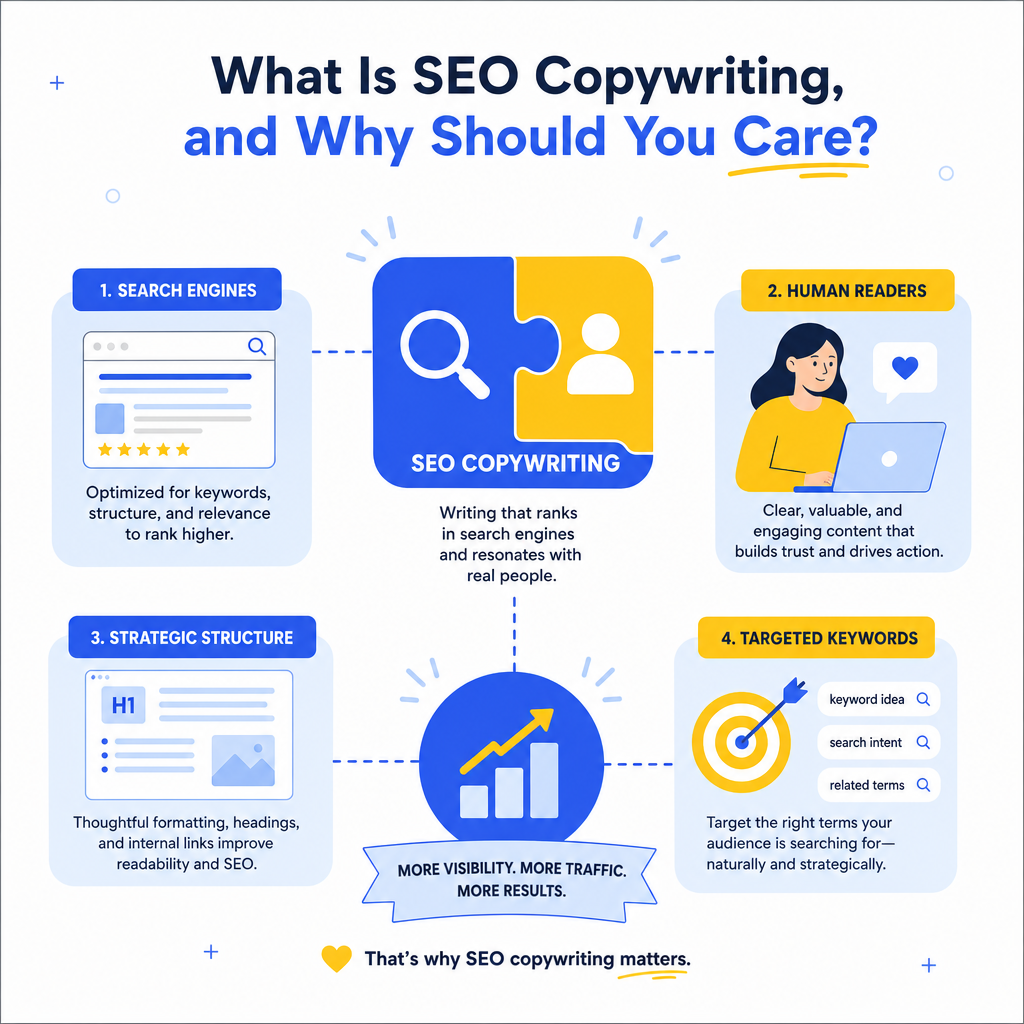
SEO copywriting is the practice of writing web content that satisfies two audiences at once: search engine algorithms and human readers. Unlike basic content writing, which focuses primarily on delivering information, SEO copywriting is intentionally structured to rank for specific keywords while moving readers toward a defined goal, whether that is signing up for a newsletter, making a purchase, or requesting a quote.
The distinction matters because writing for search engines alone produces robotic, keyword-stuffed content that drives visitors away. Writing purely for humans without considering search intent means your content may never be discovered in the first place. True SEO copywriting finds the balance between both, and that balance is what separates high-performing pages from those buried on page five of Google.
For a deeper look at how content writing fits into the broader SEO ecosystem, the What Is SEO Content Writing, and Why Does It Matter? guide on Fast SEO Fix covers the foundational concepts in detail.
Step 1: Research Your Keywords with Search Intent in Mind
Before you write a single word, you need to understand what your target audience is actually searching for. Keyword research is the foundation of effective SEO copywriting, but the goal is not just to find high-volume terms. You need to identify keywords that align with search intent, meaning what the searcher actually wants to accomplish.
There are four primary types of search intent:
- Informational: The user wants to learn something (for example, "how does SEO copywriting work")
- Navigational: The user is looking for a specific website or brand
- Commercial: The user is comparing options before making a decision (for example, "best SEO copywriting tools")
- Transactional: The user is ready to take action (for example, "hire SEO copywriter")
Step 2: Structure Your Copy for Both Scanners and Readers
Most web visitors do not read content word for word. They scan headings, bullet points, and bold text to decide whether a page is worth their time. Your job as an SEO copywriter is to make that scanning experience so compelling that visitors slow down and actually read.
How Should You Format SEO Copy?
Use a clear heading hierarchy with H1, H2, and H3 tags. Your H1 should contain your primary keyword and clearly communicate the page's value. H2s should break the content into logical sections, and H3s should support those sections with specific subtopics.
Beyond headings, keep paragraphs short (two to four sentences works well for web content). Use bullet points to break down lists, steps, or features. Bold key phrases that carry important meaning. White space is your friend because it makes content feel approachable rather than overwhelming.
Here is a quick reference table comparing strong and weak SEO copywriting practices:
| Element | Weak Practice | Strong Practice |
|---|---|---|
| Keyword usage | Stuffed repeatedly in every sentence | Naturally woven into headings and body text |
| Paragraph length | 8-10 sentences per paragraph | 2-4 sentences per paragraph |
| Headings | Vague or generic titles | Keyword-rich, descriptive, and specific |
| Call-to-action | "Click here" | "Download your free SEO checklist today" |
| Meta description | Left blank or auto-generated | Manually written with primary keyword and clear benefit |
| Internal links | None or irrelevant | Contextually placed links to related content |
Step 3: Write a Compelling Headline That Earns the Click

Your headline is the most important line of copy you will write. It appears in search results, on social media, and at the top of your page. A weak headline means fewer clicks, and fewer clicks signal to search engines that your content is not worth ranking highly.
Strong SEO headlines typically include the primary keyword near the beginning, communicate a clear benefit or outcome, and create enough curiosity to earn the click. Numbers, questions, and power words (like "proven," "simple," or "essential") consistently outperform vague or generic titles.
According to research published by the Nielsen Norman Group, users spend a significant portion of their time reading only the first few words of a headline before deciding whether to continue. This reinforces why front-loading your keyword and benefit into the headline is a non-negotiable SEO copywriting skill.
Step 4: Optimize Your On-Page Elements Without Overdoing It
SEO copywriting extends beyond the body text. Every on-page element contributes to how search engines interpret and rank your content.
Which On-Page Elements Matter Most?
- Title tag: Should be 50-60 characters, include your primary keyword, and communicate value
- Meta description: Should be 150-160 characters, include the keyword naturally, and include a soft call-to-action
- URL slug: Keep it short, descriptive, and keyword-focused (avoid dates or random numbers)
- Image alt text: Describe the image accurately and include a keyword where it fits naturally
- First paragraph: Introduce your primary keyword within the first 100 words of body copy
Step 5: Write Copy That Converts, Not Just Copy That Ranks
Ranking on page one means nothing if visitors land on your page and immediately leave. This is where the "copywriting" half of SEO copywriting becomes critical. Great SEO copy does not just inform, it persuades.
Use these conversion-focused techniques throughout your content:
- Address pain points early: Acknowledge the problem your reader is facing before presenting your solution
- Use social proof: Reference statistics, case studies, or testimonials to build credibility
- Create urgency where appropriate: Time-sensitive offers or limited availability can motivate action
- Write clear calls-to-action: Every page should have at least one specific next step for the reader to take
- Speak directly to the reader: Use "you" and "your" to create a personal, conversational tone
Step 6: Optimize for Featured Snippets and AI-Powered Search
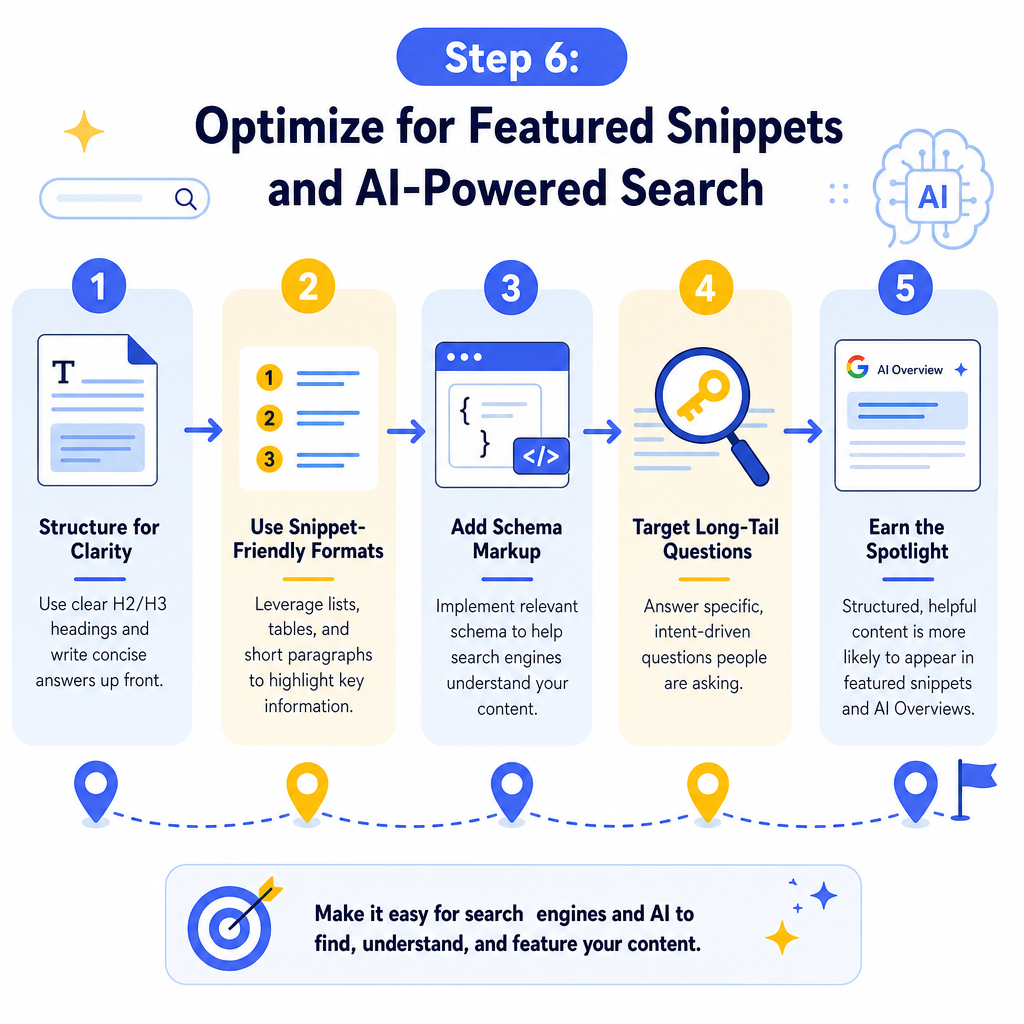
Search behavior has shifted considerably in 2026. AI-powered search results, including Google's AI Overviews and other large language model (LLM) integrations, now pull answers directly from web pages. To appear in these featured positions, your SEO copy needs to be structured in a way that makes it easy for both humans and AI to extract clear, concise answers.
How Do You Write for Featured Snippets?
- Answer questions directly and concisely, ideally within 40-60 words
- Use question-based headings (like the ones in this guide) to signal that you are addressing specific queries
- Include definition-style paragraphs that begin with "X is..." or "X refers to..."
- Use numbered lists for step-by-step processes and bullet points for feature lists
- Ensure your content is factually accurate and cites authoritative sources
Step 7: Edit, Test, and Refine Your Copy Over Time
Even the best SEO copywriters treat their first draft as a starting point, not a finished product. After writing, review your content with fresh eyes and ask whether each paragraph earns its place on the page. Cut anything that does not serve the reader or support the page's goal.
Beyond initial editing, use analytics to track how your copy performs. Monitor metrics like time on page, bounce rate, scroll depth, and conversion rate. If visitors are leaving quickly, your introduction may not be compelling enough. If they are reading but not converting, your call-to-action may need work. SEO copywriting is an iterative process, and the data will always tell you where to improve.
According to the Content Marketing Institute's research on content performance, brands that regularly audit and update their existing content see significantly stronger long-term organic traffic growth compared to those that only publish new content.
Conclusion
SEO copywriting is one of the most valuable skills in digital marketing today. It requires an understanding of search intent, keyword strategy, on-page optimization, persuasive writing, and content structure, all working together in service of a single goal: connecting the right reader with the right content at the right moment.
The steps outlined in this guide give you a practical framework to start applying SEO copywriting principles immediately. Begin with thorough keyword research, structure your content for both scanners and readers, optimize every on-page element, and always write with conversion in mind. Then refine based on real performance data.
If you are ready to put these principles into action, Fast SEO Fix is here to help. Explore our resources, implement what you have learned today, and watch your content start earning the rankings and results it deserves.

Stefan Winter
Founder & SEO Expert
Founder of Fast SEO Fix and SEO automation expert. Stefan built Fast SEO Fix to solve the tedious problem of manual SEO work. He specializes in SEO optimized content generation, keyword research, and automated SEO strategies.
