The Complete Guide to Content Optimization: Strategies That Drive Real Results in 2026
Posted by
 Stefan Winter
TL;DR
Content optimization in 2026 goes far beyond keyword stuffing—it requires matching search intent, demonstrating topical authority, and creating genuinely valuable content that serves both search engines and human readers. By focusing on comprehensive coverage, proper on-page elements, and ongoing refinement, you can build sustainable organic traffic that compounds over time.
The Complete Guide to Content Optimization: Strategies That Drive Real Results in 2026
If you have ever published a piece of content and watched it disappear into the void of search engine results pages, you are not alone. Millions of articles, blog posts, and web pages go live every single day, and most of them never reach the audience they were created for. The difference between content that ranks and content that gets ignored often comes down to one critical discipline: content optimization. This guide walks you through everything you need to know about optimizing your content for search engines, human readers, and the increasingly sophisticated AI-driven discovery tools shaping the digital landscape in 2026.
What Is Content Optimization?
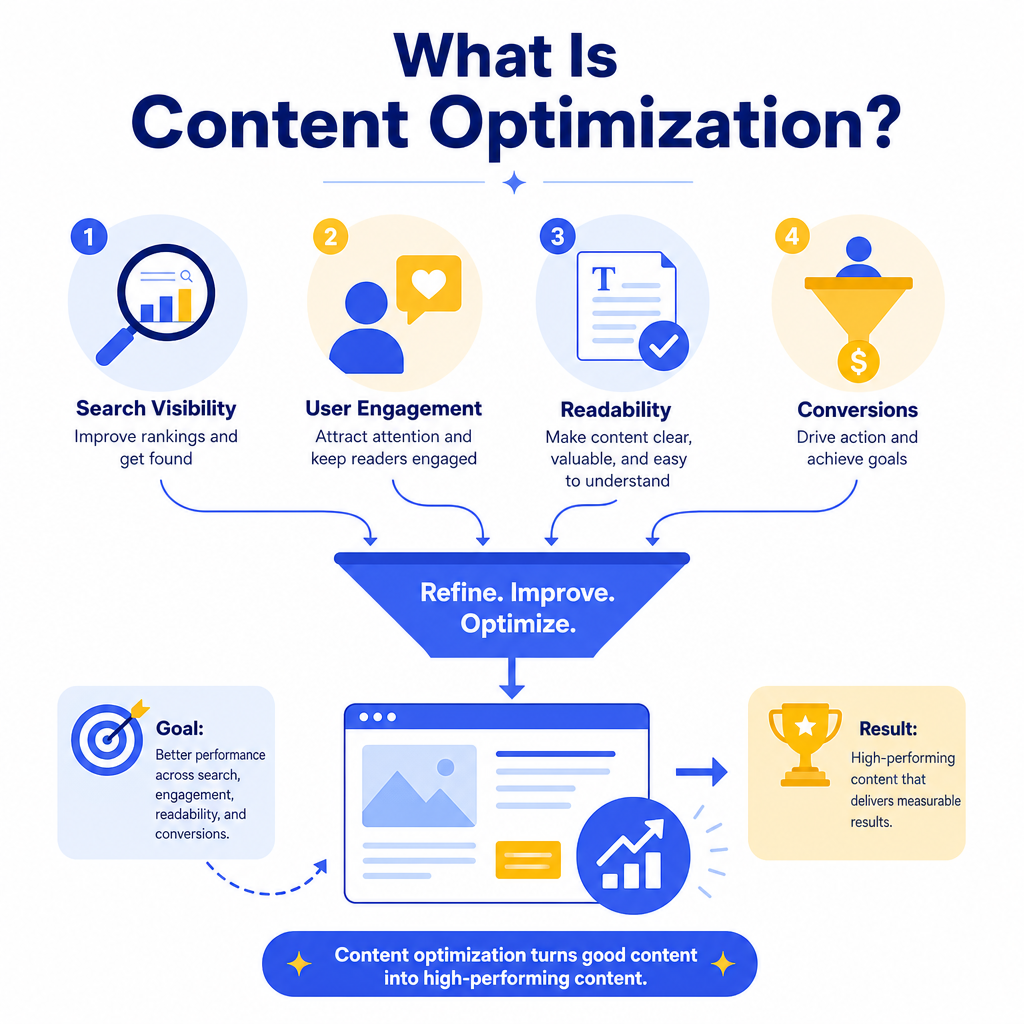
Content optimization is the process of refining and improving digital content so that it performs better across multiple dimensions, including search engine rankings, user engagement, readability, and conversion rates. It goes far beyond simply inserting keywords into a paragraph. True content optimization considers the full experience a reader has when they encounter your material, from the moment they see your headline in a search result to the action they take after reading your final sentence.
In 2026, content optimization has evolved significantly. Search engines now use advanced natural language processing and machine learning models to evaluate content quality in ways that were not possible just a few years ago. This means that keyword stuffing and other outdated tactics actively hurt your performance. Modern content optimization is about demonstrating genuine expertise, answering real questions thoroughly, and creating material that people actually want to read and share.
Understanding content optimization also means recognizing that it is not a one-time task. It is an ongoing process of analysis, adjustment, and improvement. Content that performs well today may need updates six months from now as search trends shift, competitors publish new material, and user behavior evolves.
Why Does Content Optimization Matter?
Is Content Optimization Worth the Effort?
Absolutely. The return on investment for well-optimized content is among the highest of any digital marketing activity. Organic search traffic is sustainable, compounds over time, and does not require continuous advertising spend to maintain. A single well-optimized article can generate traffic and leads for years after it is published.
Beyond search traffic, optimized content builds trust and authority with your audience. When readers find content that thoroughly answers their questions, addresses their concerns, and provides genuine value, they are more likely to return to your site, share your material, and ultimately convert into customers or loyal followers. Content optimization is the foundation of a sustainable content marketing strategy.
How Do You Optimize Content for Search Engines?
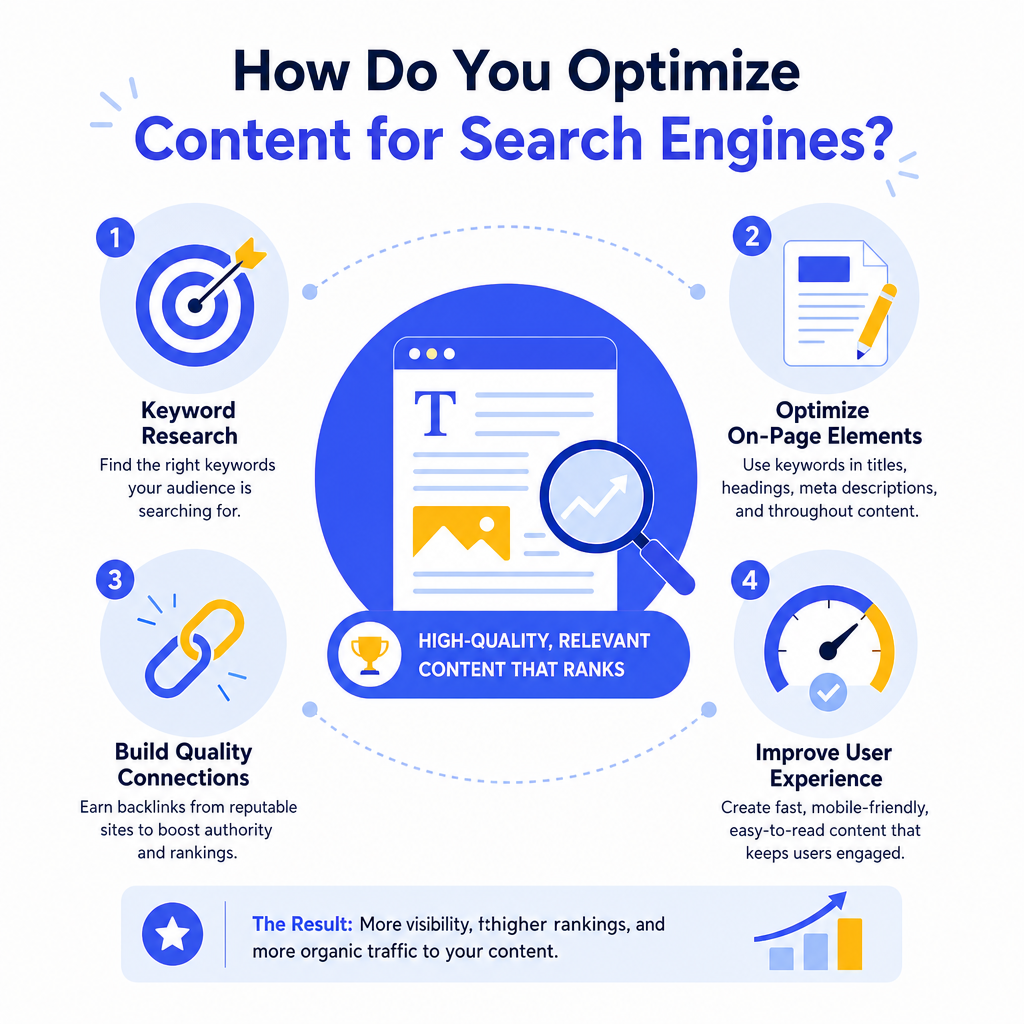
Optimizing content for search engines involves several interconnected elements that work together to signal quality and relevance. Here is a breakdown of the core components.
Keyword Research and Intent Matching
Before you write a single word, you need to understand what your target audience is searching for and, more importantly, why they are searching for it. Keyword research in 2026 is less about finding high-volume terms and more about understanding search intent. There are four primary types of search intent to consider:
- Informational intent: The user wants to learn something ("how does content optimization work")
- Navigational intent: The user is looking for a specific site or resource
- Commercial intent: The user is comparing options before making a decision
- Transactional intent: The user is ready to take action or make a purchase
On-Page Optimization Elements
Once you have your keyword strategy in place, on-page optimization ensures that search engines can correctly understand and categorize your content. Key on-page elements include:
- Title tags: Keep them under 60 characters and include your primary keyword naturally
- Meta descriptions: Write compelling summaries of 150 to 160 characters that encourage clicks
- Header hierarchy: Use H1 for your main title, H2 for major sections, and H3 for subsections
- Internal linking: Connect related content across your site to build topical authority
- Image alt text: Describe images accurately using relevant keywords where appropriate
- URL structure: Keep URLs short, descriptive, and keyword-rich
Content Depth and Topical Authority
Search engines in 2026 reward content that demonstrates comprehensive knowledge of a subject. This means covering your topic thoroughly, addressing related subtopics, and answering the questions your audience is most likely to have. Building topical authority requires publishing a cluster of related content pieces that collectively cover a subject from multiple angles.
Content Optimization Best Practices for 2026
The following table summarizes key content optimization factors and their relative impact on performance, helping you prioritize your efforts effectively.
| Optimization Factor | Impact Level | Primary Benefit | Difficulty |
|---|---|---|---|
| Search intent alignment | Very High | Improves ranking relevance | Medium |
| Content depth and comprehensiveness | Very High | Builds topical authority | High |
| Readability and structure | High | Reduces bounce rate | Low |
| Internal linking | High | Distributes page authority | Low |
| Core Web Vitals (page speed) | High | Improves user experience | Medium |
| Keyword placement and density | Medium | Signals topic relevance | Low |
| Image optimization | Medium | Improves load time and accessibility | Low |
| Schema markup | Medium | Enables rich search results | High |
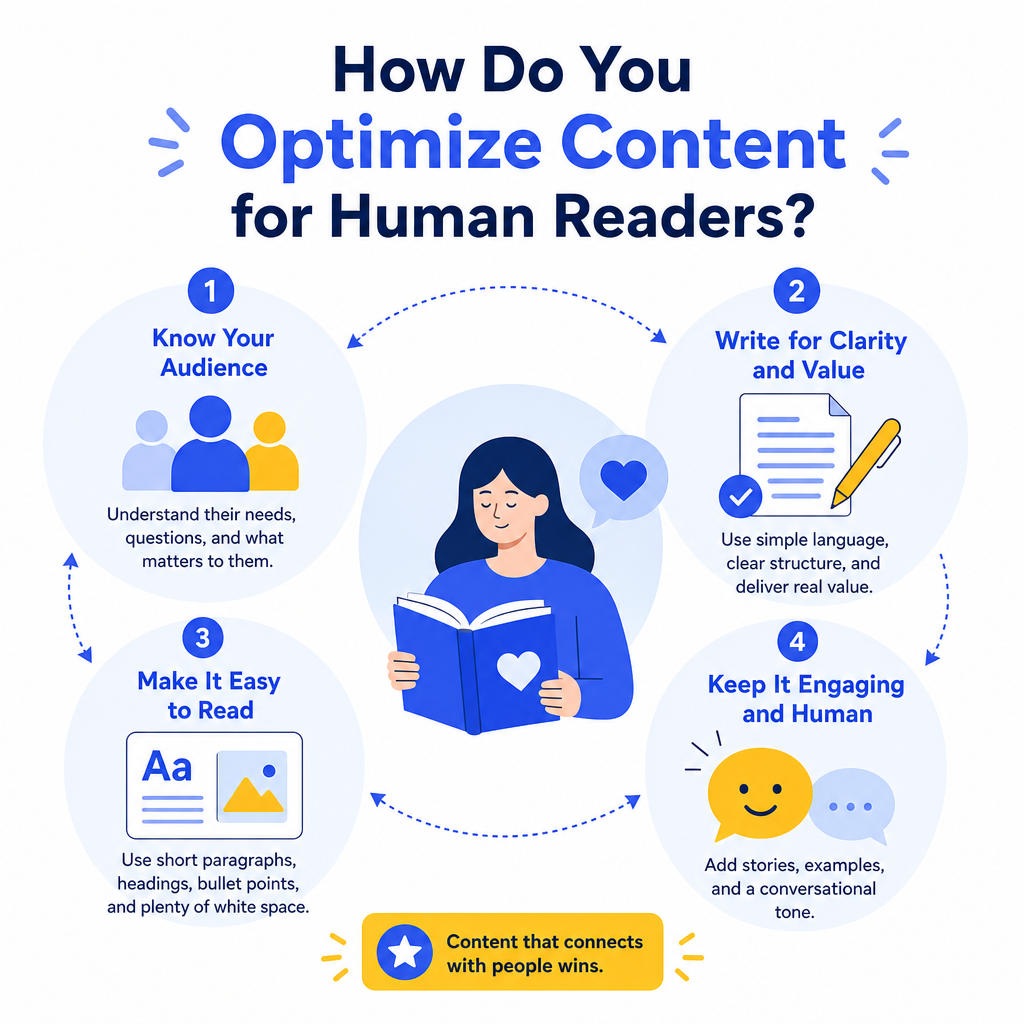
How Do You Optimize Content for Human Readers?
What Makes Content Genuinely Readable?
Search engine optimization and human-centered writing are not opposing forces. In fact, the best-performing content in 2026 succeeds precisely because it serves both audiences well. Readable content shares several characteristics:
- Short paragraphs: Aim for three to four sentences per paragraph to improve visual flow
- Active voice: Active constructions are more direct and energetic than passive ones
- Transition sentences: Guide readers naturally from one idea to the next
- Concrete examples: Abstract concepts become memorable when illustrated with real scenarios
- Scannable structure: Use headers, bullet points, and bold text to help readers find what they need quickly
How Should You Structure Your Content for Maximum Engagement?
Structure your content with the reader's journey in mind. Start with a hook that establishes relevance and promises value. Move into the core information in a logical sequence that builds understanding progressively. Use your conclusion to reinforce key takeaways and prompt the reader toward a meaningful next step.
Front-loading your most important information is particularly effective for search traffic. Many readers arrive at your content looking for a specific answer. If they find it quickly, they are more likely to trust you for deeper reading. If they have to scroll endlessly before reaching the point, they will leave.
Measuring and Improving Your Content Optimization Efforts
How Do You Know If Your Content Is Optimized Enough?
Optimization without measurement is guesswork. The following metrics provide a clear picture of how your content is performing:
- Organic search traffic: Are people finding your content through search engines?
- Average position: Where does your content rank for its target keywords?
- Click-through rate (CTR): Are searchers choosing your result over competitors?
- Bounce rate: Are visitors engaging with your content or leaving immediately?
- Time on page: Are readers consuming your content thoroughly?
- Conversions: Is your content driving the actions that matter to your business?
The Content Refresh Strategy
One of the most underutilized content optimization tactics is refreshing existing content. Updating older articles with new information, improved structure, and additional depth can significantly boost their performance without requiring you to create something from scratch. Prioritize refreshing content that ranks on page two of search results, since these pieces are closest to breaking through to meaningful visibility.
Conclusion
Content optimization is not a single technique or a quick fix. It is a disciplined, ongoing commitment to creating material that serves your audience better than anything else available on the subject. By aligning your content with search intent, building topical depth, prioritizing readability, and measuring your results consistently, you position yourself to earn sustainable organic traffic and genuine audience trust in 2026 and beyond.
The brands and creators that win in today's content landscape are those who treat optimization as a core competency rather than an afterthought. Start by auditing your existing content using the metrics and principles outlined in this guide. Identify your highest-potential pieces, apply the optimization strategies that will have the greatest impact, and build a regular review process into your content workflow. Your audience is out there searching for exactly what you have to offer. Content optimization is how you make sure they find it.
Frequently Asked Questions
Content optimization is a core component of SEO that focuses specifically on refining and improving digital content across multiple dimensions including search rankings, engagement, and readability. SEO is the broader discipline that encompasses content optimization, technical optimization, link building, and other strategies to improve visibility.
No. Keyword stuffing actively hurts your performance in 2026 because modern search engines use advanced natural language processing to detect and penalize this outdated tactic. Instead, focus on naturally incorporating keywords while prioritizing genuine expertise and thorough answers to user questions.
Search intent is critically important—it's one of the most impactful optimization efforts you can make. Matching your content format and depth to the correct intent (informational, navigational, commercial, or transactional) ensures you're providing exactly what users are looking for, improving both rankings and engagement.
Results vary depending on competition and domain authority, but well-optimized content typically begins generating meaningful organic traffic within 3-6 months. The key advantage is that optimized content compounds over time, continuing to generate traffic and leads for years after publication.
Topical authority means publishing a cluster of related content pieces that collectively demonstrate comprehensive knowledge of a subject from multiple angles. Search engines in 2026 reward this approach because it signals genuine expertise and helps users find thorough answers to their questions.

Stefan Winter
Founder & SEO Expert
Founder of Fast SEO Fix and SEO automation expert. Stefan built Fast SEO Fix to solve the tedious problem of manual SEO work. He specializes in SEO optimized content generation, keyword research, and automated SEO strategies.
