What Is Search Engine Marketing, and Why Does It Matter in 2026?
Posted by
 Stefan Winter
How to Build a Search Engine Marketing Strategy That Actually Drives Results
Search engine marketing is one of the most direct paths to getting your business in front of people who are already looking for what you offer. Unlike social media or display advertising, SEM puts your message at the exact moment of intent, when a user types a query and expects an answer. But running paid search campaigns without a clear strategy is like driving with no destination in mind. You burn budget, collect clicks that go nowhere, and wonder why the results never match the investment. This guide walks you through how to build a search engine marketing strategy from the ground up, with practical steps you can apply right away.
What Is Search Engine Marketing, and Why Does It Matter in 2026?
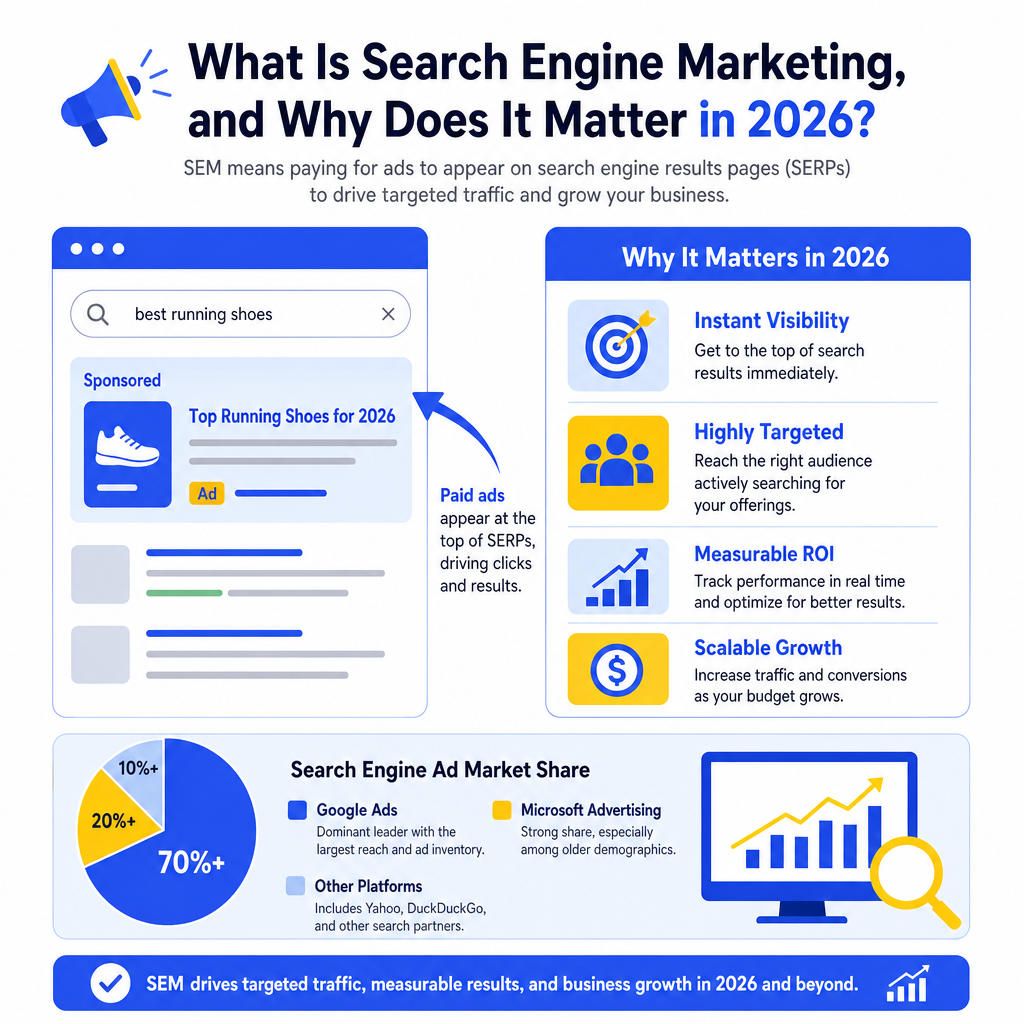
Search engine marketing (SEM) refers to the practice of gaining website traffic by purchasing ads that appear on search engine results pages (SERPs). Google Ads is the dominant platform, but Bing Ads (now Microsoft Advertising) holds a significant share of the market, particularly among older demographics and B2B audiences.
The reason SEM matters more than ever in 2026 is simple: search behavior has not slowed down. According to Statista's data on global search engine usage, Google processes billions of queries every single day. Even capturing a small fraction of relevant searches in your niche can translate into meaningful revenue.
SEM is also measurable in ways that traditional advertising never was. You can see exactly how much each click costs, which keywords convert, and what your return on ad spend looks like in real time. That level of transparency is what makes it such a powerful tool for businesses of all sizes.
Step 1: Define Your Goals Before You Spend a Single Dollar
Every effective SEM campaign begins with a clear objective. Without one, you have no way to measure success or make informed optimizations.
Ask yourself these questions before opening your ad platform:
- Are you trying to generate leads, drive e-commerce sales, or build brand awareness?
- What is your target cost per acquisition (CPA)?
- What does your conversion funnel look like from click to close?
- How much budget can you realistically allocate per month?
Step 2: Conduct Thorough Keyword Research
Keyword research is the foundation of any SEM campaign. Choosing the wrong keywords means paying for clicks that will never convert.
What Types of Keywords Should You Target?
There are three main keyword match types you will work with in platforms like Google Ads:
| Match Type | How It Works | Best For |
|---|---|---|
| Broad Match | Ads show for related searches, synonyms, and variations | Brand awareness, discovery |
| Phrase Match | Ads show when the search contains your phrase in order | Balanced reach and relevance |
| Exact Match | Ads show only for the precise keyword or close variants | High-intent, conversion-focused campaigns |
How Do You Find the Right Keywords?
Start with tools like Google Keyword Planner, which is free to use with a Google Ads account. Look for keywords that combine reasonable search volume with manageable competition. High-volume, highly competitive keywords are often dominated by large brands with deep pockets. Long-tail keywords, those with three or more words, tend to have lower competition and higher purchase intent.
Also pay attention to negative keywords. Adding terms like "free," "DIY," or competitor brand names (if irrelevant to your offering) to your negative keyword list prevents your ads from showing to users who are unlikely to convert.
Step 3: Build Tightly Themed Ad Groups
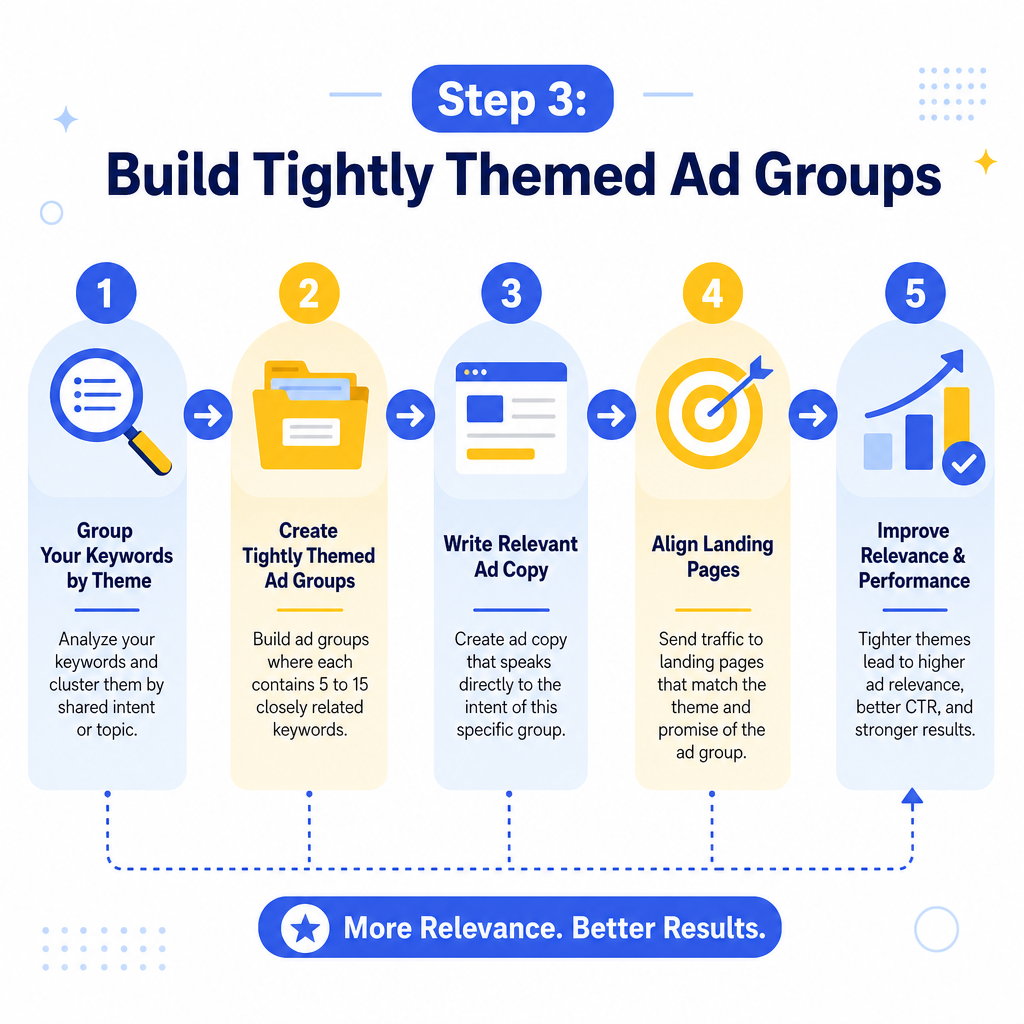
One of the most common SEM mistakes is cramming dozens of keywords into a single ad group. This approach makes it nearly impossible to write ad copy that speaks directly to each keyword's intent.
Instead, organize your campaign into tightly themed ad groups where each group contains five to fifteen closely related keywords. This structure allows you to write highly relevant ads for each theme, which improves your Quality Score. A higher Quality Score means Google rewards you with lower cost-per-click and better ad placement, making your budget work harder.
For example, if you run a digital marketing agency, you might have separate ad groups for "SEO services," "PPC management," and "content marketing," each with tailored ad copy that matches what users in that group are searching for.
Step 4: Write Ad Copy That Earns the Click
Your ad copy is the first impression users have of your brand. You have limited space to communicate value, so every word needs to pull its weight.
Effective SEM ad copy typically includes:
- A headline that mirrors the user's search intent
- A clear value proposition that differentiates you from competitors
- A specific call to action (Get a Free Quote, Start Your Trial, Shop Now)
- Ad extensions such as sitelinks, callouts, and structured snippets to add context and increase click-through rate
Step 5: Optimize Your Landing Pages for Conversion
Getting the click is only half the battle. If your landing page does not deliver on the promise your ad made, users will bounce and you will have wasted your spend.
Your landing page should:
- Match the message and offer in your ad (this is called message match)
- Load in under three seconds on mobile and desktop
- Feature a single, clear call to action above the fold
- Include trust signals such as testimonials, certifications, or case studies
- Remove navigation links that could distract users from converting
Step 6: Set Up Conversion Tracking and Analytics
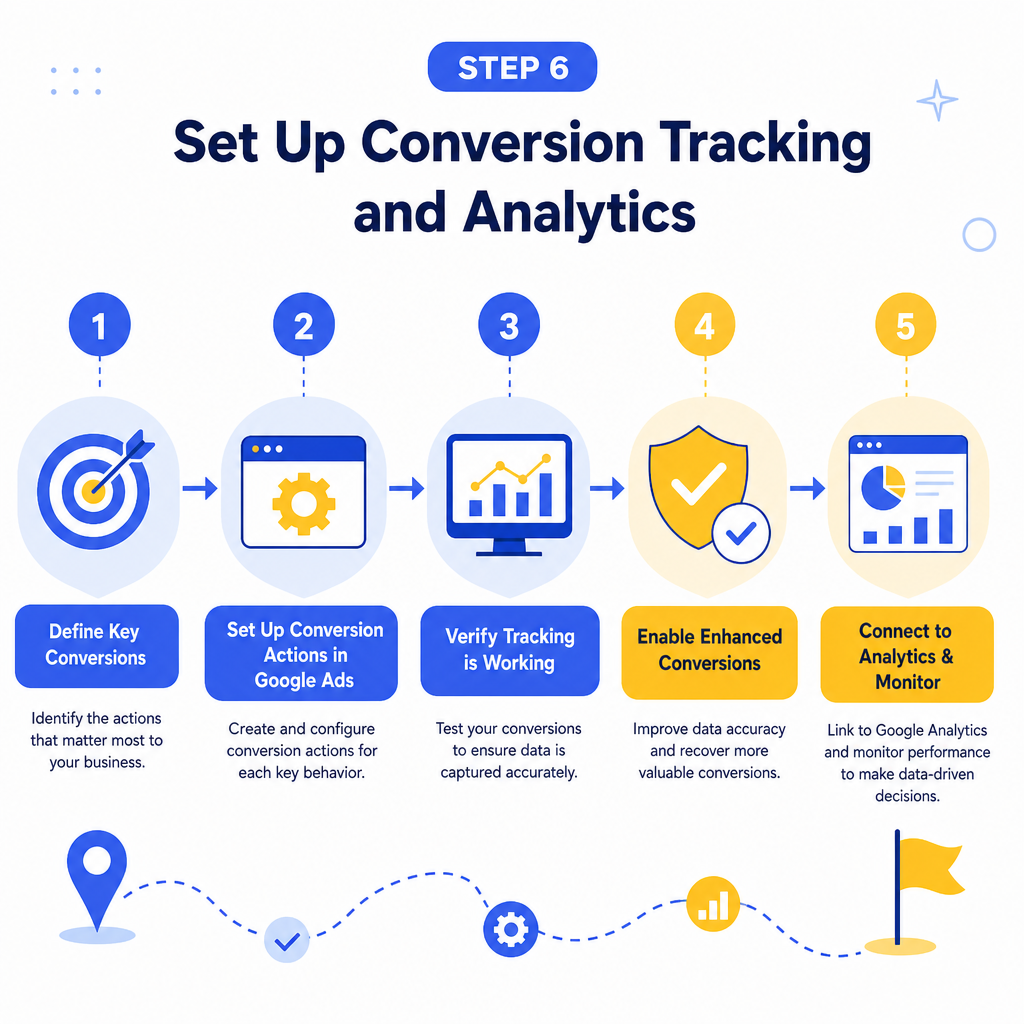
You cannot optimize what you cannot measure. Before your campaigns go live, make sure conversion tracking is properly configured.
In Google Ads, this means setting up conversion actions for the specific behaviors that matter to your business, whether that is a form submission, a phone call, a purchase, or a page visit. Connect your Google Ads account to Google Analytics 4 for deeper insight into user behavior after the click.
According to Google's own recommendations for campaign measurement, proper conversion tracking is essential for smart bidding strategies to function correctly. Without it, automated bidding has no signal to optimize toward, and your campaigns will underperform.
Step 7: Monitor, Test, and Refine Continuously
SEM is not a set-it-and-forget-it channel. The campaigns that deliver the best long-term results are the ones that receive consistent attention and iterative testing.
Build a regular optimization rhythm into your workflow:
- Review search term reports weekly to identify new negative keywords
- Test at least two ad variations per ad group at all times
- Adjust bids based on device, location, time of day, and audience performance
- Pause underperforming keywords and reallocate budget to top performers
- Experiment with ad extensions to find combinations that lift click-through rate
How Does SEM Fit Into a Broader Digital Marketing Strategy?
SEM works best when it is part of a coordinated approach rather than a standalone tactic. Paid search can drive immediate traffic while your organic SEO efforts build momentum over time. Content marketing supports both channels by creating assets that improve Quality Score, generate backlinks, and nurture leads through the funnel.
If you are thinking about how to turn that traffic into revenue once it arrives, exploring what monetizing traffic actually means for your business model is a logical next step. The mechanics of SEM are straightforward, but the strategy behind it connects to your entire growth model.
For businesses with limited time and resources, WordStream's PPC University offers a solid library of free resources to deepen your understanding of paid search fundamentals.
Conclusion
Search engine marketing gives you a direct line to high-intent audiences at the exact moment they are ready to act. But that opportunity only pays off when you approach it with structure and discipline. Define your goals clearly, research your keywords carefully, build tightly organized campaigns, write copy that earns attention, and optimize relentlessly based on real data.
The steps outlined in this guide are not theoretical. They are the same practices that separate campaigns with a positive return on ad spend from those that drain budgets with little to show for it. Start with one campaign, master the fundamentals, and scale from there. The investment in getting SEM right is one of the most reliable ways to grow your business online in 2026 and beyond.
Ready to sharpen your overall digital presence alongside your paid campaigns? Explore more practical guides at Fast SEO Fix and start building a search strategy that works on every front.

Stefan Winter
Founder & SEO Expert
Founder of Fast SEO Fix and SEO automation expert. Stefan built Fast SEO Fix to solve the tedious problem of manual SEO work. He specializes in SEO optimized content generation, keyword research, and automated SEO strategies.
