The Complete Guide to How to Structure a Blog Post for SEO
Posted by
 Stefan Winter
TL;DR
Structuring a blog post for SEO means organizing content with a clear hierarchy of headings, strategic keyword placement, and reader-friendly formatting that satisfies both search engines and human readers. Following a proven framework—H1 title, introduction, H2/H3 sections, and conclusion—signals relevance to Google while making your content easy to scan and navigate.
The Complete Guide to How to Structure a Blog Post for SEO

If you have ever published a blog post that received almost no traffic, you are not alone. Many writers produce genuinely helpful content that never gets discovered simply because the structure is working against them. Learning how to structure a blog post for SEO is one of the highest-leverage skills any content creator can develop in 2026. It is not just about sprinkling keywords into paragraphs. It is about organizing your ideas in a way that satisfies both search engine crawlers and real human readers at the same time. In this complete guide, you will learn the exact framework professionals use to build blog posts that rank, engage, and convert.
Why Does Blog Post Structure Matter for SEO?
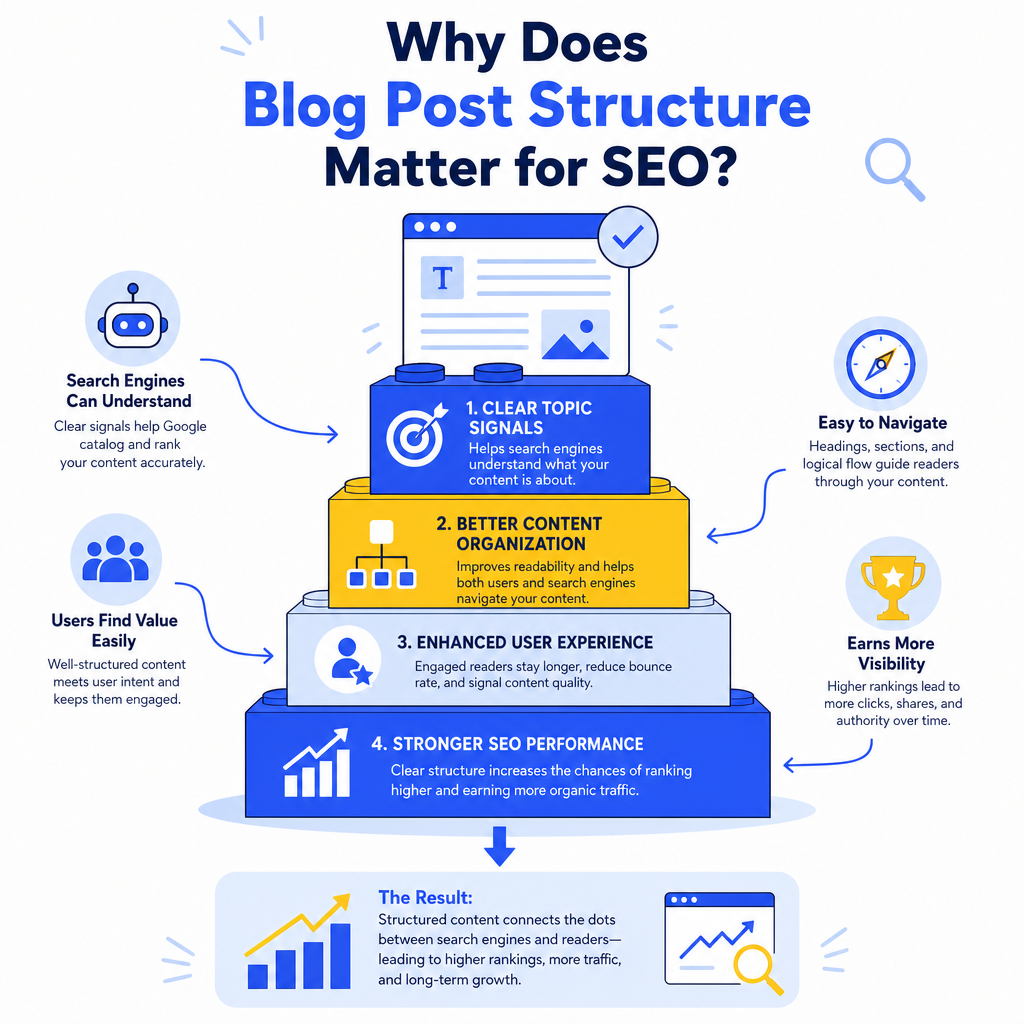
Before diving into the tactical steps, it helps to understand why structure carries so much weight in search engine optimization. Google's ranking algorithms have grown remarkably sophisticated, but they still rely on clear signals to understand what a page is about and how useful it is to readers.
A well-structured blog post sends multiple positive signals at once. It tells search engines which topics are primary and which are secondary. It reduces bounce rates by making content easy to scan. It also increases the time readers spend on your page, which is a behavioral signal that search engines interpret as a sign of quality.
Beyond algorithms, structure serves your readers directly. People rarely read blog posts word for word. They scan headings, glance at bullet points, and look for the specific answer they came for. When your post is organized logically, readers find what they need quickly, trust your content more, and are far more likely to share it or return to your site.
What Is the Ideal Structure for an SEO Blog Post?
The ideal structure follows a hierarchy that mirrors how both humans and search engines process information. Think of it as a pyramid: broad context at the top, specific details below, and a clear conclusion at the base.
Here is the foundational framework every SEO-optimized blog post should follow:
- Title (H1): One clear, keyword-rich headline that appears once on the page
- Introduction: A short, engaging opening that states the problem and promises a solution
- Body Sections (H2 headings): Major topic areas that support the main subject
- Subsections (H3 headings): Deeper dives into specific points within each H2 section
- Conclusion: A summary with a clear call-to-action
- Meta elements: Title tag, meta description, and URL slug optimized for the target keyword
How to Write an SEO-Optimized Title and Introduction
What Makes a Strong H1 Title?
Your H1 title is the single most important on-page SEO element after the content itself. It should include your primary keyword naturally, ideally near the beginning of the title. It should also be specific enough to match search intent without being so narrow that it limits your audience.
Avoid stuffing multiple keywords into the title. One well-placed primary keyword with a compelling angle performs far better than a title that reads like a list of search terms. For example, "How to Structure a Blog Post for SEO: A Complete Guide" is clear, keyword-rich, and gives the reader an immediate sense of value.
How Should You Write the Introduction?
Your introduction has one job: convince the reader to keep reading. Open with a relatable problem, a surprising statistic, or a bold statement that speaks directly to your target audience's frustration or goal. Within the first two to three sentences, the reader should feel that you understand their situation.
After the hook, briefly explain what the post will cover and what the reader will gain by finishing it. Weave your primary keyword into the introduction naturally, ideally within the first 100 words. This placement helps search engines confirm relevance without making the text feel forced.
How to Use Headings and Subheadings Effectively
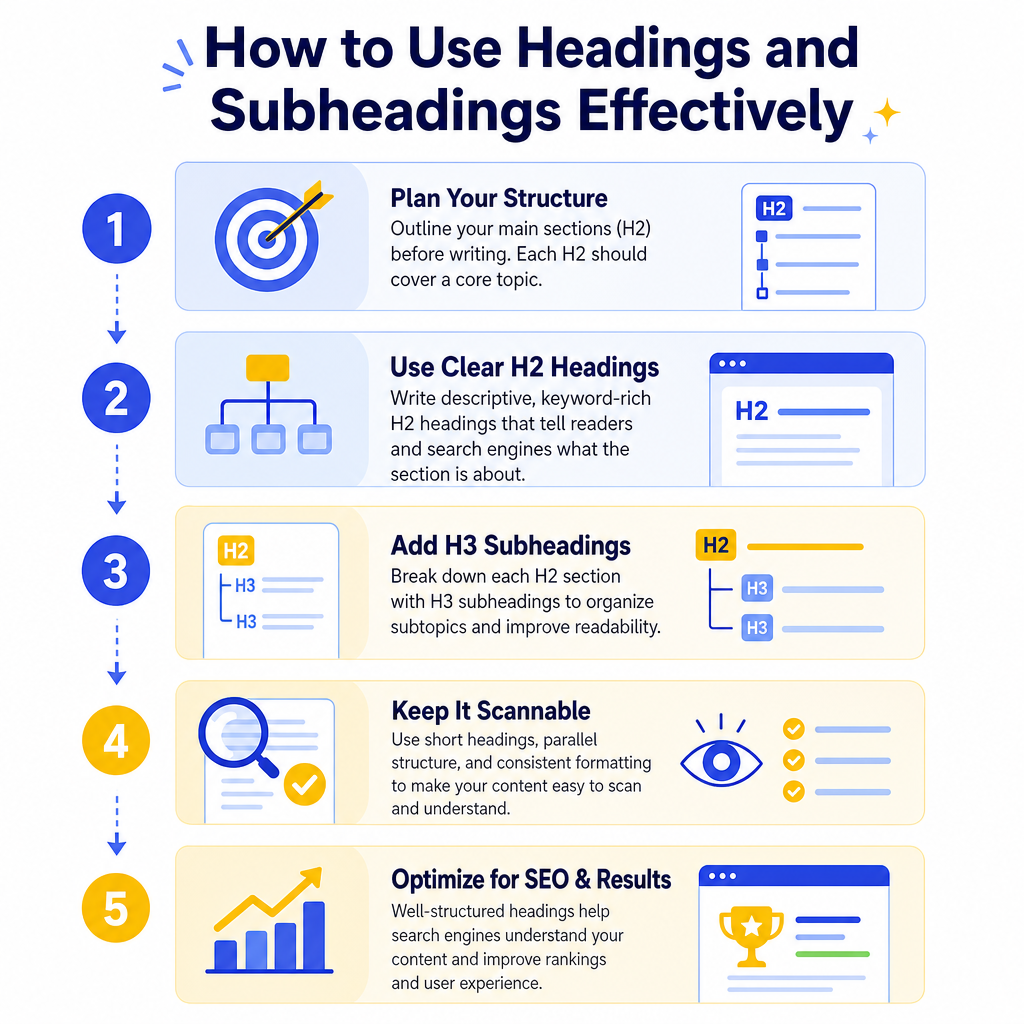
Headings are the skeleton of your blog post. They provide structure for search engines and navigation for readers. Using them correctly is one of the most impactful things you can do when learning how to structure a blog post for SEO.
Use H2 headings for your main sections. Each H2 should represent a distinct subtopic that supports your overall subject. Use H3 headings to break down complex points within an H2 section. In most cases, you will not need to go deeper than H3 for a standard blog post.
A practical tip is to write your headings before you write the body content. Treat them like an outline. If your headings tell a coherent story on their own, your post has a solid structure. If they feel random or disconnected, reorganize before you start filling in the paragraphs.
Keyword Placement: Where and How Often?
Keyword placement is about balance. You want search engines to recognize your topic clearly, but you also want your writing to feel natural and authoritative to human readers.
Here is a practical breakdown of where to place your primary keyword:
- In the H1 title
- Within the first 100 words of the introduction
- In at least one H2 subheading
- Naturally throughout the body (roughly every 200 to 300 words)
- In the meta title and meta description
- In the URL slug
Content Formatting Best Practices for SEO
Beyond headings and keywords, the visual formatting of your post plays a direct role in SEO performance. Well-formatted content is easier to read, which keeps readers on your page longer and signals quality to search engines.
Use short paragraphs. Aim for three to five sentences per paragraph. Long blocks of text are visually intimidating and cause readers to abandon the page. Break up complex information with bullet points or numbered lists. Use bold text sparingly to highlight truly critical points, not just for decoration.
Images, charts, and tables also contribute to structure. They provide visual relief, break up long sections, and can themselves be optimized with descriptive alt text that includes relevant keywords.
SEO Blog Post Structure at a Glance
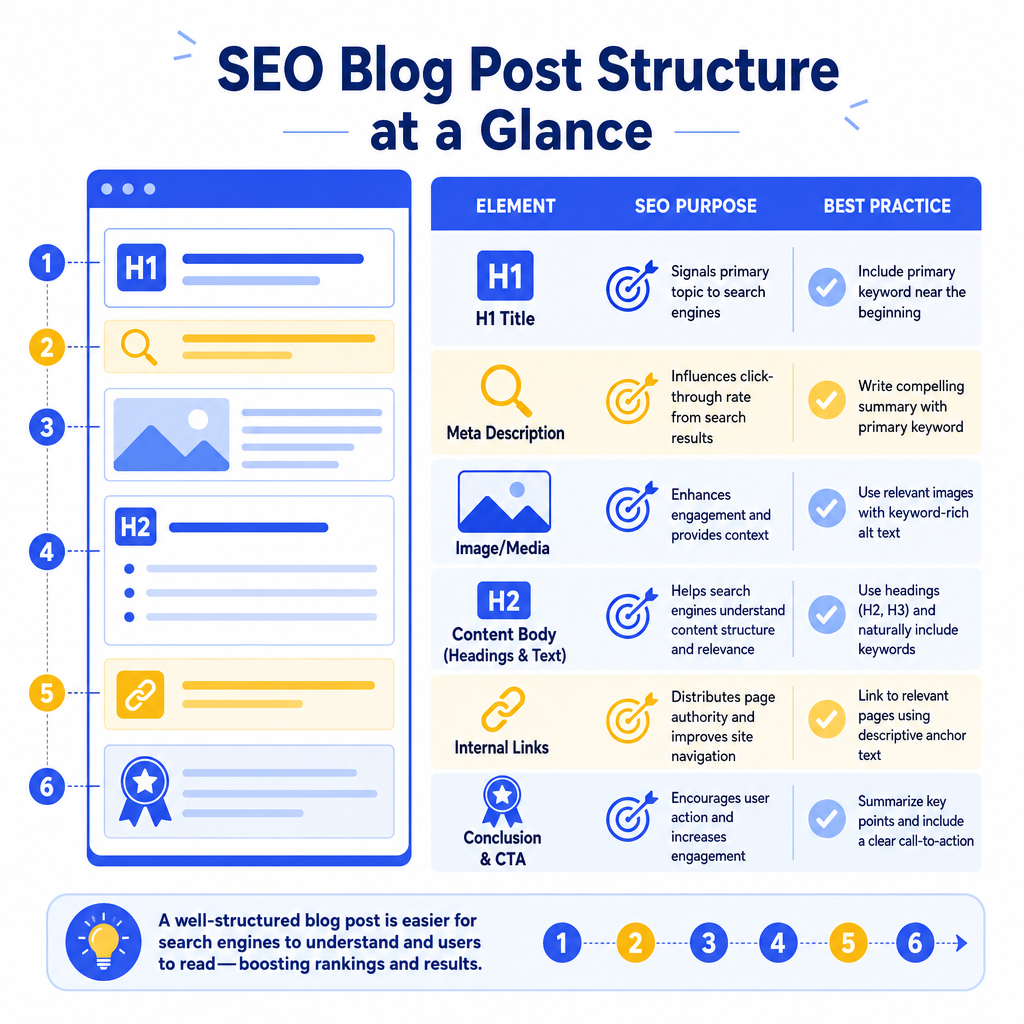
The table below summarizes the key structural elements of an SEO-optimized blog post, their purpose, and best practices for each.
| Structural Element | SEO Purpose | Best Practice |
|---|---|---|
| H1 Title | Signals primary topic to search engines | Include primary keyword near the beginning |
| Introduction | Establishes relevance and reduces bounce rate | Hook the reader, include keyword in first 100 words |
| H2 Headings | Organizes major subtopics | Use keyword variations naturally |
| H3 Subheadings | Adds depth and scannability | Break down complex H2 points |
| Body Paragraphs | Delivers value and keyword context | Keep paragraphs short (3-5 sentences) |
| Internal Links | Builds site authority and keeps readers engaged | Link to 2-4 relevant posts per article |
| Meta Title and Description | Controls how the post appears in search results | Stay within character limits, include keyword |
| URL Slug | Helps search engines understand page topic | Use keyword, keep it short and readable |
How Long Should an SEO Blog Post Be?
Word count is a common source of confusion. The honest answer is that the right length depends on the topic and the competition. For most informational topics in 2026, posts between 1,200 and 2,500 words tend to perform well. However, length should always serve the reader, not a target number.
A post that answers the reader's question thoroughly in 1,000 words is more valuable than a padded 3,000-word post that repeats itself. Use tools like Google Search Console and competitor analysis to gauge what length is performing well for your specific keyword. Then aim to match or slightly exceed that depth while adding genuine value that competitors have missed.
Internal Linking and Content Depth
Internal linking is one of the most underused structural tools in SEO. When you link from one blog post to another relevant post on your site, you help search engines understand the relationships between your content and distribute authority across your pages.
As you structure your blog post, look for natural opportunities to reference other posts you have written. A good rule of thumb is to include two to four internal links per post. Make sure the anchor text (the clickable words) is descriptive and relevant, not generic phrases like "click here."
Content depth also matters. A post that covers a topic from multiple angles, addresses common questions, and anticipates follow-up queries will consistently outperform a shallow post targeting the same keyword. Structure your post so that it answers the primary question and then naturally leads into related questions the reader is likely to have next.
Conclusion
Mastering how to structure a blog post for SEO is not a one-time task. It is a skill you refine with every post you publish. The framework covered in this guide gives you a reliable starting point: a clear H1 title, an engaging introduction, well-organized H2 and H3 headings, strategic keyword placement, and clean formatting that serves your readers first.
Start by auditing one of your existing posts using the table in this guide as a checklist. Identify which structural elements are missing or weak, then make targeted improvements. You may be surprised how much organic traffic a few structural adjustments can unlock. If you are starting a new post, build the outline before you write a single paragraph. Structure is the foundation everything else rests on, and a strong foundation makes every other SEO effort more effective.
Ready to put this into practice? Pick one blog post today, apply this framework, and watch how your traffic responds over the next 60 to 90 days.
Frequently Asked Questions
A well-structured post sends clear signals to search engines about your content's topic and quality, reduces bounce rates by improving scannability, and increases time-on-page—all factors that boost rankings. It also helps readers find answers quickly, increasing trust and shareability.
The ideal structure includes an H1 title, engaging introduction, H2 sections for main topics, H3 subsections for deeper details, a conclusion with a call-to-action, and optimized meta elements. This hierarchy mirrors how both search engines and humans process information.
Place your primary keyword in the H1 title, within the first 100 words of the introduction, in at least one H2 heading, naturally throughout the body every 200-300 words, and in the meta title and URL slug. Avoid keyword stuffing; prioritize natural readability.
Write headings first and treat them as an outline. If your headings tell a coherent story on their own, your post has solid structure. This approach ensures logical organization before you invest time in writing body paragraphs.
A strong H1 title includes your primary keyword naturally near the beginning, is specific enough to match search intent, and provides a compelling angle that conveys value. Avoid stuffing multiple keywords; one well-placed keyword outperforms keyword-heavy titles.

Stefan Winter
Founder & SEO Expert
Founder of Fast SEO Fix and SEO automation expert. Stefan built Fast SEO Fix to solve the tedious problem of manual SEO work. He specializes in SEO optimized content generation, keyword research, and automated SEO strategies.
