What Is Content Marketing Software, and Why Does It Matter?
Posted by
 Stefan Winter
TL;DR
Content marketing software helps teams plan, create, publish, and measure content at scale, but choosing the right tool requires auditing your workflow first and evaluating platforms against your specific needs rather than chasing features. The key is understanding which category of software solves your actual bottlenecks—whether that's editorial planning, SEO optimization, AI writing assistance, distribution, or analytics—and ensuring it integrates cleanly with your existing tech stack.
How to Choose and Use Content Marketing Software That Actually Drives Results

If you have ever stared at a blank content calendar wondering how to scale your output without sacrificing quality, you are not alone. Content marketing software promises to solve that problem, but the market is crowded, the feature lists are overwhelming, and the wrong choice can cost you both time and money. This guide walks you through exactly how to evaluate, select, and implement content marketing software so that every piece of content you publish works harder for your business.
---
What Is Content Marketing Software, and Why Does It Matter?

Before diving into the how-to steps, it helps to get clear on what we are actually talking about.
What is content marketing software?Content marketing software is a category of digital tools designed to help teams plan, create, publish, distribute, and measure content at scale. It covers everything from editorial calendars and AI writing assistants to SEO optimization plugins and analytics dashboards. Some platforms bundle all of these features into one workspace. Others specialize in a single function and integrate with the rest of your stack.
The reason this matters in 2026 is simple: the volume of content required to stay competitive has grown dramatically, while audiences have become far more selective about what they actually engage with. Generic, rushed content no longer cuts it. You need a system that helps your team produce targeted, well-researched, and properly optimized content consistently. Without the right software supporting that process, you are essentially trying to win a marathon in dress shoes.
---
Step 1: Audit Your Current Content Workflow Before You Buy Anything
The biggest mistake teams make is purchasing software before they understand their own process. Shiny features are easy to get excited about, but they only add value if they solve a real problem in your workflow.
Start by mapping out every step your content takes from idea to published post. Where do delays happen? Where does quality slip? Where are team members duplicating effort? Common pain points include:
- No centralized place to track content ideas and assignments
- Inconsistent keyword research practices across writers
- Publishing without proper on-page SEO checks
- No system for repurposing or updating older content
- Difficulty measuring which content actually contributes to traffic or conversions
---
Step 2: Understand the Core Categories of Content Marketing Software
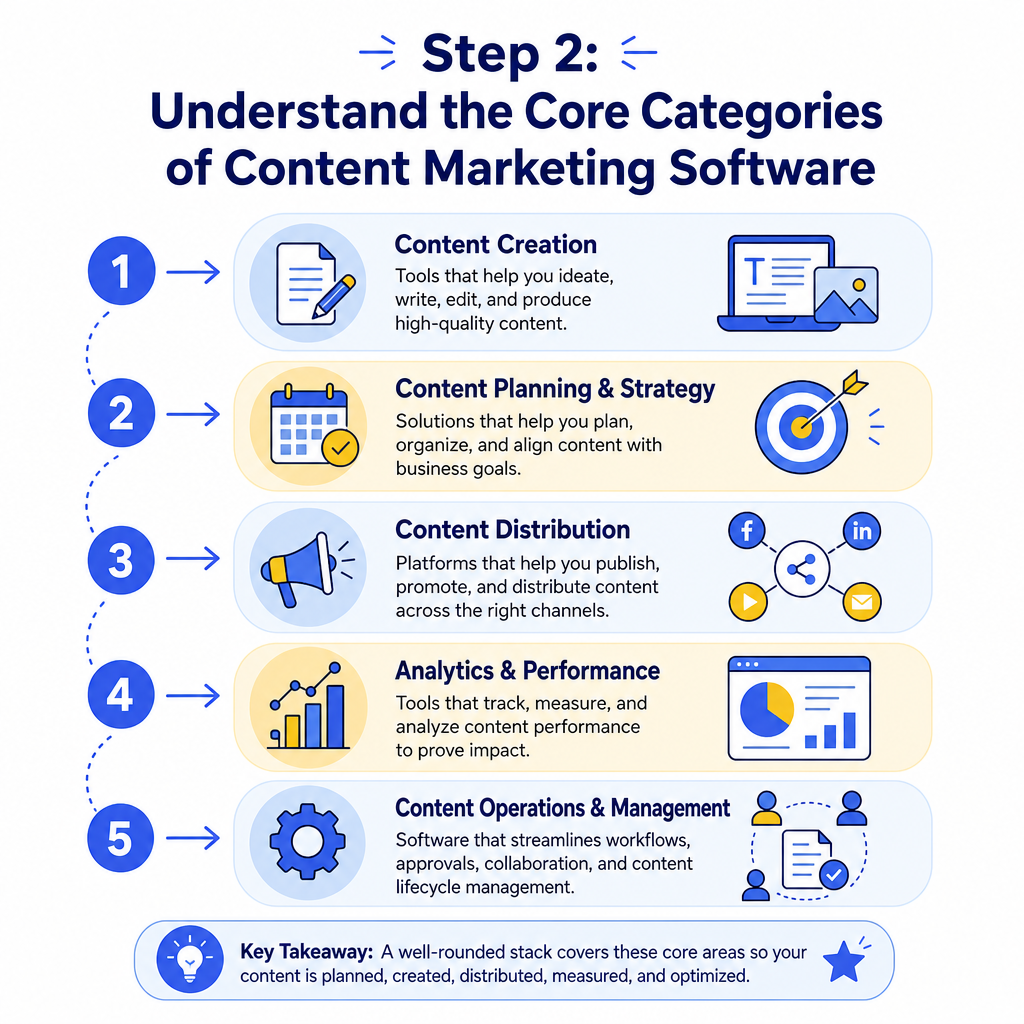
Not all content marketing tools do the same thing. Understanding the main categories helps you build a stack that covers your needs without paying for redundant features.
What Are the Main Types of Content Marketing Software?
| Category | Primary Function | Best For |
|---|---|---|
| Content Planning Tools | Editorial calendars, topic ideation, workflow management | Teams managing multiple writers or channels |
| SEO Content Platforms | Keyword research, content briefs, optimization scoring | Writers who need SEO guidance built into their process |
| AI Writing Assistants | Draft generation, rewriting, headline suggestions | Teams looking to speed up first-draft production |
| Content Distribution Tools | Social scheduling, email integration, syndication | Brands publishing across multiple channels |
| Analytics and Reporting | Traffic tracking, engagement metrics, conversion attribution | Marketers who need to prove content ROI |
| Content Audit Software | Inventory tracking, gap identification, refresh recommendations | Teams managing large existing content libraries |
---
Step 3: Evaluate Software Against These Non-Negotiable Criteria
Once you know what category or categories you need, the next step is narrowing down specific tools. Here is a practical evaluation framework to apply to any platform you are considering.
Does it support your SEO workflow?Content marketing without SEO is just publishing. The software you choose should either have native SEO features or integrate cleanly with dedicated SEO tools. Look for keyword suggestion capabilities, readability scoring, internal linking prompts, and content brief generation. According to the Content Marketing Institute's annual research, organizations that document their content strategy and use supporting technology consistently outperform those that do not.
How steep is the learning curve?A tool your team does not use is worse than no tool at all. During any free trial period, have actual writers and editors test the platform, not just the manager who made the purchase decision. Pay attention to how quickly they can complete real tasks without needing to watch tutorials.
Does it scale with your team?Look at seat pricing, collaboration features, and permission levels. A tool that works beautifully for a two-person team can become a bottleneck when you add freelancers, agency partners, or multiple internal departments.
What does the integration ecosystem look like?Your content marketing software needs to talk to your CMS, your analytics platform, and ideally your CRM. Check the native integrations list carefully. Zapier workarounds can fill gaps, but they add complexity and potential failure points.
---
Step 4: Build Your Content Marketing Tech Stack Intentionally

Rather than adopting every tool that promises results, build your stack with intention. A lean, well-integrated stack almost always outperforms a bloated one.
A practical starting point for most content teams in 2026 looks something like this:
- Planning layer: A project management tool with editorial calendar functionality (Notion, Asana, or a dedicated content planner like CoSchedule)
- Research and optimization layer: An SEO platform that supports keyword research and content briefs
- Creation layer: Your preferred writing environment with AI assistance where appropriate
- Distribution layer: A social and email scheduler
- Measurement layer: Google Analytics 4 or a comparable analytics platform connected to your content URLs
Understanding how automation fits into this picture is also worth exploring. Our breakdown of blogger automation and how it fits into a content workflow covers how to use automation without losing the human quality that search engines and readers both reward.
---
Step 5: Set Up Your Software for SEO-Driven Content Production
Having the right tools is only half the job. How you configure and use them determines whether you see results.
Create content brief templates inside your platform. Every piece of content should start with a brief that includes the target keyword, secondary keywords, search intent, recommended word count, internal linking opportunities, and a rough outline. Most content planning tools allow you to build reusable templates for this. Integrate keyword data into your editorial calendar. Rather than treating keyword research as a separate step that happens before planning, connect your SEO platform to your planning tool so that keyword difficulty, search volume, and opportunity scores are visible alongside each content assignment. Use content scoring features consistently. Many SEO content platforms provide an optimization score as you write. Train your team to treat a minimum score as a publishing requirement, not a suggestion. According to Semrush's State of Content Marketing report, content that is properly optimized for search intent generates significantly more organic traffic than content that relies on volume alone. Schedule regular content reviews. Set a recurring task in your project management tool to review content that is six months or older. Use your analytics data to identify pieces that have dropped in traffic and flag them for updates. This is where having a content audit layer in your stack pays off significantly.---
Step 6: Measure What Matters and Iterate
Content marketing software should make measurement easier, not just generate more dashboards to ignore.
What metrics should you actually track?Focus on metrics that connect content to business outcomes rather than vanity numbers. Useful signals include:
- Organic search traffic per piece of content
- Keyword ranking positions over time
- Time on page and scroll depth (engagement quality indicators)
- Conversion events attributed to content (form fills, demo requests, purchases)
- Content production velocity (how many pieces your team publishes per week or month)
For teams that want to go deeper on identifying content gaps and opportunities, understanding keyword gap analysis can reveal where competitors are capturing traffic that your content strategy has not yet addressed.
---
Conclusion
Choosing and implementing content marketing software is not a one-time decision. It is an ongoing process of matching tools to your team's evolving needs, building habits around the features that drive results, and measuring performance honestly enough to keep improving.
The steps in this guide give you a practical framework: audit your workflow first, understand the software categories available, evaluate tools against real criteria, build a lean and integrated stack, configure it for SEO-driven production, and measure outcomes that actually connect to business goals.
The right content marketing software does not replace strategy or creativity. It creates the conditions for both to thrive consistently. If you are ready to take your content operation from reactive to systematic, start with Step 1 today. Map your current workflow, identify your biggest bottleneck, and let that finding drive every tool decision that follows.
---
Frequently Asked Questions
Content marketing software is a digital tool or suite of tools designed to help teams plan, create, publish, distribute, and measure content at scale. It can include editorial calendars, AI writing assistants, SEO optimization plugins, social scheduling, and analytics dashboards, either bundled together or as specialized single-function platforms.
While spreadsheets can work for very small teams, content marketing software becomes essential as your output scales. It prevents bottlenecks, ensures consistency, enables collaboration, and provides data-driven insights that spreadsheets cannot. The volume and selectivity of modern audiences make systematic, optimized content production nearly impossible without proper tools.
First, audit your current content workflow to identify real pain points and bottlenecks. Map out every step from idea to publication, note where delays and quality issues occur, and understand what problems you actually need to solve. This prevents you from buying impressive features that don't address your actual needs.
The main categories are content planning tools (editorial calendars and workflow management), SEO content platforms (keyword research and optimization), AI writing assistants (draft generation), content distribution tools (social scheduling), analytics and reporting platforms, and content audit software. Most teams use a combination of two to three categories.
Evaluate tools based on whether they support your SEO workflow, how steep the learning curve is, if they scale with your team size, and what integrations they offer with your existing tech stack. Have actual writers and editors test the platform during free trials rather than relying solely on manager evaluation.

Stefan Winter
Founder & SEO Expert
Founder of Fast SEO Fix and SEO automation expert. Stefan built Fast SEO Fix to solve the tedious problem of manual SEO work. He specializes in SEO optimized content generation, keyword research, and automated SEO strategies.
