What Is Content Length, and Why Does It Matter for SEO?
Posted by
 Stefan Winter
TL;DR
Content length matters for SEO because longer, comprehensive content tends to rank better and earn more backlinks, but only when it genuinely adds value. The ideal length varies by content type and search intent—informational blog posts typically perform best at 1,500-2,500 words, while product pages need only 300-600 words.
How to Choose the Right Content Length for SEO Success
Every time you sit down to write a blog post, article, or landing page, one question quietly lingers in the background: how long should this actually be? Content length is one of the most debated topics in SEO, and for good reason. Get it right, and your content ranks well, keeps readers engaged, and drives conversions. Get it wrong, and you either bore your audience with unnecessary filler or leave them wanting more because you cut things short.
In this guide, you will learn exactly how to determine the ideal content length for different content types, what the research says about word count and rankings, and how to make every word count toward your SEO goals in 2026.
What Is Content Length, and Why Does It Matter for SEO?
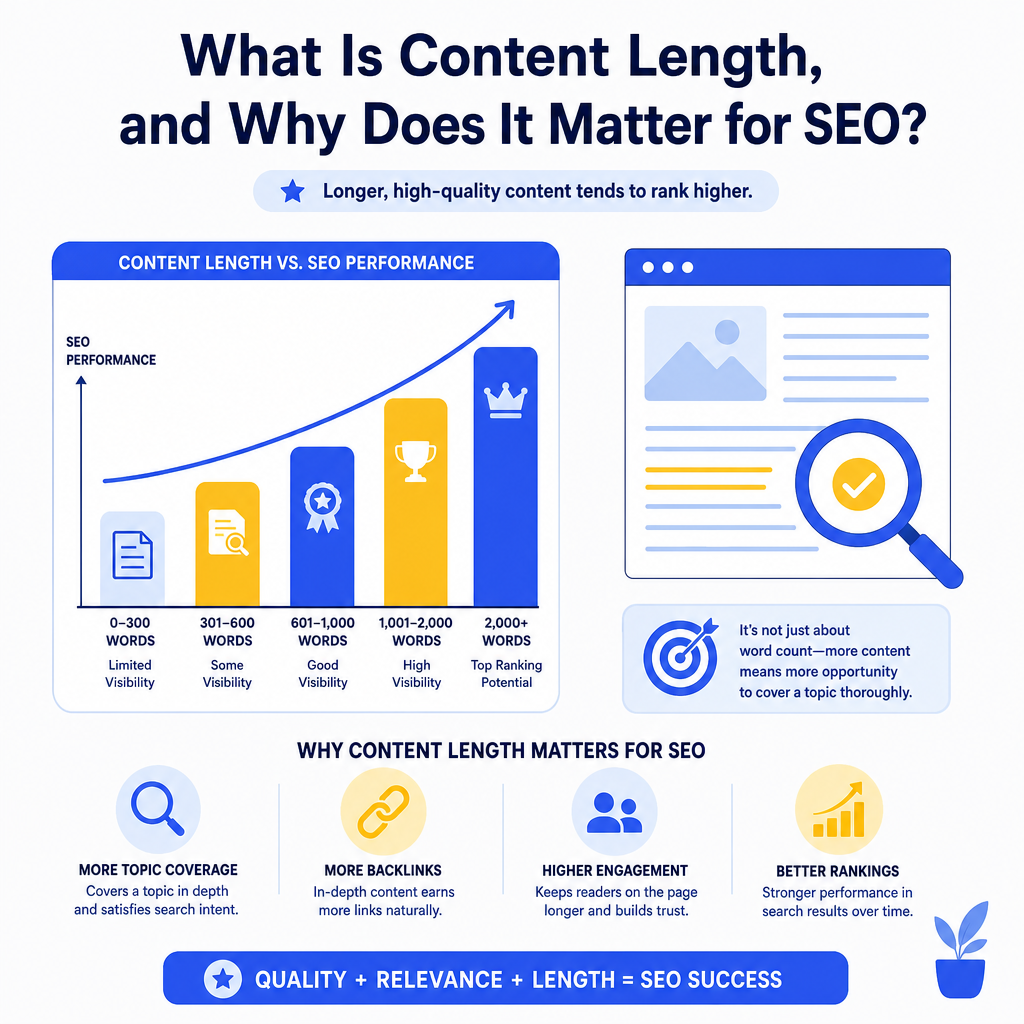
Content length refers to the total word count of a piece of written content, whether that is a blog post, a product page, a landing page, or a pillar article. But it is not just about hitting a number. Search engines like Google evaluate content based on how thoroughly it addresses a topic, and length is often a proxy for depth.
When a page covers a subject comprehensively, it tends to earn more backlinks, generate longer dwell times, and satisfy search intent more effectively. All of these signals contribute to stronger rankings. That said, length without quality is meaningless. A 3,000-word post stuffed with repetition will underperform compared to a focused 1,200-word article that directly answers what a reader needs.
According to Backlinko's analysis of Google's ranking factors, longer content tends to generate more backlinks than shorter content, which is one of the most important ranking signals in existence. However, this correlation only holds when the longer content is genuinely more useful, not just longer.
How Does Content Length Affect Search Rankings?
Does longer content always rank better?
Not always, but in many cases, longer content does outperform shorter content for competitive informational keywords. The reason is simple: comprehensive content covers more related subtopics, answers more follow-up questions, and tends to attract more organic backlinks over time.
For broad, informational queries like "how to start a blog" or "what is content marketing," longer guides in the range of 1,500 to 3,000 words tend to dominate the first page. These topics have a lot of ground to cover, and users expect thorough answers.
For local or transactional queries, however, shorter and more direct content often wins. A user searching for "best pizza near me" or "buy running shoes online" does not want a 2,000-word essay. They want quick, relevant results. This is why matching content length to search intent is just as important as the word count itself.
What does the data say about ideal content length?
Research from HubSpot's content marketing studies consistently shows that blog posts between 2,100 and 2,400 words generate the most organic traffic on average. However, this average masks a lot of variation depending on industry, keyword difficulty, and content type.
Here is a quick reference table that breaks down recommended content lengths by content type and intent:
| Content Type | Recommended Word Count | Primary Goal |
|---|---|---|
| Blog post (informational) | 1,500 to 2,500 words | Rankings and traffic |
| Pillar page or ultimate guide | 3,000 to 5,000+ words | Authority and backlinks |
| Product page | 300 to 600 words | Conversions |
| Landing page | 500 to 1,000 words | Lead generation |
| News article | 400 to 800 words | Timeliness and clicks |
| FAQ page | 800 to 1,500 words | Featured snippets |
| Social media post (caption) | 100 to 300 words | Engagement |
Step-by-Step: How to Determine the Right Content Length
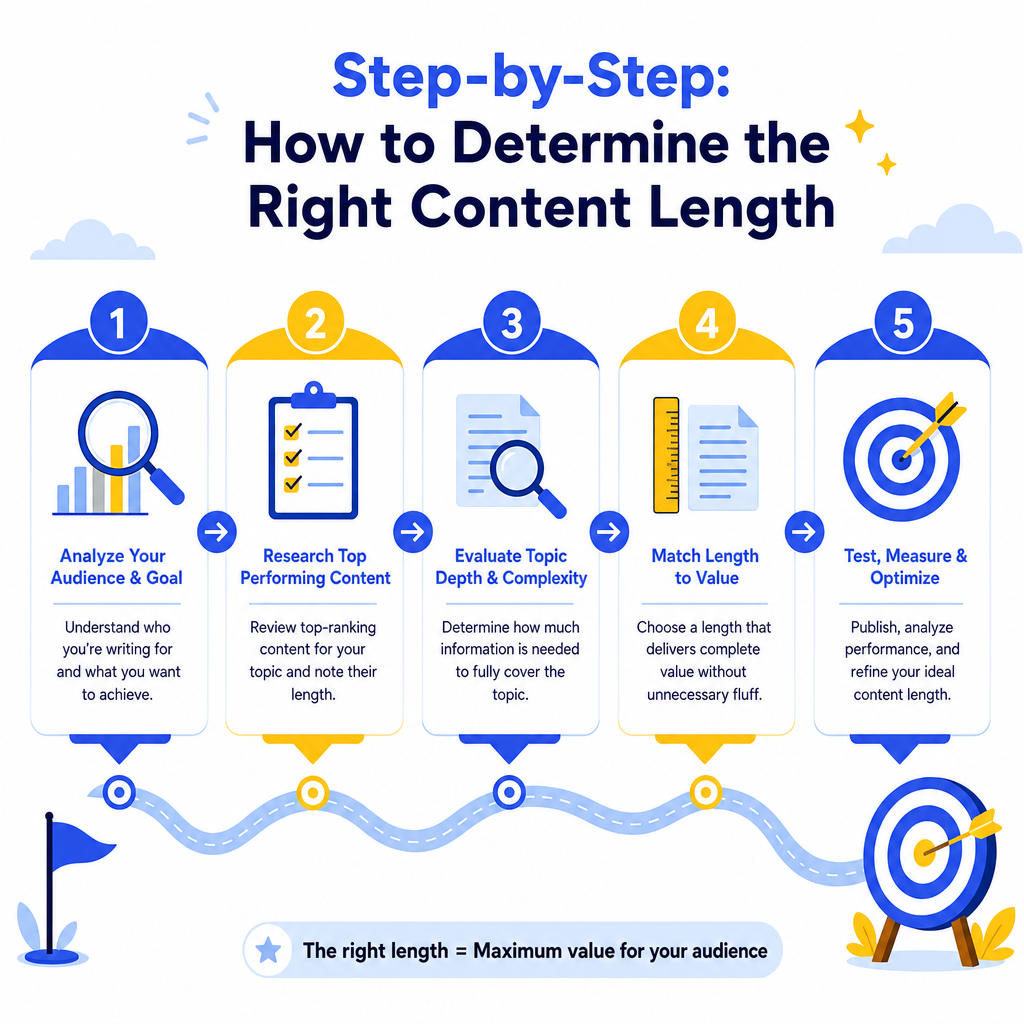
Step 1: Analyze the search intent behind your keyword
Before you write a single word, search your target keyword on Google and study the top five results. Ask yourself: are these pages short and direct, or long and comprehensive? Are they listicles, guides, or product pages? The format and length of top-ranking pages tells you exactly what Google believes satisfies the intent behind that query.
If the top results average around 1,800 words, you should aim for at least that length, and ideally a bit more if you can add genuine value. If they average 600 words, there is no need to write 3,000 words just to seem thorough.
Step 2: Identify the subtopics your competitors cover
Use a tool like Semrush's content gap analysis or simply read through competing articles to identify which subtopics they address. Make a list of every relevant angle, question, or related concept they cover. This becomes your content outline.
The goal is not to copy competitors but to ensure your content is at least as comprehensive, and ideally more useful. Covering subtopics that competitors miss is one of the fastest ways to justify longer content while also differentiating your page.
This process ties directly into content optimization strategies that drive real results, where depth and relevance work together to improve rankings rather than relying on word count alone.
Step 3: Build your outline before you write
Once you know your target length and the subtopics to cover, build a structured outline with H2 and H3 headings. This serves two purposes. First, it keeps your writing focused and prevents you from padding the content with irrelevant information. Second, it helps search engines understand the structure and hierarchy of your content, which supports better indexing and featured snippet opportunities.
A solid outline for a 2,000-word post might include an introduction, four to six main sections with supporting subsections, a FAQ section, and a conclusion. Each section should have a clear purpose and add something new rather than repeating points already made.
Step 4: Write for the reader first, then optimize for search
One of the most common mistakes writers make is treating content length as a target to hit rather than a natural outcome of covering a topic well. Write everything a reader genuinely needs to know, then check your word count. If you have covered the topic thoroughly and the post is 1,400 words, do not pad it to 2,000 just to reach an arbitrary goal.
On the flip side, if you find yourself stopping at 800 words but know there are important questions left unanswered, keep writing. Quality and completeness should drive length, not the other way around.
If you are exploring ways to scale this process efficiently, learning about AI tools for SEO content automation can help you produce well-structured drafts faster while maintaining the depth that search engines reward.
Step 5: Trim ruthlessly after your first draft
Once your draft is complete, go back and cut anything that does not serve the reader. Remove redundant sentences, unnecessary introductions to sections, and filler phrases that add words without adding meaning. Tight, purposeful writing almost always outperforms bloated content, even when the total word count is lower.
A useful editing principle is to ask yourself, "Does this sentence or paragraph help the reader understand or act on something?" If the answer is no, cut it.
Step 6: Monitor performance and adjust over time
Content length is not a set-it-and-forget-it decision. After publishing, track metrics like average time on page, bounce rate, and keyword rankings. If a post ranks on page two but competitors have significantly longer content, consider expanding it. If a post has a high bounce rate despite being long, the issue may be that the content is too dense or padded.
Revisiting and updating content based on performance data is one of the most effective SEO tactics available. Regular updates signal to search engines that your content is current and maintained, which can positively impact rankings.
Common Content Length Mistakes to Avoid
- Writing to a word count target instead of writing to cover the topic completely
- Assuming longer content always wins without checking what top-ranking pages actually look like
- Ignoring mobile readers, who may find very long pages harder to navigate without clear headings and formatting
- Failing to update older content that has become thin or outdated compared to newer competitor pages
- Treating all content types the same, when product pages and blog posts have very different length requirements
Frequently Asked Questions About Content Length
Conclusion
Choosing the right content length is a strategic decision that should be driven by search intent, competitor analysis, and a genuine commitment to serving your reader. There is no universal answer, but there is always a right answer for each specific keyword, audience, and content type.
The most effective approach in 2026 is to research before you write, outline before you draft, and edit before you publish. When you treat content length as a natural outcome of covering a topic thoroughly rather than a target to chase, you will consistently produce content that ranks well, reads well, and converts.
Start with your next piece of content. Search the keyword, study the top results, build your outline, and write until the topic is covered completely. That is the standard that wins.
Frequently Asked Questions
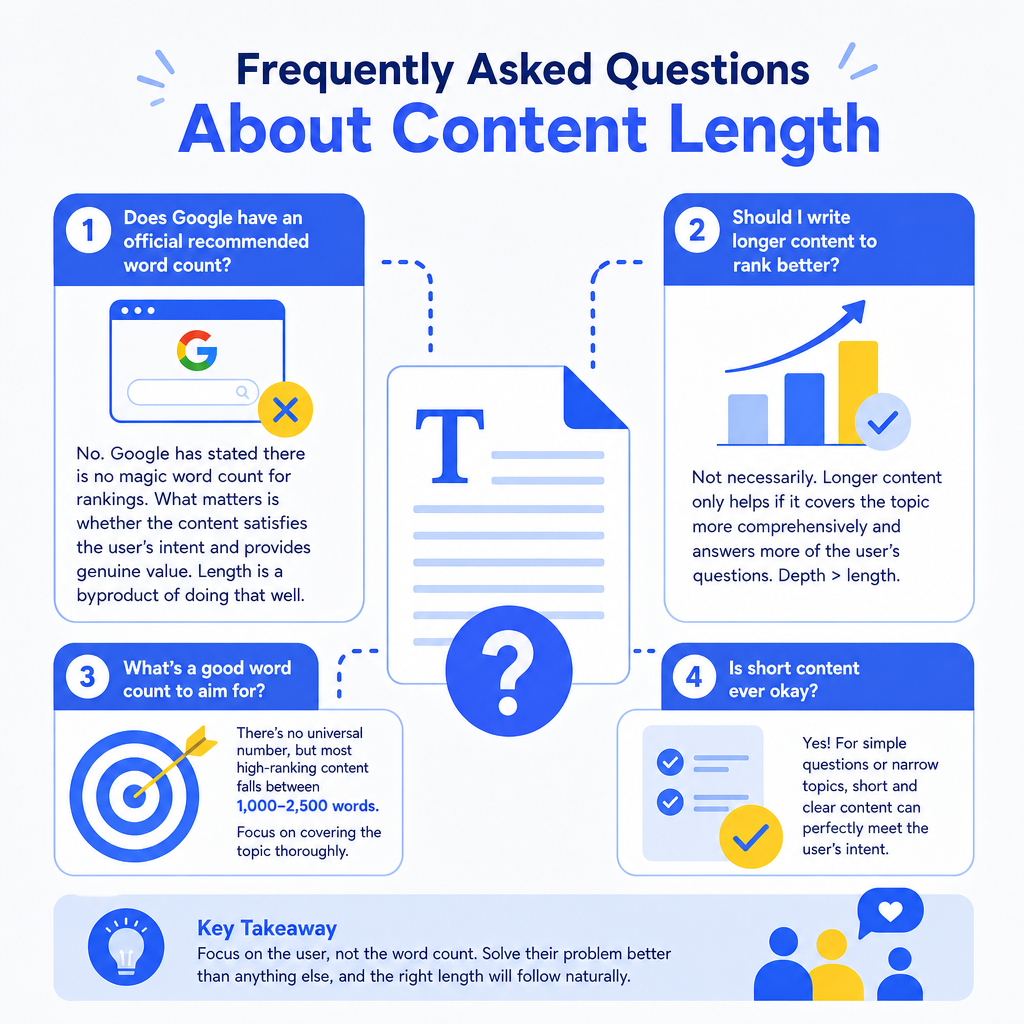
Not always. While longer content tends to rank better for broad informational queries, shorter and more direct content often wins for local or transactional searches. The key is matching content length to search intent rather than simply maximizing word count.
Research shows blog posts between 2,100 and 2,400 words generate the most organic traffic on average. However, the ideal length depends on your specific niche, keyword difficulty, and what competitors are ranking for.
Analyze the top five Google search results for your target keyword to see what length and format Google considers optimal for that query. Then aim to match or exceed that length while adding unique value and covering subtopics competitors may have missed.
It depends on the content type and search intent. A 1,000-word article may be sufficient for a landing page or news article, but informational blog posts targeting competitive keywords typically need 1,500+ words to rank well.
Yes, short content can rank well if it matches search intent and is genuinely useful. Product pages, local search results, and transactional queries often rank better with concise, focused content rather than lengthy articles.

Stefan Winter
Founder & SEO Expert
Founder of Fast SEO Fix and SEO automation expert. Stefan built Fast SEO Fix to solve the tedious problem of manual SEO work. He specializes in SEO optimized content generation, keyword research, and automated SEO strategies.
