What Is a Content Marketing Plan, and Why Do You Need One?
Posted by
 Stefan Winter
How to Build a Content Marketing Plan That Actually Drives Results

If you have ever sat down to create content and felt like you were just throwing ideas at the wall, you are not alone. Most businesses produce content without a clear direction, and the results reflect that. A well-structured content marketing plan changes everything. It gives your team a roadmap, aligns your content with business goals, and ensures that every piece you publish serves a purpose. In this guide, you will learn exactly how to build a content marketing plan from scratch, step by step, so your efforts translate into measurable growth.
What Is a Content Marketing Plan, and Why Do You Need One?
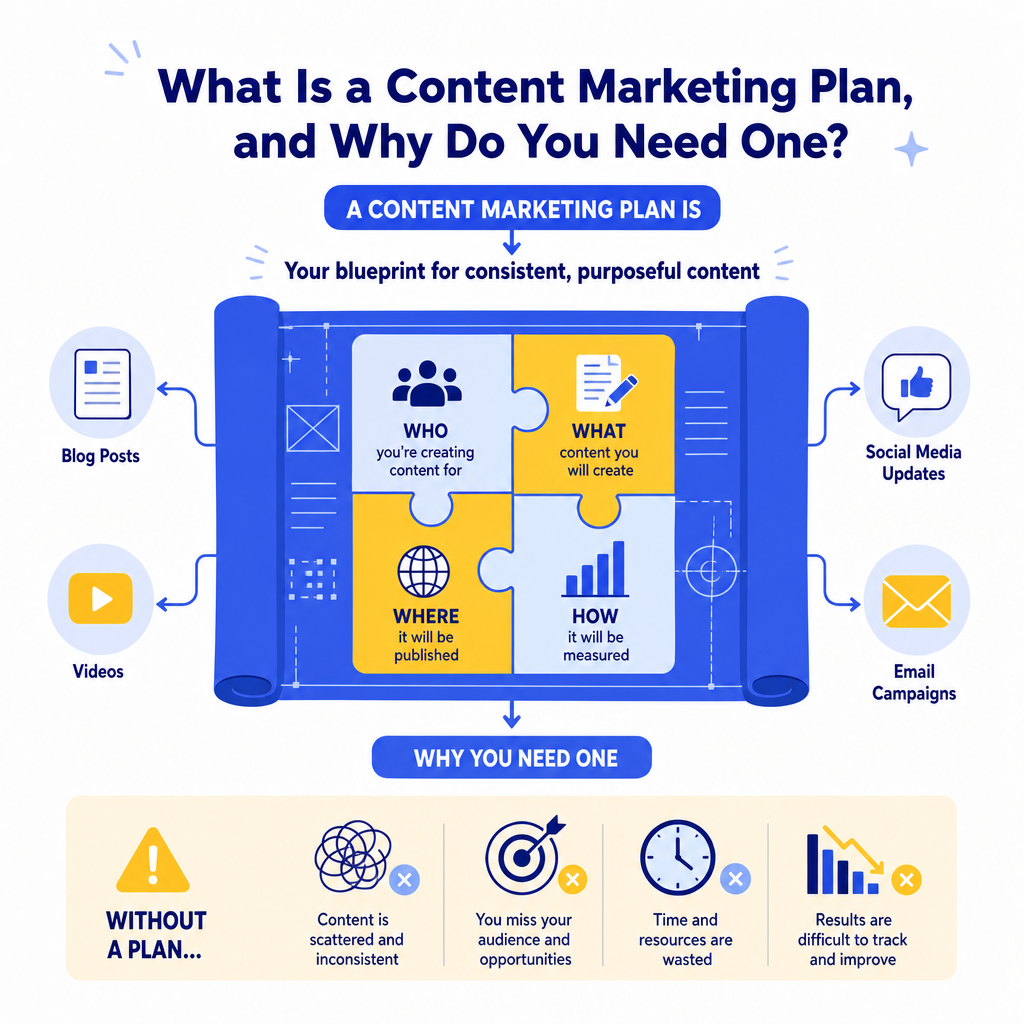
A content marketing plan is a documented strategy that outlines what content you will create, who it is for, where it will be published, and how it will be measured. Think of it as the blueprint for every blog post, video, social media update, and email campaign your brand produces.
Without a plan, content production becomes reactive. You publish when you feel inspired, cover topics at random, and have no consistent way to measure whether your work is paying off. With a plan, your content becomes intentional. Each piece connects to a broader goal, whether that is increasing organic traffic, generating leads, or building brand authority.
According to the Content Marketing Institute's annual research, organizations that document their content strategy are significantly more likely to report success than those that do not. The data is consistent year after year, and the message is clear: documentation matters.
Step 1: Define Your Goals and Key Performance Indicators
Before you write a single word of content, you need to know what success looks like. Start by asking yourself what you want your content to accomplish. Common goals include:
- Increasing organic search traffic
- Growing an email subscriber list
- Improving brand awareness in a specific niche
- Generating qualified leads for a sales team
- Reducing customer support inquiries through educational content
Before you finalize your goals, it is worth reading our guide on defining your goals before you write a single word, which walks through this foundational step in more detail.
Step 2: Identify and Understand Your Target Audience
A content marketing plan is only as strong as your understanding of the audience it serves. You need to know who you are writing for before you can decide what to write about.
Start by building a basic audience profile. Consider demographics like age, job title, and location, but go deeper than surface-level data. What problems is your audience trying to solve? What questions do they type into search engines? What type of content do they prefer, long-form articles, short videos, or quick how-to guides?
You can gather this information through customer interviews, website analytics, social media comments, and competitor research. The more specific your audience profile, the more targeted and effective your content will be.
Step 3: Conduct Keyword Research to Find Content Opportunities
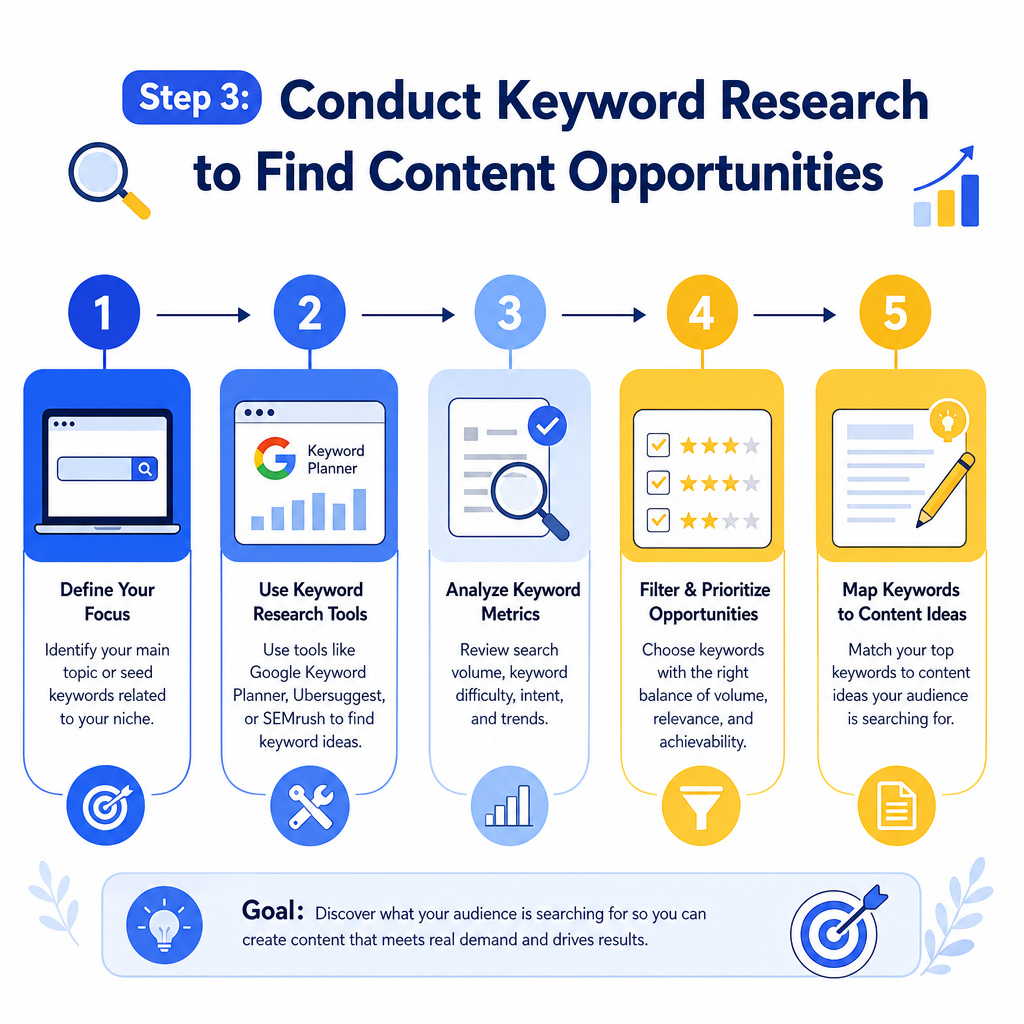
Keyword research is the backbone of any SEO-driven content marketing plan. It tells you what your audience is actively searching for, so you can create content that meets real demand rather than content you simply assume people want.
Use tools like Google Keyword Planner or other established keyword research platforms to find terms related to your niche. Look for a mix of:
- High-volume, competitive keywords for long-term authority building
- Long-tail keywords with lower competition for quicker wins
- Question-based queries that map to informational intent
How Does Keyword Research Connect to Content Gaps?
Keyword research is also how you discover what your competitors are ranking for that you are not. This is called a content gap analysis. By identifying topics where your competitors have strong visibility and you have none, you can prioritize content that closes those gaps and captures traffic you are currently missing. Our post on performing a gap analysis in SEO explains this process thoroughly if you want to go deeper on the topic.
Step 4: Plan Your Content Types and Formats
Not all content serves the same purpose, and a strong content marketing plan accounts for variety. Different formats work better at different stages of the buyer journey.
| Content Type | Best For | Buyer Journey Stage |
|---|---|---|
| Blog posts | Organic search traffic | Awareness |
| Case studies | Building trust and credibility | Consideration |
| Email newsletters | Nurturing existing leads | Consideration |
| How-to guides | Educating and converting | Decision |
| Video tutorials | Engagement and retention | Awareness / Consideration |
| Landing pages | Driving specific conversions | Decision |
Step 5: Build a Content Calendar
A content calendar is where your plan becomes operational. It transforms a strategy document into a schedule your team can actually follow.
Your content calendar should include:
- Publication date for each piece
- Topic and working title
- Target keyword for SEO-focused content
- Content format (blog post, video, infographic, etc.)
- Assigned writer or creator
- Distribution channels (website, email, social media)
- Status (in progress, in review, published)
How Often Should You Publish?
Publishing frequency depends on your resources and goals. Consistency matters far more than volume. One well-researched, SEO-optimized post per week will outperform three rushed, thin pieces every time. Set a cadence you can sustain for at least six months before evaluating results.
Step 6: Establish a Content Creation and Review Process
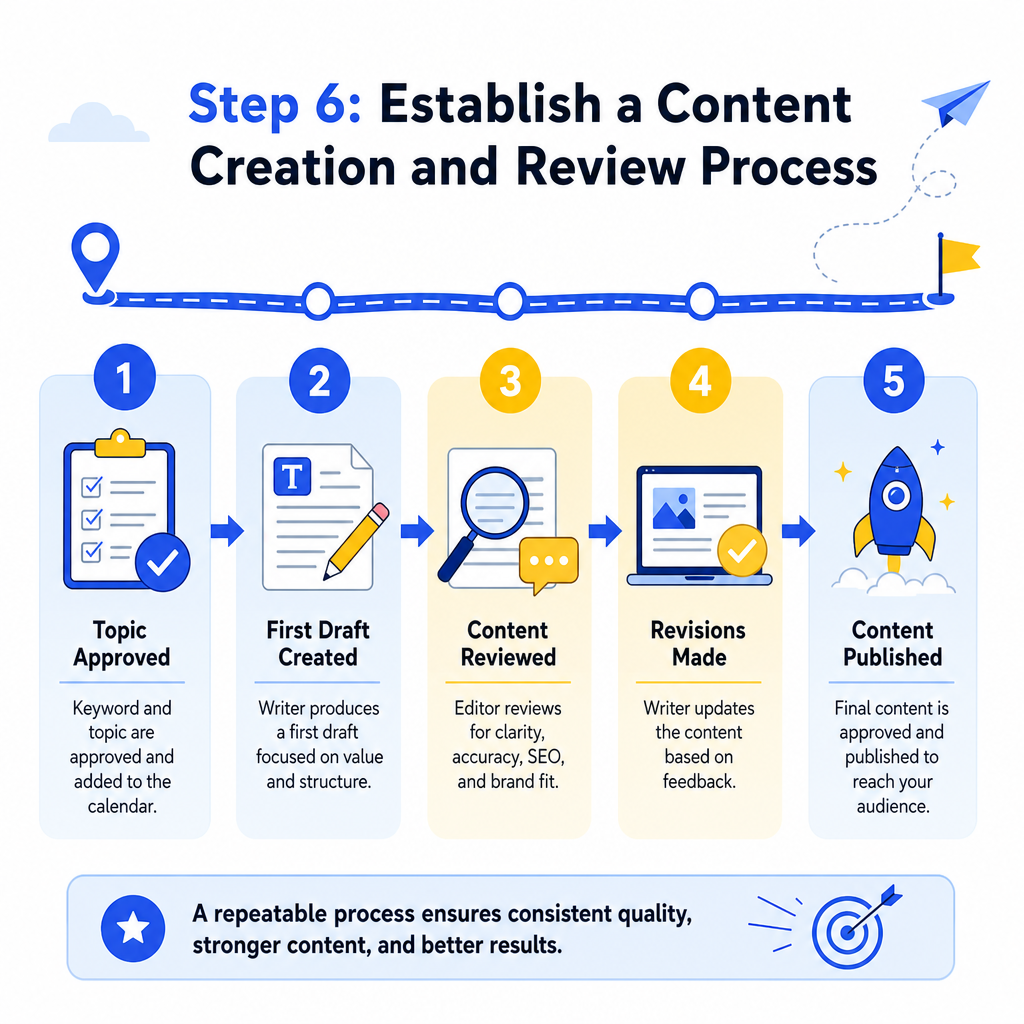
A content marketing plan is only effective if the content it produces is high quality. That requires a repeatable creation process with clear roles and checkpoints.
A basic content workflow looks like this:
1. Keyword and topic are approved and added to the calendar 2. Writer produces a first draft following the content brief 3. Editor reviews for accuracy, tone, and SEO alignment 4. Designer adds visuals or formatting elements if needed 5. Final review and approval before scheduling 6. Content is published and distributed across channels
Document this process so every team member knows what is expected at each stage. Clear workflows reduce bottlenecks and improve the consistency of your output.
Step 7: Distribute and Promote Your Content
Publishing content on your website is only the first step. A strong content marketing plan includes a distribution strategy that amplifies each piece across multiple channels.
Consider the following distribution tactics:
- Share new posts across your social media profiles with platform-appropriate captions
- Include recent content in your email newsletter
- Repurpose blog posts into shorter social media threads or video scripts
- Reach out to relevant websites for link-building opportunities
- Update and republish older posts that have lost traffic
Step 8: Measure Results and Refine Your Approach
A content marketing plan is a living document. Once your content is live and circulating, you need to track performance and use that data to improve future decisions.
Monitor these metrics regularly:
- Organic traffic from search engines
- Keyword rankings for your target terms
- Engagement metrics (time on page, scroll depth, bounce rate)
- Conversion rates from content-driven traffic
- Backlinks earned from published content
Conclusion
Building a content marketing plan is not a one-time task. It is an ongoing commitment to intentional, audience-focused content that serves both your readers and your business goals. When you define clear objectives, understand your audience, conduct thorough keyword research, and measure your results consistently, your content stops being a guessing game and starts being a growth engine.
The steps outlined in this guide give you a proven framework to follow, whether you are starting from scratch or restructuring an existing approach. Start with the foundations, stay consistent, and refine as you go. The businesses that succeed with content marketing are not the ones with the biggest budgets. They are the ones with the clearest plans.
Ready to take the next step? Explore the resources on Fast SEO Fix to sharpen your keyword research skills, improve your content quality, and build a search-driven content operation that delivers lasting results.

Stefan Winter
Founder & SEO Expert
Founder of Fast SEO Fix and SEO automation expert. Stefan built Fast SEO Fix to solve the tedious problem of manual SEO work. He specializes in SEO optimized content generation, keyword research, and automated SEO strategies.
