What Exactly Is an SEO Content Audit?
Posted by
 Stefan Winter
How to Perform a Complete SEO Content Audit in 2026: The Ultimate Step-by-Step Guide

Your website's content is the foundation of your SEO success, but how do you know if it's actually working? An SEO content audit reveals which pages drive traffic, which ones need optimization, and which should be removed entirely. This comprehensive guide will walk you through every step of conducting a thorough content audit that identifies opportunities, eliminates dead weight, and maximizes your search engine visibility.
What Exactly Is an SEO Content Audit?
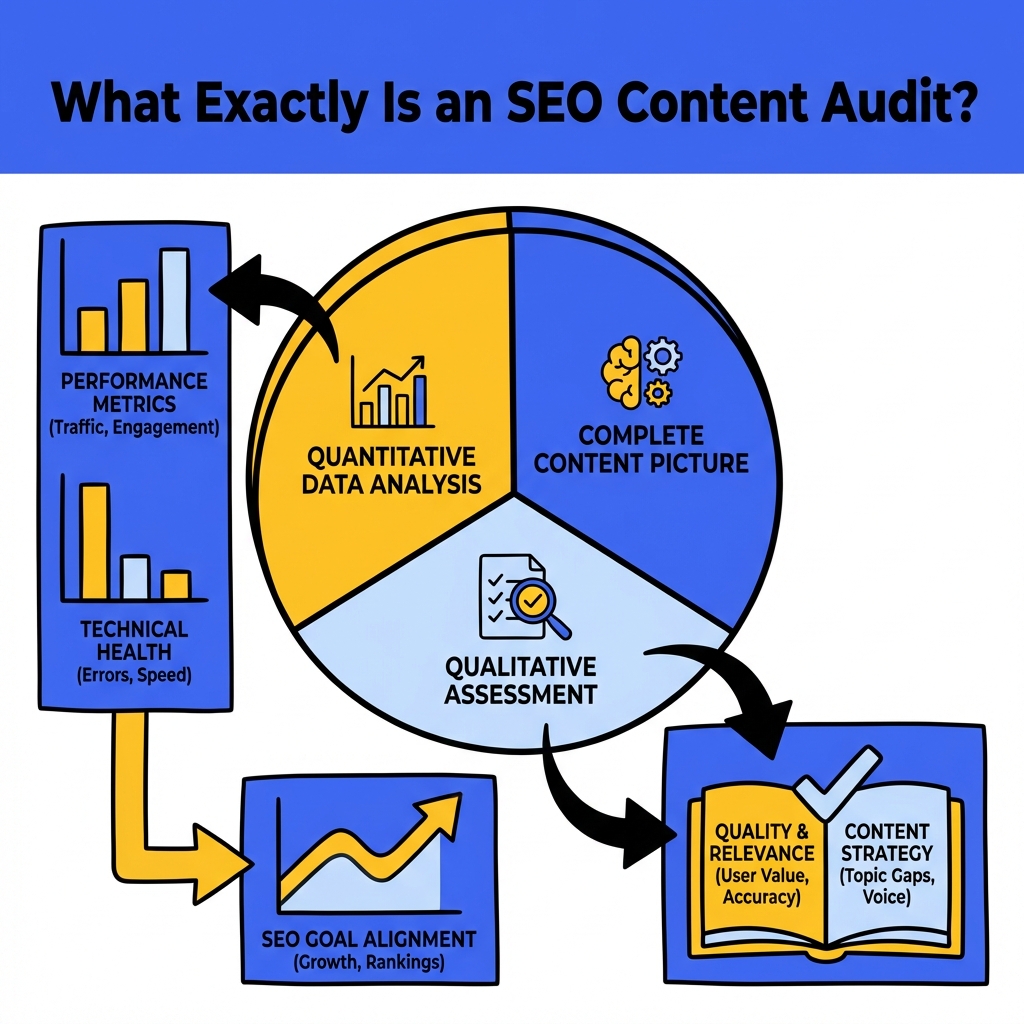
An SEO content audit is a systematic evaluation of all content on your website to assess its performance, quality, and alignment with your SEO goals. Unlike a basic content review, this process combines quantitative data analysis with qualitative assessment to create a complete picture of your content's effectiveness.
The audit examines multiple factors including search rankings, organic traffic, user engagement metrics, technical SEO elements, and content quality. By analyzing these components together, you can identify which pieces of content contribute to your SEO success and which ones hold your website back.
Modern SEO content audits in 2026 go beyond simple traffic metrics. They incorporate user experience signals, semantic search optimization, and AI-driven content analysis to ensure your content meets both search engine algorithms and user expectations.
Why Should You Conduct Regular SEO Content Audits?
Search engines continuously update their algorithms, user behavior evolves, and your business goals shift over time. Content that performed well last year might now be dragging down your overall site performance. Regular audits help you stay ahead of these changes.
A comprehensive content audit reveals hidden opportunities within your existing content. You might discover high-performing pages that could rank for additional keywords with minor optimizations, or find content gaps that competitors are exploiting. This insight allows you to maximize your content ROI without starting from scratch.
The audit process also identifies technical issues that impact SEO performance. Broken internal links, missing meta descriptions, duplicate content, and poor page load speeds all become apparent during a thorough content review. Addressing these issues can provide immediate ranking improvements across your entire website.
How to Prepare for Your SEO Content Audit
What Tools Do You Need?
Before diving into the audit process, gather the essential tools that will provide accurate data and streamline your analysis. Google Analytics and Google Search Console form the foundation of your audit toolkit, providing traffic data, search performance metrics, and technical insights directly from Google.
Choose a comprehensive SEO platform like SEMrush, Ahrefs, or Moz to access keyword rankings, backlink data, and competitor analysis. These tools also offer content audit features that can automate parts of the process. For technical analysis, consider tools like Screaming Frog or Sitebulb to crawl your website and identify structural issues.
Spreadsheet software remains crucial for organizing and analyzing your findings. Create a master spreadsheet that will serve as your audit hub, tracking all metrics and recommendations in one centralized location.
How Should You Set Audit Goals?
Define specific, measurable objectives for your content audit before you begin. Are you trying to improve organic traffic by 25%? Increase conversion rates from content pages? Identify content gaps in your industry? Clear goals will guide your analysis and help prioritize recommendations.
Consider your business objectives and how content supports them. An e-commerce site might focus on product page optimization and buying intent keywords, while a B2B service provider might prioritize thought leadership content and lead generation pages. Align your audit goals with these broader business priorities.
Step 1: How to Inventory All Your Content
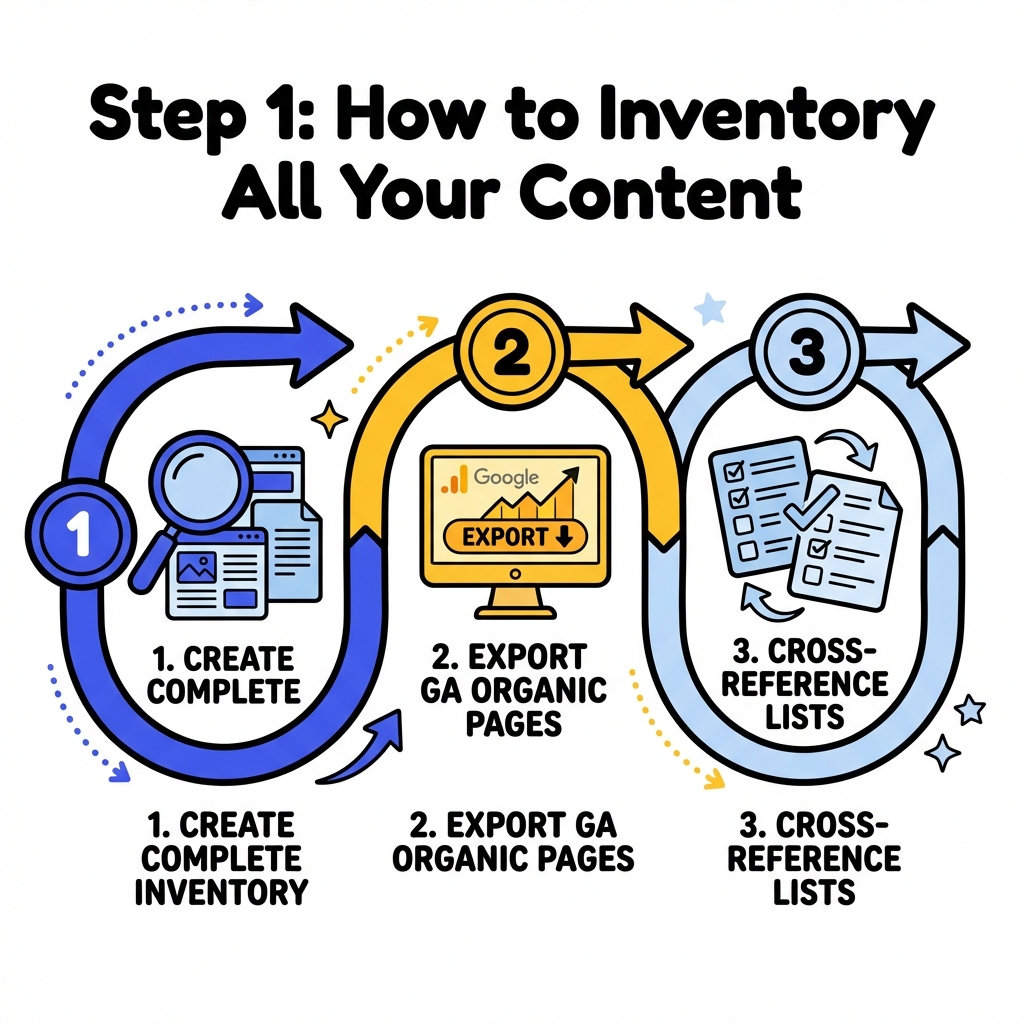
Start by creating a complete inventory of every page on your website. Use Google Analytics to export a list of all pages that received organic traffic in the past 12 months. This gives you a baseline of content that search engines have actually indexed and served to users.
Cross-reference this list with a complete site crawl using tools like Screaming Frog to identify pages that exist but haven't received organic traffic. These pages might have technical issues preventing search engines from finding or ranking them properly.
Create a master spreadsheet with columns for URL, page title, meta description, word count, publish date, last updated date, and primary target keyword. This inventory becomes the foundation for all subsequent analysis steps.
| Content Type | Number of Pages | Avg. Organic Traffic | Avg. Word Count | Priority Level |
|---|---|---|---|---|
| Blog Posts | 150 | 245 sessions/month | 1,200 words | High |
| Product Pages | 75 | 180 sessions/month | 800 words | High |
| Service Pages | 25 | 320 sessions/month | 1,500 words | Critical |
| About/Company | 10 | 45 sessions/month | 600 words | Medium |
| Resources | 40 | 95 sessions/month | 900 words | Medium |
Step 2: How to Analyze Content Performance Metrics
What Metrics Matter Most?
Focus on metrics that directly correlate with SEO success and business objectives. Organic traffic remains the primary indicator of search engine visibility, but dig deeper into user behavior metrics like bounce rate, time on page, and pages per session to understand content quality.
Examine search rankings for target keywords using your SEO platform. Identify pages ranking on the second page of search results (positions 11-20) as these represent immediate optimization opportunities. Content ranking in these positions often needs only minor improvements to break into the top 10.
Track conversion metrics for content that supports business goals. This might include email signups, contact form submissions, or product purchases originating from specific content pages. High-traffic content with low conversion rates indicates optimization potential.
How to Identify Top Performers and Underperformers?
Sort your content inventory by organic traffic to identify your highest-performing pages. These top performers often share common characteristics like comprehensive coverage of topics, strong keyword optimization, and high-quality backlinks. Analyze these patterns to replicate success across other content.
Create a separate list of underperforming content using specific criteria. Pages with fewer than 10 organic sessions per month, high bounce rates above 80%, or zero conversions over six months typically need significant improvement or removal.
Pay special attention to content published more than two years ago. Older content often contains outdated information, targets keywords that are no longer relevant, or uses SEO techniques that no longer work effectively. This content frequently offers the biggest improvement opportunities.
Step 3: How to Evaluate Content Quality and Relevance
Is Your Content Meeting User Intent?
Analyze whether your content actually answers the questions users are asking. Search for your target keywords and examine the top-ranking results to understand what type of content Google considers most relevant. Compare your content format, depth, and approach to these successful examples.
User intent has evolved significantly, with search engines now prioritizing content that provides comprehensive, authoritative answers. Content that only scratches the surface of topics rarely ranks well in 2026. Evaluate whether your content provides enough depth and expertise to satisfy user queries completely.
Consider the search journey and where your content fits. Informational content should educate and inform, while commercial content should help users make purchasing decisions. Misaligned content intent often results in high bounce rates and poor rankings despite technical optimization.
How to Assess Content Freshness?
Review publication and last updated dates for all content in your inventory. Content in rapidly changing industries like technology, healthcare, or finance requires more frequent updates to maintain search engine trust and user value.
Identify factual accuracy issues, broken external links, and outdated statistics or references. Search engines favor fresh, accurate content, and users quickly lose trust in brands that provide outdated information. Create a schedule for regular content updates based on topic sensitivity and performance data.
Look for opportunities to expand and improve existing content rather than creating entirely new pieces. Developing a comprehensive SEO content strategy template can help you systematically approach content updates and ensure consistency across your website.
Step 4: How to Conduct Technical SEO Analysis
What Technical Elements Should You Review?
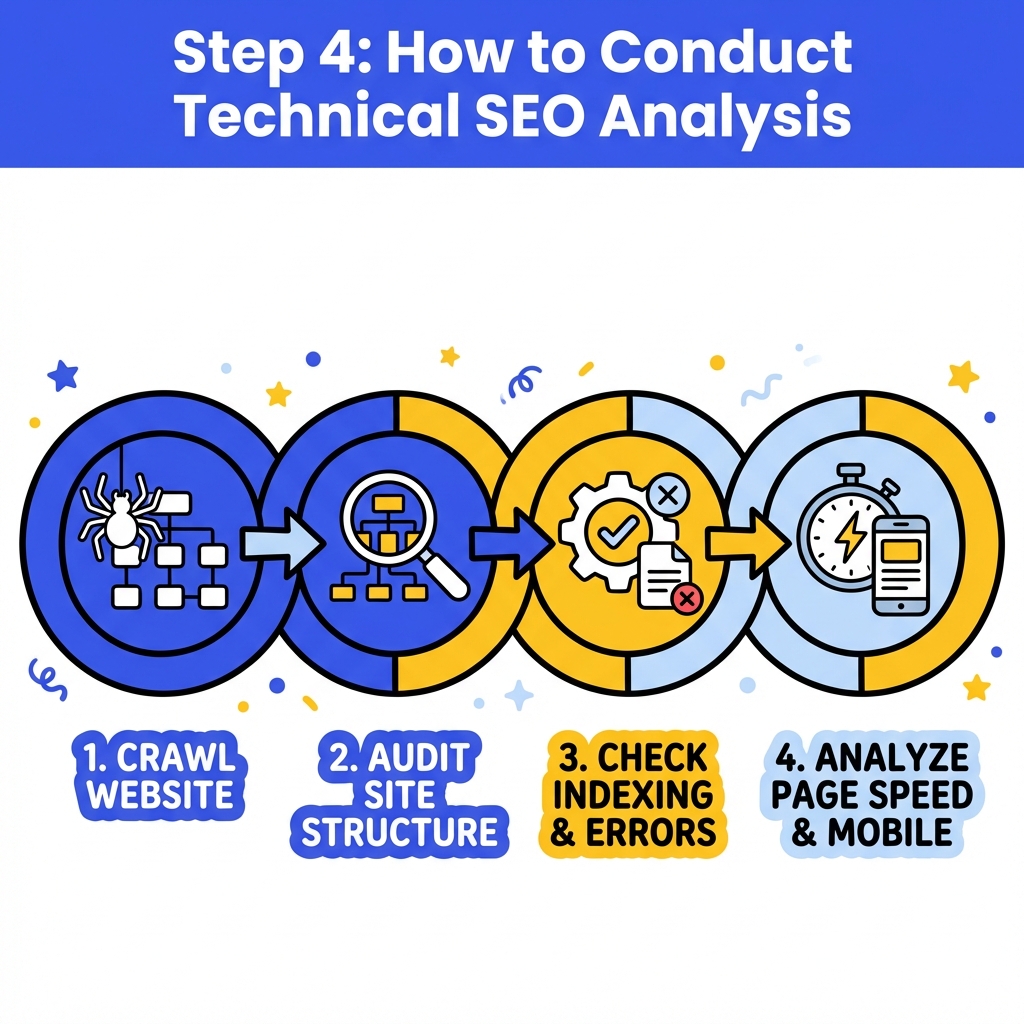
Examine on-page SEO elements for every piece of content in your audit. Check for missing or poorly optimized title tags, meta descriptions, and header tags. These elements directly impact search engine rankings and click-through rates from search results.
Analyze internal linking structure to identify orphaned pages and missed linking opportunities. Strong internal linking helps search engines understand your site structure and distributes page authority throughout your website. Pages with no internal links often perform poorly in search results.
Review image optimization, including alt text, file names, and file sizes. Large, unoptimized images slow down page load speeds, which negatively impacts both user experience and search rankings. Modern AI-powered SEO analysis can help identify these technical issues more efficiently.
How to Identify Duplicate Content Issues?
Use tools like Copyscape or Siteliner to identify duplicate content across your website. Duplicate content confuses search engines about which version to rank and can result in reduced visibility for all affected pages.
Check for near-duplicate content where multiple pages target the same keywords or cover very similar topics. This internal competition often prevents any single page from ranking well. Consider consolidating similar content or clearly differentiating the focus of each page.
External duplicate content occurs when other websites copy your content without permission. While this doesn't directly hurt your rankings, it can dilute the authority signals that search engines associate with your original content.
Step 5: How to Analyze Keyword Performance
Are You Targeting the Right Keywords?
Review the keywords each piece of content currently ranks for using Google Search Console and your SEO platform. Many pages rank for keywords beyond their primary target, revealing opportunities to optimize for additional relevant terms.
Analyze keyword difficulty and search volume for your target keywords. Content targeting highly competitive keywords with low domain authority often struggles to rank well. Consider targeting long-tail variations or related keywords with better ranking potential.
Examine keyword cannibalization issues where multiple pages compete for the same search terms. This internal competition typically results in lower rankings for all affected pages. Consolidate or redirect competing pages, or clearly differentiate their keyword focus.
How to Identify Content Gaps?
Compare your content coverage to top-ranking competitors in your industry. Use tools like SEMrush's Content Gap analysis to identify keywords your competitors rank for that you don't target. These gaps represent opportunities for new content creation or existing content optimization.
Analyze search trends and emerging topics in your industry using tools like Google Trends or Answer the Public. Early content creation around trending topics can establish authority and capture traffic before competition increases.
Review your customer support tickets, sales team feedback, and social media comments to identify questions your audience asks that your content doesn't address. This real-world insight often reveals valuable content opportunities that keyword research tools miss.
Step 6: How to Create Your Content Action Plan
What Content Should You Keep, Improve, or Remove?
Categorize every piece of content into one of four buckets: keep as-is, optimize, consolidate, or remove. High-performing content that drives traffic and conversions with minimal technical issues can remain unchanged. Focus your optimization efforts on content with the highest potential impact.
Content with decent traffic but poor user engagement metrics typically needs optimization rather than removal. These pages often require better keyword targeting, improved readability, or enhanced calls-to-action to convert traffic into business results.
Remove or redirect content that provides no SEO value and serves no business purpose. Pages with zero organic traffic, no backlinks, and no conversion potential often hurt overall site performance. However, be cautious about removing pages with external links or historical significance.
How to Prioritize Your Optimization Efforts?
Create a priority matrix based on potential impact and required effort. Quick wins include pages ranking positions 11-20 that need only minor optimization to reach the first page. These often provide the fastest ROI from your audit efforts.
High-traffic pages with technical issues should receive immediate attention, as fixes can impact significant portions of your organic traffic. Similarly, pages that drive conversions but have declining traffic deserve priority optimization to maintain business results.
Consider seasonal factors and business priorities when scheduling content improvements. Understanding when publishing time matters for SEO can help you time content updates for maximum impact.
How to Implement Your SEO Content Audit Findings
What's the Best Approach for Content Optimization?
Start with technical fixes that can be implemented quickly across multiple pages. Updating missing meta descriptions, fixing broken internal links, and optimizing images often provide immediate improvements with minimal effort.
For content optimization, focus on one page at a time to ensure thorough improvement. Update outdated information, expand thin content, improve keyword optimization, and enhance user experience elements like readability and formatting.
Track the impact of your changes using Google Analytics and Search Console. Monitor rankings, traffic, and user engagement metrics for optimized pages to measure the success of your audit recommendations. This data will inform future audit cycles and optimization strategies.
How Often Should You Repeat This Process?
Plan to conduct comprehensive SEO content audits annually, with quarterly mini-audits focusing on high-priority pages and recent content. The frequency depends on your content volume, industry change rate, and available resources.
Implement ongoing monitoring for key performance indicators rather than waiting for formal audit cycles. Set up alerts for significant traffic drops, ranking changes, or technical issues that require immediate attention.
Consider leveraging SEO content automation tools to streamline routine audit tasks and focus human effort on strategic analysis and optimization decisions.
Conclusion
A thorough SEO content audit provides the roadmap for transforming your website's search performance. By systematically evaluating every piece of content through the lens of performance data, technical optimization, and user value, you can identify opportunities that drive meaningful traffic and business results.
The key to audit success lies in taking action on your findings. Prioritize high-impact optimizations, track your results, and maintain ongoing monitoring to ensure sustained improvement. Remember that content auditing is not a one-time task but an essential component of long-term SEO strategy.
Ready to unlock your website's full potential? Start your SEO content audit today using this step-by-step framework, and watch as optimized content drives increased visibility, engagement, and conversions for your business.

Stefan Winter
Founder & SEO Expert
Founder of Fast SEO Fix and SEO automation expert. Stefan built Fast SEO Fix to solve the tedious problem of manual SEO work. He specializes in SEO optimized content generation, keyword research, and automated SEO strategies.
