What Should You Consider Before Investing in SEO Tools?
Posted by
 Stefan Winter
How to Choose the Right SEO Tools for Maximum Website Growth in 2026

Selecting the perfect SEO tools can make the difference between a website that thrives and one that gets lost in search results. With hundreds of options available, from free basic analyzers to comprehensive enterprise platforms, finding the right combination for your specific needs requires strategic thinking. This guide walks you through a proven process for evaluating, selecting, and implementing SEO tools that will drive measurable results for your website.
What Should You Consider Before Investing in SEO Tools?
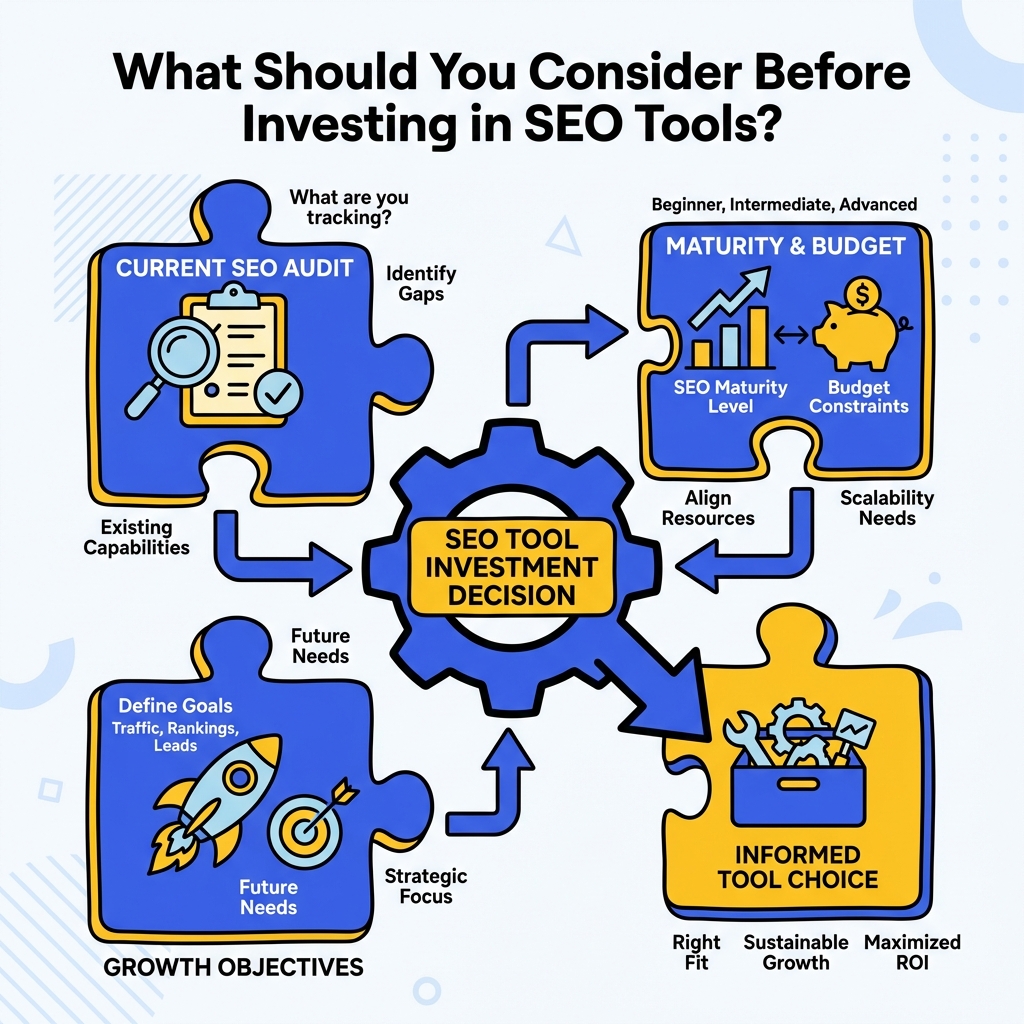
Before diving into specific tool recommendations, you need to establish clear criteria for evaluation. Your choice should align with your current SEO maturity level, budget constraints, and growth objectives.
Start by auditing your existing SEO capabilities. Document what you're currently tracking, which metrics matter most to your business, and where you're experiencing the biggest gaps. Many businesses make the mistake of purchasing premium tools when they haven't maximized the potential of free alternatives like Google Search Console and Google Analytics.
Consider your team's technical expertise as well. Advanced platforms offer powerful features but require significant learning curves. If you're working with limited resources, prioritize tools with intuitive interfaces and comprehensive onboarding support. The most sophisticated tool becomes worthless if your team can't effectively implement its recommendations.
How Do You Evaluate Different Categories of SEO Tools?
SEO tools generally fall into several distinct categories, each serving specific optimization functions. Understanding these categories helps you build a comprehensive toolkit without unnecessary overlap.
Keyword Research and Analysis Tools form the foundation of most SEO strategies. These platforms help identify search opportunities, analyze competitor keywords, and track ranking performance. Look for tools that provide accurate search volume data, keyword difficulty scores, and related term suggestions. Technical SEO Auditing Tools scan your website for crawlability issues, site speed problems, and structural concerns. The best options offer automated monitoring, detailed error explanations, and prioritized fix recommendations. Some tools excel at comprehensive site audits, while others specialize in specific areas like page speed or mobile optimization.| Tool Category | Primary Function | Key Features to Look For | Typical Price Range |
|---|---|---|---|
| Keyword Research | Search opportunity identification | Search volume, difficulty scores, competitor analysis | $99-$400/month |
| Technical Audit | Site health monitoring | Automated scans, error prioritization, fix guidance | $50-$300/month |
| Content Optimization | On-page SEO enhancement | Content scoring, optimization suggestions, SERP analysis | $29-$200/month |
| Link Analysis | Backlink profile evaluation | Link quality assessment, competitor backlinks, outreach tools | $100-$500/month |
| Rank Tracking | Position monitoring | Local/global tracking, competitor comparisons, reporting | $25-$250/month |
What Features Indicate a High-Quality SEO Tool?

The best SEO tools share several characteristics that separate them from mediocre alternatives. Recognition of these features helps you avoid costly mistakes and ensures your investment delivers genuine value.
Data accuracy stands as the most critical factor. Tools that provide outdated or incorrect information can lead to poor strategic decisions. Verify accuracy by cross-referencing data with multiple sources, especially for keyword search volumes and competitor analysis. Reputable tools typically source data from reliable APIs and update their databases regularly.
Integration capabilities significantly impact long-term utility. Your SEO tools should connect seamlessly with existing marketing platforms, analytics systems, and content management systems. This connectivity enables automated reporting, streamlined workflows, and more comprehensive data analysis.
User interface design affects daily productivity more than most people realize. Tools with cluttered dashboards, confusing navigation, or slow loading times create friction that reduces adoption rates. The most effective platforms present complex data in digestible formats and allow customization based on user preferences.
How Should You Test SEO Tools Before Committing?
Most reputable SEO tool providers offer trial periods or freemium versions that allow hands-on evaluation. Use these opportunities strategically to assess real-world performance rather than relying solely on marketing materials.
Create a standardized testing process that evaluates each tool against your specific use cases. Run the same website audit across multiple platforms and compare the results. Look for tools that identify issues others miss, provide clearer explanations, or offer more actionable recommendations.
Pay attention to customer support quality during trial periods. Test response times, knowledge levels, and willingness to help with implementation questions. Professional SEO consulting services often rely heavily on tool support when serving clients, making this evaluation particularly important for agencies.
What Questions Should You Ask During Tool Trials?
Focus your evaluation on practical implementation rather than feature lists. Ask yourself whether the tool actually improves your decision-making process and provides insights you couldn't obtain elsewhere.
Test the tool's reporting capabilities by generating sample reports for stakeholders. Evaluate whether the visualizations communicate effectively and whether you can customize reports for different audiences. Many tools offer impressive analytics but fall short in presenting data for non-technical team members.
Assess the learning curve realistically. Document how long it takes team members to become proficient with basic functions and estimate the time investment required for advanced features. Factor this training time into your total cost of ownership calculations.
How Do You Build an Integrated SEO Tool Stack?
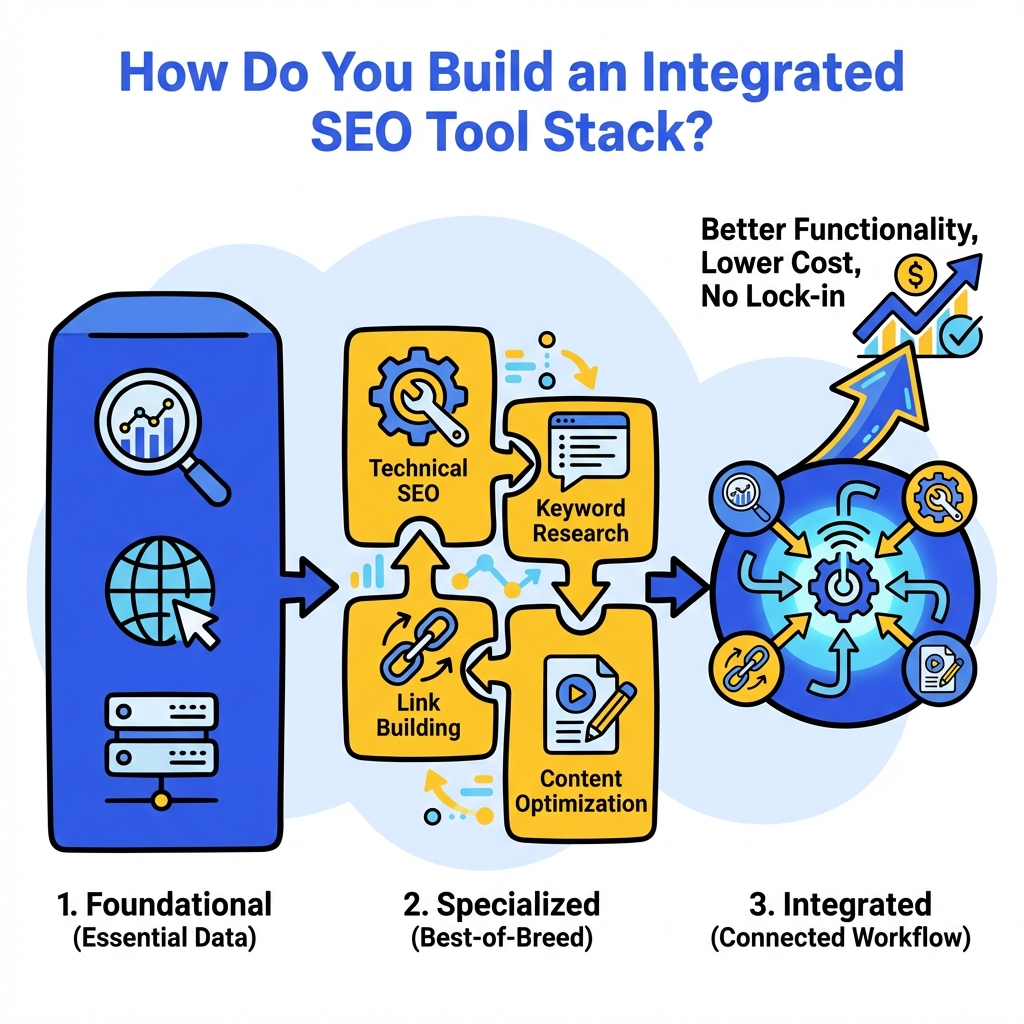
Rather than relying on a single comprehensive platform, many successful SEO professionals build integrated tool stacks that combine specialized solutions. This approach often provides better functionality at lower costs while avoiding vendor lock-in.
Start with foundational tools that cover essential functions, then add specialized solutions as your needs evolve. For example, you might begin with Google Search Console for basic performance monitoring, add a dedicated keyword research tool for content planning, and later incorporate technical auditing software for advanced optimization.
Consider how different tools complement each other rather than simply avoiding overlap. A robust SEO reporting dashboard might pull data from multiple sources to provide comprehensive performance insights that no single tool could deliver.
Automation becomes increasingly important as your tool stack grows. Look for platforms that offer API access or native integrations with other tools in your stack. This connectivity enables automated data sharing, reduces manual reporting tasks, and provides more comprehensive analysis capabilities.
What Are the Most Common SEO Tool Selection Mistakes?
Understanding frequent mistakes helps you avoid costly errors that can set back your SEO progress. Many businesses focus too heavily on feature lists without considering practical implementation challenges.
Over-investing in premium tools before mastering basic SEO principles wastes resources and creates false confidence. According to Moz's annual SEO survey, many successful SEO professionals achieve excellent results using relatively simple tool combinations paired with solid strategic thinking.
Choosing tools based solely on price often leads to poor outcomes. Both expensive and cheap options can deliver value when properly matched to specific needs. Focus on return on investment rather than absolute cost, and remember that the right tool can pay for itself through improved search performance.
Neglecting team training represents another significant oversight. Even the best tools require proper implementation to deliver results. Budget time and resources for onboarding, ongoing education, and process development alongside your tool investments.
How Should You Measure SEO Tool Effectiveness?
Establishing clear success metrics before implementing new tools helps you evaluate their impact objectively. Define specific goals that align with broader business objectives rather than vanity metrics that don't drive meaningful outcomes.
Track efficiency improvements in addition to SEO performance gains. Measure how much time the tool saves, how it improves decision-making speed, and whether it enables your team to handle larger workloads. These operational benefits often justify tool investments even when direct SEO impact takes time to materialize.
Monitor adoption rates across your team to identify training gaps or usability issues. Tools that team members avoid or use incorrectly won't deliver expected results regardless of their capabilities. Regular check-ins and feedback sessions help optimize tool utilization and identify opportunities for additional training.
Conclusion
Choosing the right SEO tools requires balancing functionality, usability, and cost while keeping your specific needs at the center of every decision. The most successful approach involves starting with clear objectives, testing thoroughly during trial periods, and building an integrated stack that grows with your capabilities.
Remember that tools amplify good SEO strategy but can't replace fundamental knowledge and strategic thinking. Focus on platforms that enhance your decision-making process, improve team efficiency, and provide actionable insights that drive measurable results. Whether you're managing SEO in-house or working with external partners, the right tool combination will accelerate your progress toward sustainable search engine success.
Ready to optimize your SEO tool selection process? Start by auditing your current capabilities and identifying the biggest gaps in your optimization workflow. The investment in proper tool selection pays dividends through improved search performance and operational efficiency.

Stefan Winter
Founder & SEO Expert
Founder of Fast SEO Fix and SEO automation expert. Stefan built Fast SEO Fix to solve the tedious problem of manual SEO work. He specializes in SEO optimized content generation, keyword research, and automated SEO strategies.
