What Is Automated Content, and Why Should You Care?
Posted by
 Stefan Winter
TL;DR
Automated content uses AI, templates, and software to generate, schedule, and distribute content at scale while maintaining quality through human strategy and oversight. In 2026, automation is essential for meeting growing content demand, and success requires clear goals, the right tools, and structured content briefs to guide the generation process.
The Complete Guide to Automated Content: What It Is, How It Works, and Why It Matters in 2026
Automated content is reshaping how businesses, marketers, and SEO professionals approach their publishing strategies. If you have ever wondered how some websites consistently produce high volumes of well-structured, search-optimized content without a massive editorial team, automated content is often the answer. This guide walks you through exactly what automated content is, how it works in practice, and how you can use it strategically to grow your online presence in 2026. Whether you are new to the concept or looking to refine your existing approach, you will find actionable steps and clear explanations here.
What Is Automated Content, and Why Should You Care?
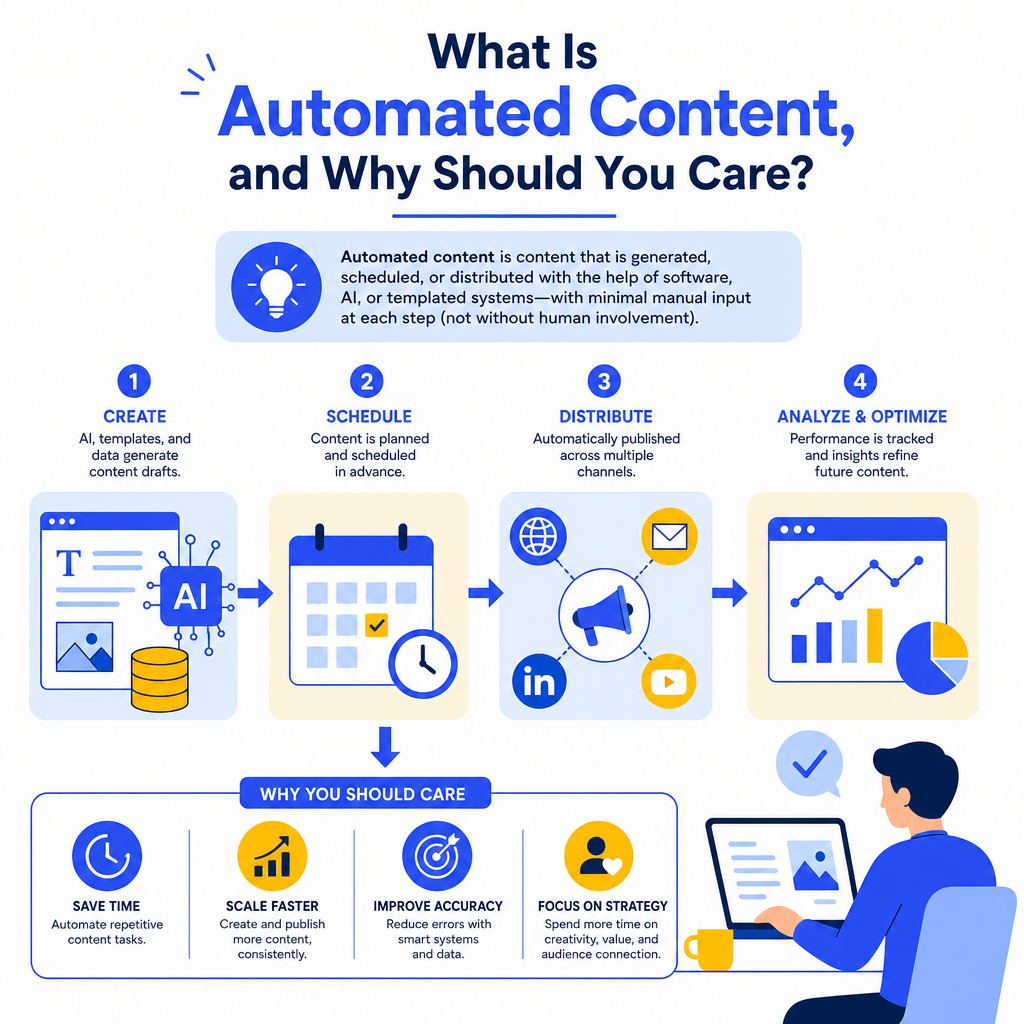
Automated content refers to any written, structured, or multimedia content that is generated, scheduled, or distributed with the help of software, artificial intelligence, or templated systems, with minimal manual input at each step. This does not mean content is created entirely without human involvement. In most effective setups, humans define the strategy, set the parameters, review outputs, and refine the results.
The reason automated content matters so much in 2026 is simple: content demand has outpaced the capacity of traditional writing teams. Search engines reward consistent, high-quality publishing. Audiences expect fresh, relevant information regularly. Automated content bridges the gap between what teams can realistically produce and what modern digital growth requires.
It is worth distinguishing automated content from low-quality, spammy content farms of the past. Today's automated content tools, powered by large language models and structured data pipelines, can produce genuinely useful, readable, and search-optimized material when guided correctly.
How Does Automated Content Actually Work?
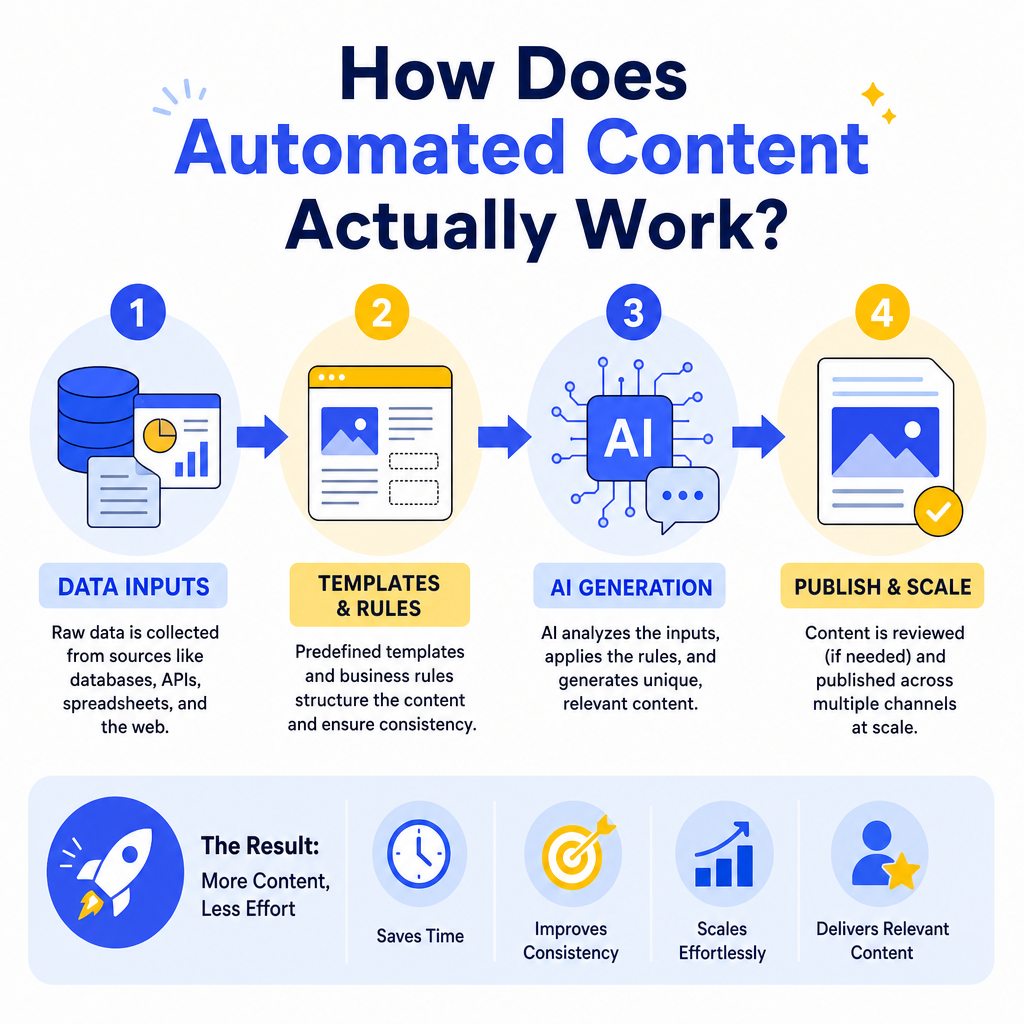
At its core, automated content relies on a combination of data inputs, rules or templates, and AI-driven generation. Here is a breakdown of the most common mechanisms:
- Template-based generation: Systems use predefined structures (for example, product descriptions or local business listings) and populate them with variable data pulled from a database.
- AI language models: Tools powered by models like GPT-4 and its successors generate original prose based on prompts, outlines, or keyword targets provided by a human strategist.
- Content scheduling and distribution: Automation tools handle publishing, social sharing, and email delivery without manual intervention at each step.
- Dynamic content personalization: Websites serve different content variations to different users based on behavior, location, or preferences, all generated and swapped automatically.
Understanding how these mechanisms connect is important before you start building your own automated content system. The technology handles volume and consistency. Your strategy and human oversight handle quality and relevance.
Step-by-Step: How to Build an Automated Content Strategy
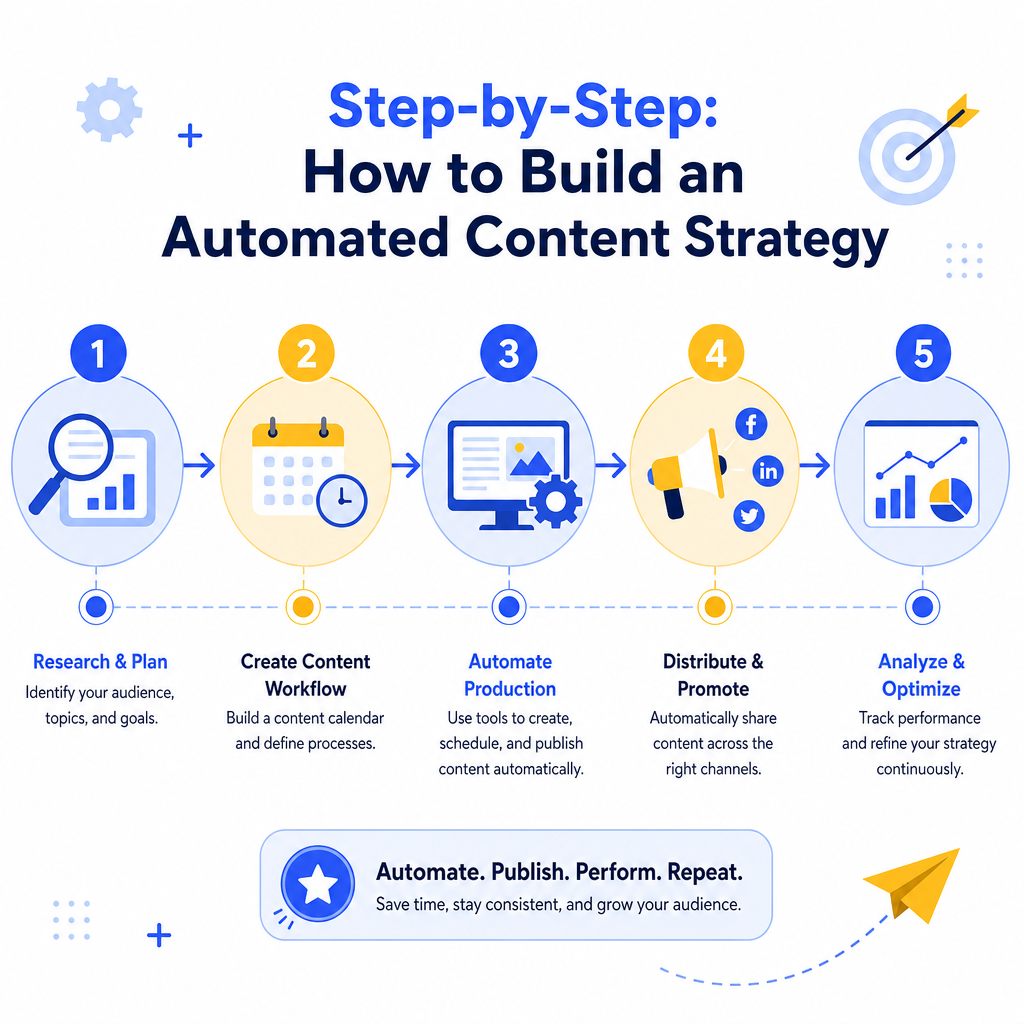
Step 1: Define Your Content Goals and Scope
Before touching any tool, get clear on what you want automated content to accomplish. Ask yourself:
- What type of content needs automation? Blog posts, product descriptions, FAQs, social captions, and email newsletters all have different automation requirements.
- What volume are you targeting? Automation makes the most sense when you need to produce content at a scale that manual writing cannot sustain.
- Who is the audience? Even automated content must be written for a specific reader. Define your target audience clearly before setting up any generation parameters.
Step 2: Choose the Right Automated Content Tools
The market in 2026 offers a wide range of tools suited to different use cases. Here is a comparison of common automated content tool categories to help you choose wisely:
| Tool Category | Best For | Human Input Required | Example Use Case |
|---|---|---|---|
| AI writing assistants | Blog posts, long-form articles | High (editing, strategy) | SEO blog content at scale |
| Template-based generators | Product descriptions, data pages | Medium (template design) | E-commerce category pages |
| Content scheduling platforms | Distribution and publishing | Low (setup only) | Social media automation |
| Dynamic personalization tools | On-site content variation | Medium (rules setup) | Landing page personalization |
| Full-stack content pipelines | End-to-end content production | High (oversight) | News aggregation, reports |
Step 3: Build a Scalable Content Brief Template
Automation works best when it has clear instructions to follow. A content brief template is the document (or data structure) that tells your automated system what to produce. A strong brief includes:
- Primary keyword and secondary keywords
- Target audience and intent (informational, transactional, navigational)
- Desired word count and format
- Key points or data to include
- Tone and voice guidelines
- Internal linking targets
Step 4: Set Up Your Quality Control Process
This step is non-negotiable. Automated content, no matter how sophisticated the tool, requires human review before publication. Your quality control process should check for:
- Factual accuracy: AI systems can generate plausible-sounding but incorrect information. Always verify key claims.
- Brand voice consistency: Does the output sound like your brand, or does it feel generic?
- SEO alignment: Are the primary and secondary keywords used naturally and in the right places?
- Readability and structure: Does the content flow logically? Are headings, bullet points, and paragraphs used effectively?
- Originality: Run outputs through plagiarism detection tools to confirm uniqueness.
Step 5: Optimize Automated Content for Search
Producing content automatically does not mean SEO happens automatically. You need to actively optimize each piece. Key actions include:
- Keyword placement: Ensure the primary keyword appears in the title, first paragraph, at least one H2 heading, and naturally throughout the body.
- Meta tags: Write unique meta titles and descriptions for every automated piece. Do not let the system generate these without review.
- Internal linking: Add relevant internal links to connect automated content to your existing site structure.
- Schema markup: For structured content like FAQs or product pages, add appropriate schema to improve how search engines display your results.
Step 6: Monitor Performance and Refine
Automated content is not a set-it-and-forget-it system. You need to track how your content performs and use that data to improve your templates, briefs, and generation parameters over time.
Key metrics to monitor include:
- Organic traffic per article
- Average time on page
- Bounce rate
- Keyword ranking positions
- Conversion rate from content pages
What Are the Risks of Automated Content, and How Do You Avoid Them?
Automated content carries real risks if handled carelessly. The most common pitfalls include:
- Thin content: Automated systems can produce content that meets a word count but lacks genuine depth or value. Combat this by requiring specific data points, examples, or expert insights in every brief.
- Keyword stuffing: Some automation tools over-optimize by repeating keywords unnaturally. Set clear guidelines for keyword density and always review outputs.
- Duplicate content: Template-based systems can accidentally produce near-identical pages at scale. Use canonicalization and content differentiation rules to prevent this.
- Loss of brand voice: Without strong tone guidelines, automated content can feel bland or inconsistent. Invest time in defining your voice parameters before scaling.
Conclusion
Automated content, when implemented thoughtfully, is one of the most powerful levers available to content teams and SEO professionals in 2026. It allows you to scale your publishing, maintain consistency, and compete in content-heavy niches without burning out your team or blowing your budget. The key is pairing the right tools with a clear strategy, solid content briefs, and a disciplined quality control process.
Start by identifying one content type in your business that would benefit most from automation, whether that is blog posts, product descriptions, or FAQs. Build your brief template, choose your tools, and run a small pilot batch before scaling. Measure the results, refine your approach, and grow from there.
If you are ready to take your content strategy further, explore how Fast SEO Fix can help you build a search-driven content system that works smarter, not just harder.
Frequently Asked Questions
No. Modern automated content powered by AI language models and proper human oversight produces genuinely useful, readable, and search-optimized material. The key difference is strategic guidance and quality review at each step.
Template-based content like product descriptions, FAQs, and local business listings automate well, as do blog posts and long-form articles when paired with AI writing assistants. Content requiring deep expertise or original reporting benefits less from full automation.
Humans define strategy, set parameters, review outputs, and refine results. The level varies by tool and content type, but effective automated content always includes human oversight to ensure quality and relevance.
A strong brief includes primary and secondary keywords, target audience intent, desired word count, key points to cover, tone guidelines, and internal linking targets. This structure ensures the automated system produces on-brand, optimized content.
Automated content can improve SEO when it's high-quality, well-optimized, and strategically deployed. Search engines reward consistent, relevant publishing. Poor-quality automation without human review will harm rankings, but properly executed automation supports growth.

Stefan Winter
Founder & SEO Expert
Founder of Fast SEO Fix and SEO automation expert. Stefan built Fast SEO Fix to solve the tedious problem of manual SEO work. He specializes in SEO optimized content generation, keyword research, and automated SEO strategies.
