The Complete Guide to Automatic Content: Transform Your Content Strategy in 2026
Posted by
 Stefan Winter
TL;DR
Automatic content generation uses AI and machine learning to create high-quality, personalized content at scale, reducing production costs by 60-80% while increasing output 300-500%. This technology has become essential for businesses to meet modern content demands and maintain competitive advantage in 2026.
The Complete Guide to Automatic Content: Transform Your Content Strategy in 2026
The digital landscape has evolved dramatically, and content creation demands have reached unprecedented levels. Businesses now face the challenge of producing high-quality, engaging content at scale while maintaining consistency and relevance. Automatic content has emerged as a game-changing solution that addresses these challenges head-on. In this comprehensive guide, you'll discover everything you need to know about automatic content, from its fundamental principles to advanced implementation strategies that will revolutionize your content marketing approach in 2026 and beyond.
What Is Automatic Content and Why Does It Matter?
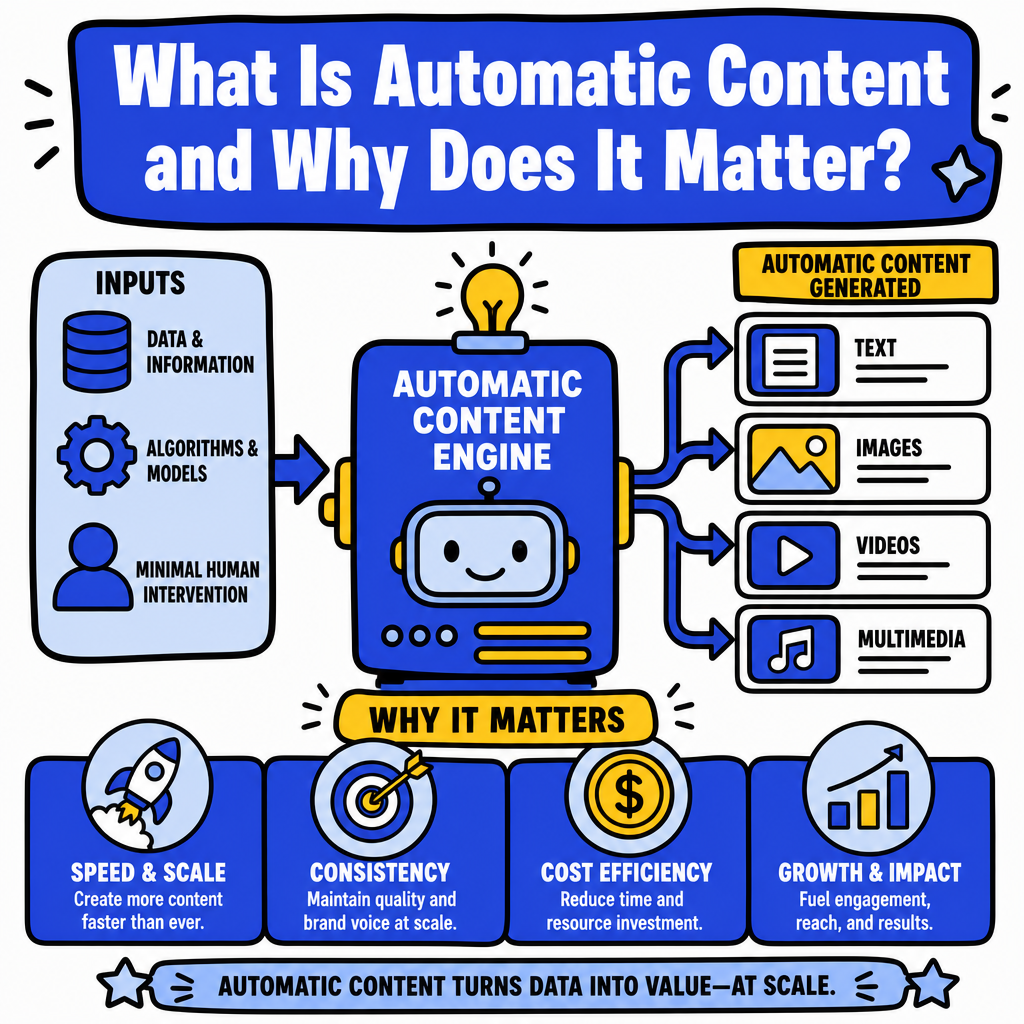
Automatic content refers to digitally generated text, images, videos, or multimedia materials created through artificial intelligence, machine learning algorithms, and automated systems with minimal human intervention. This technology has transformed from a futuristic concept into a practical business solution that powers everything from news articles and product descriptions to social media posts and email campaigns.
The significance of automatic content extends far beyond simple efficiency gains. Modern businesses operate in an environment where content consumption has increased by over 400% compared to previous years, while consumer attention spans continue to shrink. Traditional content creation methods simply cannot keep pace with these demands, making automatic content not just advantageous but essential for competitive survival.
Furthermore, automatic content enables unprecedented personalization at scale. Instead of creating one-size-fits-all content, businesses can now generate thousands of variations tailored to specific audience segments, geographic regions, or individual user preferences. This level of customization was previously impossible with manual content creation processes.
How Does Automatic Content Generation Actually Work?
The mechanics behind automatic content involve sophisticated algorithms that analyze vast datasets to understand patterns, context, and user intent. Natural Language Processing (NLP) serves as the foundation, enabling systems to comprehend human language nuances, grammatical structures, and semantic relationships between concepts.
Machine learning models are trained on millions of text samples, learning to recognize successful content patterns, engagement triggers, and audience preferences. These systems don't simply copy existing content but rather synthesize new material by understanding underlying principles of effective communication. The process involves data input, pattern recognition, content assembly, and quality optimization through iterative refinement.
Modern automatic content systems also incorporate real-time data feeds, allowing them to adapt content based on current trends, breaking news, market conditions, or user behavior patterns. This dynamic approach ensures that generated content remains relevant and timely, addressing one of the primary concerns about automated systems producing outdated or irrelevant material.
The Technology Stack Behind Automatic Content
The infrastructure supporting automatic content typically includes cloud-based processing systems, API integrations, content management platforms, and quality assurance mechanisms. These components work together to create a seamless content production pipeline that can operate continuously without human oversight.
Advanced systems also incorporate feedback loops that learn from content performance metrics, user engagement data, and conversion rates. This continuous learning process means that automatic content systems become more effective over time, producing increasingly sophisticated and targeted materials that align with business objectives.
What Are the Key Benefits of Using Automatic Content?
Implementing automatic content strategies delivers measurable advantages across multiple business dimensions. Cost reduction represents the most immediate benefit, with organizations typically seeing 60-80% decreases in content production expenses while simultaneously increasing output volume by 300-500%.
Speed and scalability transform content operations from bottlenecks into competitive advantages. What previously required weeks of planning, writing, editing, and approval can now be accomplished in hours or even minutes. This acceleration enables businesses to respond rapidly to market opportunities, trending topics, or competitive threats without compromising content quality.
Consistency across all content channels becomes achievable when automatic systems maintain brand voice, messaging standards, and quality benchmarks. Human content creators often struggle with maintaining uniform tone and style across large volumes of content, but automatic systems excel at preserving these elements while adapting to different formats and platforms.
| Benefit Category | Traditional Content | Automatic Content | Improvement Factor |
|---|---|---|---|
| Production Speed | 2-5 pieces/day | 50-200 pieces/day | 10-40x faster |
| Cost per Piece | $50-200 | $2-10 | 5-25x cheaper |
| Consistency Score | 60-75% | 90-95% | 20-35% better |
| Scalability | Limited by team size | Virtually unlimited | Exponential |
How Can You Choose the Right Automatic Content Solution?
Selecting an appropriate automatic content platform requires careful evaluation of your specific needs, technical capabilities, and long-term objectives. Begin by assessing your current content volume requirements, quality standards, and integration needs with existing marketing technology stacks.
Consider the types of content you need most frequently. Some platforms excel at generating blog posts and articles, while others specialize in product descriptions, social media content, or technical documentation. The best solution aligns with your primary content categories while offering flexibility for future expansion.
Technical considerations include API availability, content management system compatibility, workflow integration capabilities, and customization options. Your chosen platform should seamlessly integrate with existing tools rather than requiring complete system overhauls that disrupt established processes.
Evaluating Content Quality and Brand Alignment
Quality assessment mechanisms vary significantly between platforms. Look for solutions that offer extensive customization options, brand voice training capabilities, and robust editing interfaces. The ability to fine-tune output according to your specific requirements distinguishes professional-grade solutions from basic content generators.
Consider platforms that provide detailed analytics and performance tracking features. Understanding how your automatic content performs compared to manually created materials helps optimize strategies and demonstrate return on investment to stakeholders.
What Are the Best Practices for Implementing Automatic Content?
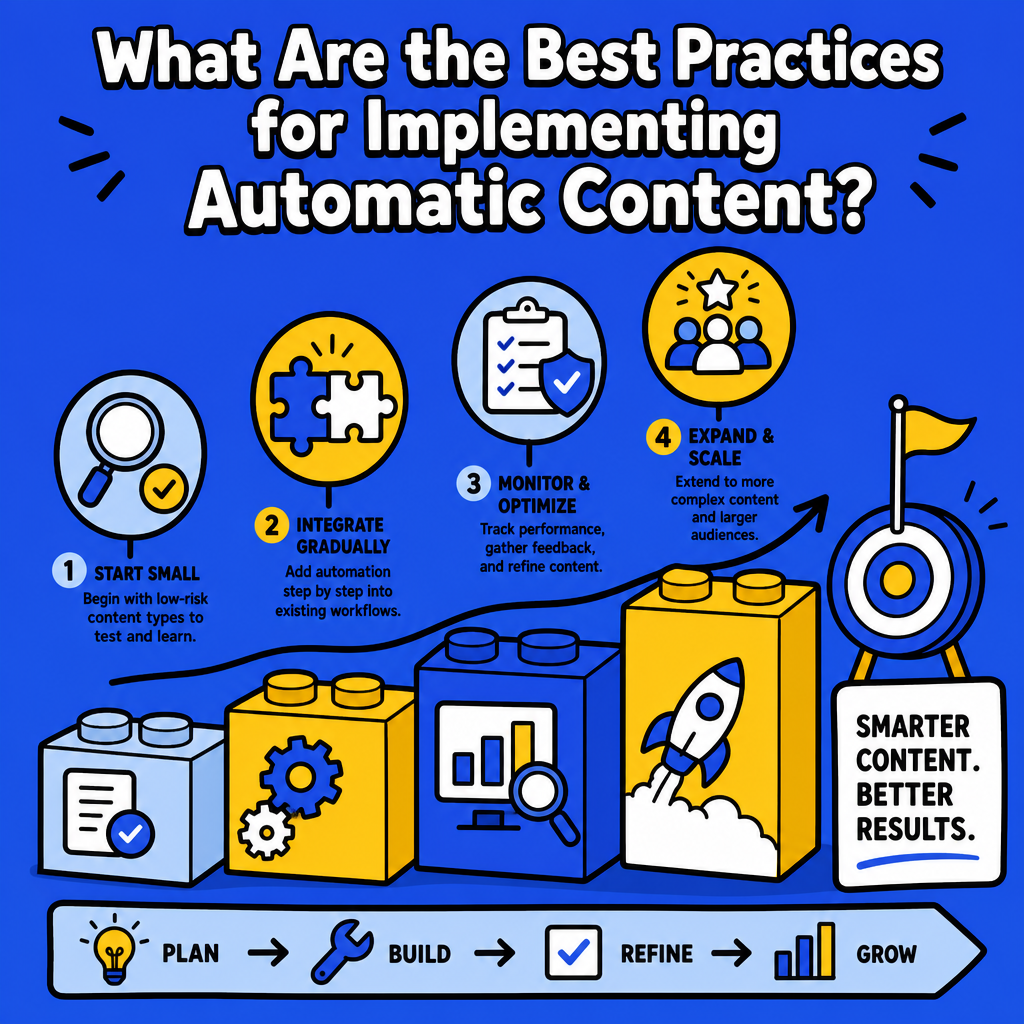
Successful automatic content implementation requires strategic planning and gradual integration rather than complete replacement of existing processes. Start with low-risk content categories such as product descriptions, social media posts, or internal communications before expanding to customer-facing materials or high-stakes marketing campaigns.
Establish clear quality control processes that include human oversight, brand compliance checks, and performance monitoring. While automatic content reduces manual effort, it doesn't eliminate the need for strategic guidance and quality assurance. Create workflows that balance automation efficiency with human creativity and strategic thinking.
Train your team on automatic content tools and processes. Success depends on team members understanding how to effectively prompt, edit, and optimize automatically generated content. This education investment pays dividends through improved output quality and more efficient workflows.
Content Strategy Integration
Integrate automatic content into broader content marketing strategies rather than treating it as a standalone solution. Use automated systems to handle routine, high-volume content needs while reserving human creativity for strategic pieces, thought leadership content, and complex storytelling that requires emotional intelligence and industry expertise.
Develop content templates and brand guidelines that help automatic systems produce materials aligned with your marketing objectives. Clear parameters and examples improve output quality while reducing the need for extensive post-generation editing.
How Do You Measure Automatic Content Success?
Measuring automatic content effectiveness requires tracking both operational metrics and business impact indicators. Operational metrics include production volume, cost per piece, time savings, and quality scores. These measurements demonstrate efficiency gains and process improvements.
Business impact metrics focus on engagement rates, conversion performance, search engine rankings, and revenue attribution. Compare these results between automatic content and manually created materials to understand relative performance and identify optimization opportunities.
Implement A/B testing protocols that systematically compare automatic content variations against each other and against human-created alternatives. This data-driven approach helps refine automatic content strategies and maximize performance across different content types and audience segments.
What Does the Future Hold for Automatic Content?
The automatic content landscape continues evolving rapidly, with 2026 marking a significant maturation point for the technology. Emerging developments include improved contextual understanding, enhanced creativity capabilities, and better integration with multimedia content formats including video, audio, and interactive elements.
Personalization capabilities are advancing toward true individualization, where content adapts not just to demographic segments but to individual user preferences, behavior patterns, and real-time context. This evolution promises to deliver unprecedented relevance and engagement rates.
Industry-specific automatic content solutions are becoming more sophisticated, with specialized platforms emerging for healthcare, finance, legal services, and technical industries. These focused solutions understand industry-specific terminology, compliance requirements, and audience expectations better than general-purpose platforms.
Conclusion
Automatic content represents a fundamental shift in how businesses approach content creation and marketing. The technology has matured beyond experimental stages into reliable, scalable solutions that deliver measurable business value. Organizations that embrace automatic content strategies position themselves for competitive advantages in efficiency, consistency, and market responsiveness.
Success with automatic content requires thoughtful implementation, ongoing optimization, and integration with broader marketing strategies. The key lies in leveraging automation for what it does best while preserving human creativity and strategic thinking for high-value activities that require emotional intelligence and complex reasoning.
Ready to transform your content strategy with automatic content? Start by evaluating your current content needs and exploring platforms that align with your specific requirements. The future of content marketing is here, and early adopters are already reaping the benefits of this revolutionary approach.
Frequently Asked Questions
Automatic content refers to digitally generated text, images, videos, or multimedia created through AI and machine learning algorithms with minimal human intervention. It uses Natural Language Processing and trained models to synthesize new material based on patterns in vast datasets.
Organizations typically see 60-80% decreases in content production costs while increasing output by 300-500%. Production speed improves by 10-40x, with automatic systems generating 50-200 pieces daily compared to 2-5 pieces with traditional methods.
Yes, automatic content systems excel at preserving brand voice, messaging standards, and quality benchmarks across all channels. They achieve 90-95% consistency scores compared to 60-75% with human creators, while adapting to different formats and platforms.
Modern automatic content systems incorporate real-time data feeds and feedback loops that allow them to adapt based on current trends, breaking news, and user behavior patterns. This dynamic approach ensures generated content remains relevant and continuously improves over time.
Evaluate your specific content volume requirements, quality standards, and integration needs with existing marketing tools. Consider which content types you need most (blog posts, product descriptions, social media, etc.) and select a platform that specializes in those areas and aligns with your long-term objectives.

Stefan Winter
Founder & SEO Expert
Founder of Fast SEO Fix and SEO automation expert. Stefan built Fast SEO Fix to solve the tedious problem of manual SEO work. He specializes in SEO optimized content generation, keyword research, and automated SEO strategies.
